
Key Points
Bullet point summary by AI
- The 2026 World Cup will continue using a technology-aided review system that aims to eliminate human error in officiating decisions.
- The system allows officials to pause play and review specific incidents through multiple camera angles, but its subjective standard has sparked widespread debate.
- A new rule for 2026 lets referees review certain fouls before play resumes, adding another layer to an already contentious process.
The 2026 World Cup will be the third such quadrennial tournament to utilize the video replay review system officially known as Video Assistant Referee, or VAR for short. If you were to take a poll amongst hardcore soccer fans, the vast majority would give it a negative review.
VAR quickly became one of soccer's most controversial features in its attempt to limit, if not eliminate, the human error aspect of on-field officiating. Unfortunately, the technology-aided system seems to have amplified the ability of humans to err when making crucial decisions that impact the result of a game.
What does Video Assistant Referee do?
In a nutshell, VAR allows the on-field referee to halt a game to go back and determine if he made a "clear and obvious error" in immediate retrospect. The key phrase that has centered most of the debate surrounding the technology, which was introduced in 2018, is "clear and obvious."
Additional officials in a booth surrounded by a multitude of screens displaying a near unlimited number of camera angles can scrutinize every play that occurs on the pitch. If they deem the on-field referee missed a serious foul or infraction, they can speak to him in his earpiece, and he'll pause the match at the next natural stoppage of play to view replays at a video monitor on the sideline. The booth officials will advise him as to what they believe was a mistake, and then the referee decides whether to accept their recommendation or stick to his guns.
Instances the Video Assistant Referee can inspect and pause play are:
- Serious fouls -- either deserving of a second yellow or straight red card and/or awarding a penalty kick
- Hand balls
- Offside (this one deserves its own explainer)
- Encroachment -- when a goalkeeper leaves his line early during a penalty kick
- Whether a foul occurred inside the penalty area or outside it
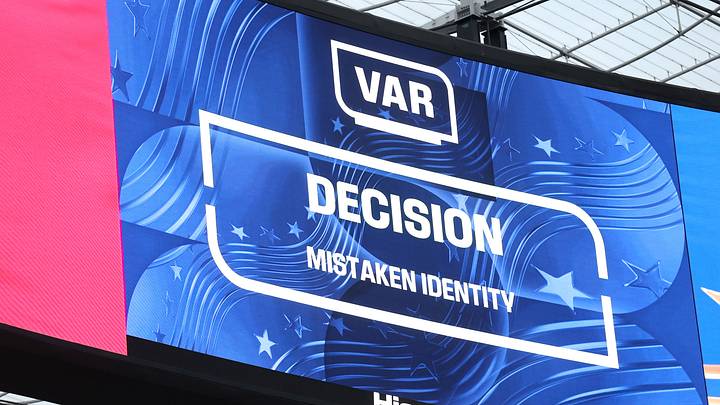
- Mistaken identity -- if the referee has booked the wrong player for a foul
- Corner kicks
There are certain occurrences when the on-field referee must reverse his initial decision if VAR gets involved. Those are called "factual decisions" and they include things like the location of a foul (whether inside or outside the penalty area), mistaken identity, encroachment and offside. The latter determination is made using semi-automated offside technology, but that's a whole different story.
How will Video Assistant Referee work at the 2026 World Cup?
Fans will witness the same process described above during the 2026 World Cup. If you're a frequent watcher of club soccer, it'll be a familiar (if not painful and annoying) experience.
There will, however, be a slight difference that was only announced days before the tournament begins. Referees will now be able to utilize VAR to determine if they missed a serious foul before the ball is put in play (i.e set pieces, throw-ins, and goal kicks). In theory, it should deter teams from getting too physical when trying to box out opponents or when trying for a quick advantage, but infractions will inevitably be categorized as two players equally jockeying for position.
The likelihood VAR causes a major controversy or influences a seemingly unjustified result during the tournament is very high. It all comes back to the phrase "clear and obvious" that supposedly sets a strict standard for decisions.
Besides the "factual decisions" an on-field referee must adhere to from VAR, the rest are completely up to him whether to accept and reverse. If VAR shows him 10 different angles of what definitely looks like a foul in the penalty area but he believed in real time it wasn't enough to warrant a spot kick, he can walk away from the monitor and refuse to change anything.
This is where the human error-eliminating objective has produced an apparently human error-amplifying system. It's ironic because to err in competition is human yet human error has become the key defect in the pursuit of an error-less game.
Soccer is far from perfect. That's what makes it the beautiful game. Fans will be able to enjoy the 2026 World Cup but should expect to be disappointed or just accept the guys trying to call the games correctly are going to make incorrect decisions.
More World Cup news and analysis:
 Add us as a preferred source on Google