
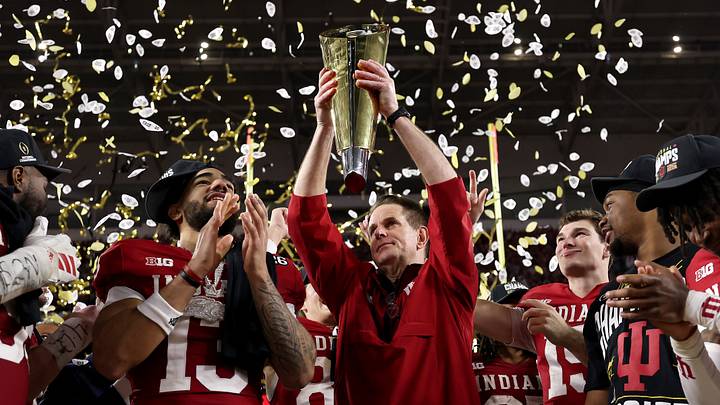
After months of wait, college football finally returns with eight Week 0 games this weekend. But while we're thrilled to have this nation's most wonderfully chaotic sport back in our lives for the foreseeable future, that chaos also makes it hard to catch up with everything that's changed since Indiana hoisted the national championship trophy back in January.
And in today's college football, one that features more billable hours than actual games, a lot has changed. Just keeping track of who's playing where is hard enough, let alone what rules have changed and what the College Football Playoff will look like. But if you're just tuning back in now and already feeling overwhelmed, have no fear: We've put together a handy guide to everything new you need to know.
2026 College Football Playoff format changes
Despite the powers that be flirting with yet another major overhaul of the College Football Playoff format all offseason long, any further expansion will have to wait at least one more year. But while the CFP will look broadly the same as it did in 2025, there are still a couple changes worth making note of.
Yes, there will still be a 12-team bracket. Yes, every Power 4 conference champion will automatically earn a bid. Here's what's new, though:
- The highest-ranked Group of 6 team (American, Conference USA, MAC, Mountain West, Pac-12, Sun Belt) will receive an automatic bid regardless of whether it's a conference champion or not
- Notre Dame will also receive an automatic bid if it lands within the top 12 of the final CFP rankings
- The four highest-ranked teams — not the four highest-ranked conference champions — will receive top-four seeds and a first-round bye
Previously, the five highest-ranked conference champions earned autobids. In 2026, though, that's been amended to every Power 4 conference champion plus the highest-ranked Group of 6 team — regardless of whether that team actually won its league. Notre Dame, meanwhile, bellyached loudly enough after last year's snub that they'll be guaranteed a spot in the final bracket as long as they finish ranked within the top 12 (which, given the Irish's cakewalk of a schedule this season, feels all but assured).
The only other change regards the seeding process. Previously, the top four seeds — and thus a first-round bye — were reserved for the four highest-ranked conference champs. Now, though, those seeds will belong to the four highest-ranked teams regardless of conference champion status.
Rule changes coming to college football in 2026

Targeting penalties adjusted
Targeting has inarguably helped get violent hits out of the game and protected defenseless offensive players. Still, it felt a little bit harsh that getting flagged for targeting in the second half of a game meant missing the entire first half of the next contest, as happened to Miami DB Xavier Lucas ahead of last year's national title game against Indiana.
So, this season, that penalty has been removed — on a player's first targeting foul, at least. A second targeting on the season will result in missing the first half of the next game, while a third means getting ejected from the current gameand missing all of the next game as well.
Offensive pass interference penalty reduced
"We really want to reserve 15-yard penalties for unsportsmanlike conduct and personal fouls," Steve Shaw, NCAA secretary-rules editor for football and national coordinator of officials, told CBS Sports in an interview. As part of that effort, offensive pass interference penalties now come with a 10-yard punishment rather than 15; treating it like holding rather than an almost automatic drive-killer would seem to make more sense on its face.
Guaranteed unsportsmanlike acts
Unsportsmanlike conduct is always a bit of a moving target. There will still be a bit of an "I know it when I see it" element in 2026, but in an effort to provide a bit more clarity to players, the NCAA has deemed five acts to be automatic 15-yard flags.
- Pantomiming gun violence
- Throat slash or nose wipe
- Removing a helmet
- Dead-ball contact fouls such as pushing or shoving
- Pushing or pulling an opposing player off the pile after the ball is dead
The fair-catch kick is back!
One of the more obscure plays in football is making a return to the college ranks in 2026. If the receiving team calls for a fair catch, they now have the option to choose a fair-catch kick — essentially, an opportunity to kick from whenever the ball is spotted and score three points. One catch: If you choose the kick and miss without the defense touching the ball, the opposing team then gets possession at the spot of the kick.
College football's eligibility carousel has left everybody confused

Are you a human being with a pulse who may or may not have ever stepped foot on a college campus? Congratulations, you're apparently eligible to FBS football in 2026. As if the COVID year and the transfer portal hadn't wreaked enough havoc on player movement, things got even crazier this offseason.
The NCAA adopted the so-called five in five rule this summer, which is what it sounds like: Every player will have the chance to play five seasons of college ball in a five-year window that begins when they step in campus. On the surface, it should bring needed clarity to what had become the wild west. But last month, a federal judge ruled that five in five should retroactively apply to the class of 2022, which had just exhausted its fourth year of eligibility this past season.
And just like that, the floodgates opened. Plenty of players rushed to try and play one year — and cash one more NIL check — regardless of whether they were, say, currently battling for a roster spot on an NFL team. Every power conference quickly ruled that players who'd previously turned pro are not eligible to return, but those rules were themselves shot down by another judge in Dallas. So as things stand, expect to see multiple players who were in NFL training camps on the field on Saturdays this fall.
Jersey patches? Yes, jersey patches

Elsewhere in our capitalist dystopia, the NCAA is for the first time allowing teams to feature sponsored patches on their uniforms during games. It's the result of the never-ending arms race kicked off by the advent of NIL: In a world where rosters routinely cost $20, $30 or even $40 million, that money has to come from somewhere, and athletic departments are desperate to get their hands on any new revenue streams they can.
This has yet to fully sweep the nation just yet, but it's only a matter of time. Ohio State will don Chase Bank logos on their jerseys for the low, low price of $15 million a year, Notre Dame, meanwhile, is set to make between $18 million and $20 million for their patch deal. LSU, BYU and Tennessee are some of the other power-conference programs that have already taken the plunge.
For the first time, the NCAA is — for schools looking to drive further revenue, a new source of sorts. With many college football rosters exceeding $30 million this season, a sponsored patch offers a unique opportunity for exposure with top brands and a stream of money coming into the athletic department.
Conference realignment has slowed, but not stopped
The power conferences have remained relatively stable for a couple of years now, thankfully. But change continues to roil the lower levels of FBS. The biggest change came in the Pac-12, which had just two orphan members (Washington State, Oregon State) after the previous version of the conference fell apart but has since regrouped and will welcome six new programs (Boise State, Colorado State, Fresno State, San Diego State, Texas State, Utah State) this season.
Most of those additions came at the expense of the Mountain West, which was forced to add North Dakota State, Northern Illinois (?) and UTEP just to get back to 10 teams. The MAC then added Sacramento State to replace Northern Illinois — a sentence that would have made you seem completely insane just a few years ago — while the Sun Belt replaced Texas State with Louisiana Tech.
 Add us as a preferred source on Google