
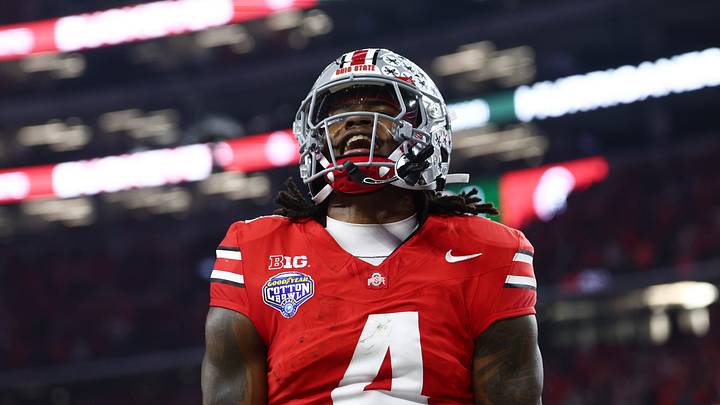
You know the new college football season is right around the corner when the preseason AP Top 25 rankings drop. Does it mean much of anything? Of course not; trying to assess teams that had yet to play a meaningful snap was an iffy proposition even before the transfer portal created massive year-over-year turnover. Do we love taking it way too seriously all the same? Hey, it's much better than focusing on work.
A ton is bound to change between now and the final College Football Playoff rankings. But we have to start somewhere when projecting how this season might play out. So, while voters are more than capable of getting things wrong, let's see how the CFP bracket would look based on the first poll of the year.
Preseason AP Top 25 college football rankings

- Ohio State Buckeyes
- Oregon Ducks
- Georgia Bulldogs
- Notre Dame Fighting Irish
- Texas Longhorns
- Indiana Hoosiers
- Miami Hurricanes
- Texas A&M Aggies
- Ole Miss Rebels
- Oklahoma Sooners
- LSU Tigers
- Texas Tech Red Raiders
- Alabama Crimson Tide
- BYU Cougars
- USC Trojans (tied for 14th)
- Michigan Wolverines
- Washington Huskies
- Penn State Nittany Lions
- SMU Mustangs
- Tennessee Volunteers
- Utah Utes
- Iowa Hawkeyes
- Houston Cougars
- Louisville Cardinals
- Missouri Tigers
Others receiving votes: Clemson 112, Florida 51, Boise State 43, Arizona 32, TCU 11, Navy 10, South Carolina 10, Illinois 9, Oklahoma State 8, Vanderbilt 8, Pittsburgh 7, Virginia Tech 6, Minnesota 5, UNLV 4, New Mexico 4, Georgia Tech 4, James Madison 3, Auburn 3, Memphis 2, California 2, Liberty 1, Western Michigan 1, Tulane 1, Virginia 1
How the 2026-27 College Football Playoff format works

Since the powers that be in this sport can't seem to stick to a single format for more than a year at a time, here's a quick refresher on how the College Football Playoff field will be determined this season.
- 12 teams total
- Each Power 4 conference champion (Big Ten, SEC, ACC, Big 12) will receive an automatic bid
- The highest-ranked Group of 6 team (American, Conference USA, MAC, Mountain West, Pac-12, Sun Belt) will receive an automatic bid regardless of whether it's a conference champion or not
- Notre Dame will also receive an automatic bid if it lands within the top 12 of the final CFP rankings
- The four highest-ranked teams — not the four highest-ranked conference champions — will receive top-four seeds and a first-round bye
We're sticking with a 12-team field this year, including up to five autobids — the champions of the Big Ten, SEC, ACC and Big 12, plus Notre Dame should the Irish finish inside the top 12. (And with that schedule, they better.)
The one major change from last year's version involves the seeding process. Rather than give the top four seeds and an all-important first-round bye to the four highest-ranked conference champions, seeding will be determined by overall ranking. (E.g., if the champion of the ACC finishes No. 8 in the final CFP Top 25, they won't automatically jump up into the top four.)
Got all that? Great. Now, without further ado, let's see what the bracket would look like based on the preseason AP Top 25 poll.
Projected 2026-27 College Football Playoff bracket based on preseason AP Top 25

Again: Winning your conference doesn't mean anything as far as seeding is concerned, so the top four seeds will be the four highest-ranked teams. Which shakes out as follows:
First-round byes:
- Ohio State (Big Ten champ)
- Oregon
- Georgia (SEC champ)
- Notre Dame
Ohio State and Georgia earn automatic bids by virtue of winning their respective conferences, while Notre Dame also punches their ticket after finishing well within the top 12. Oregon earns our first at-large bid despite finishing runner-up in the Big Ten. All four of those teams get a first-round bye and will await their opponent in the quarterfinals.
First round matchups (all games hosted by higher seed):
- No. 12 Boise State (G6 auto bid) at No. 5 Texas
- No. 11 Texas Tech (Big 12 champ) at No. 6 Indiana
- No. 10 Oklahoma at No. 7 Miami (ACC champ)
- No. 9 Ole Miss at No. 8 Texas A&M
Our lone party-crasher comes from the new-look Pac-12. Unlike the previous 12-team format, in which an automatic bid went to the highest-ranked Group of 6 conference champion, this year that automatic bid will go to the highest-ranked team from the G6. Right now, that's Boise State, which didn't crack the preseason AP poll but did lead all non-P4 teams with 43 votes received.
That means the Broncos are our No. 12 seed, and with Texas Tech securing their autobid by winning the Big 12, LSU — ranked No. 11 in the preseason AP poll — winds up the odd man out. Each of these first-round games will be held on the campus of the higher seed, with the winner moving on to face one of the top four seeds in the quarterfinals.
Quarterfinal matchups (Fiesta Bowl, Cotton Bowl, Rose Bowl, Peach Bowl)
- No. 9 Ole Miss/No. 8 Texas A&M winner vs. No. 1 Ohio State
- No. 10 Oklahoma/No. 7 Miami winner vs. No. 2 Oregon
- No. 11 Texas Tech/No. 6 Indiana winner vs. No. 3 Georgia
- No. 12 Boise State/No. 5 Texas winner vs. No. 4 Notre Dame
We've got some potentially box-office matchups here. Imagine Arch Manning leading the Longhorns against Notre Dame, or Curt Cignetti — a year after embarrassing Alabama in the Rose Bowl — looking to take down the other SEC juggernaut in Georgia? Ohio State would have a chance to score a big win for the Big Ten against the SEC, while a hypothetical Miami-Oregon matchup would pit two of the most talented rosters in the country against each other.
The four winners here would advance to the semifinals, which this year are the Sugar Bowl and the Orange Bowl, with the national title game set for Monday, Jan. 25, 2027 in Las Vegas.
 Add us as a preferred source on Google