
The college football offseason was marred by eligibility disputes, lawsuits, and the looming spectre of pro players (as if millionaire college athletes aren’t professionals) returning after NFL training camps. In a sport of constant chaos, there was more than usual, so just about everyone other than Darren Heitner was excited for college football to get out of the courtroom and onto the field.
Then, because it’s college football, Week 1 delivered one of the biggest on-field controversies in a while (thank god Western Michigan and the MAC aren’t making us follow more litigation).
Still, Week 1 also brought us the thing that makes us all put up with it all, the thing that makes us all willing to become self-taught legal experts and occasional political commentators: football. And it was beautiful.
1. Big Ten bails out Michigan in Kyle Whittingham’s debut

- First course: An old-school rock fight with a side of controversy
- Tasting note: A gross miscarriage of justice that reeked of Power Conference favoritism
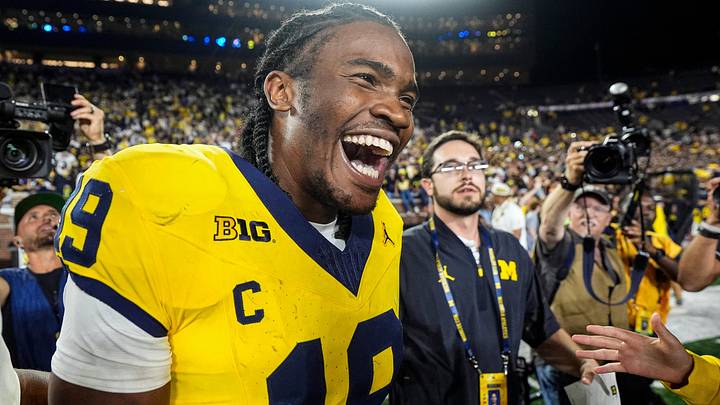
- The takeaway: Michigan has a big Bryce Underwood problem, but an inexplicable decision to put an extra second on the clock and set up another Hail Mary attempt gifted Michigan a 13-12 win over Western Michigan and kept its CFP hopes alive, at least for now.
Western Michigan is a good football team. Lance Taylor returned nearly all of his starting offense from last year’s MAC Champion, which is practically impossible in the transfer portal era. Taylor’s Broncos managed to drag Michigan into a rock fight, which, throughout his career, Kyle Whittingham has been accustomed to winning. This one, he should’ve lost.
The Michigan defense got worn down thanks in large part to an all-time ‘now let’s see the unscripted drives’ performance from Michigan. Underwood looked crisp and played fast with clean footwork, going 5-for-5 for 61 yards with 11 yards and a touchdown on a 75-yard touchdown drive. After that, Underwood went 5-for-11 for 34 yards until the game-winning drive, with two big completions to JJ Buchanan.
Flat out, Western Michigan didn’t just deserve to win that game; Western Michigan did win that game. It was over. Then it was stolen. At least that’s how it appeared on NBC’s broadcast. It felt like there was a conversation to be had about Power Conference favoritism, the growing disparity between the P4 and the G6, and the Big Ten leaning on its officials to help maximize its potential CFP at-large bids, but the Big Ten released video of its replay process, and its explanation seems to hold water.
A statement regarding the results of tonight's game between Michigan and Western Michigan. pic.twitter.com/DzJVN2ZLTc
— Big Ten Conference (@bigten) September 6, 2026
Ultimately, for Michigan, I don’t think any of it matters. This is a team that allowed Western Michigan over 40 minutes of possession time despite a 39% success rate and averaging 3.42 yards per play for the entire game, a second-percentile performance. That should be impossible. Michigan’s offensive line got no push in the run game, Western Michigan had a 19% havoc rate, and until the final play, Underwood was 0-5 on pressured dropbacks.
Even with a loss, I wouldn’t have made Michigan pay its check and leave. The Wolverines have too many big games on the schedule to build a CFP resume, facing Indiana, Ohio State, and Oregon, but I didn’t see them winning any of those games before Saturday night, and that certainly didn’t change my mind.
2. Lane Kiffin’s LSU Tigers look like a ready-made title contender
- Second course: A Baton Rouge beatdown
- Tasting note: An expensive, polarizing, and flashy dish with a surprising amount of substance, whether it has all the fixings or not.
- The takeaway: Along with all the attention and all the controversy, Lane Kiffin brought a run game to Baton Rouge. Pro players or not, these Tigers look like they have enough talent to win it all after knocking Dabo Swinney off his high horse with a 51-10 dismantling.
All Lane Kiffin did in his LSU debut was deliver Dabo Swinney his worst-ever loss as a head coach, surpassing a 51-14 beatdown at the hands of Florida State in 2013. And this was a beatdown. LSU outgained Clemson 644-145 with a 38-8 edge in first downs.
When you think of Lane Kiffin, you probably think of a lot of things: the LAX tarmac, Joey Freshwater, and of course, a high-powered passing game. Yes, Kiffin makes quarterbacking as simple as he can with an up-tempo, RPO-heavy approach chock-full of this-or-that reads. And yes, that leads to a ton of big plays, but Kiffin’s offense has always begun with the run game, and he and offensive coordinator Charlie Weis Jr. call it as well as any staff in the country.
So, after the lightning delay in Baton Rouge, it wasn’t about electricity; it was about a smashmouth run game that produced 309 yards on the ground and a stout defense that, even with an interior defensive line led by freshmen, held Clemson to 40 yards on the ground and 145 yards overall.
This was an LSU program that finished No. 132 of 136 FBS programs in rushing success rate last season at 38.6% and was No. 88 the year prior. Against Clemson, LSU had a 52% rushing success rate and 0.08 EPA/rush when you strip out explosive plays. That’s real substance and what you should expect from a program spending nearly $50 million on its roster. Yet, for some reason, LSU isn’t being regarded as a serious national title threat. Clemson isn’t a real test, but treating those Tigers this way is what a legit championship contender would do.
Like Kiffin said at halftime, “Imagine if we had pro players.” I’m not sure you need them, Lane.
3. With Trinidad Chambliss, Ole Miss is in every game

- Third course: Ole Miss’s microwavable offense
- Tasting note: Like a hot pocket, the Ole Miss offense was still frozen in parts and molten lava in others.
- The takeaway: The Rebels looked stuck in the mud with new offensive coordinator John David Baker until Trinidad Chambliss settled in and Duece Alexander took over. Even with Kewan Lacy sidelined for most of the game, Chambliss looks every bit the Heisman contender he was expected to be in the 41-38 walk-off win over Louisville.
Louisville’s defense ranked No. 113 in coverage diversity score by MatchQuarters last season, playing the eighth-highest rate of Cover 3 in the country under defensive coordinator Ron English. New DC Mark Ivey, elevated from under English, has seemingly kept that same ethos. Greg McElroy was all over it on the broadcast. With veteran linebackers who fly all over the field and a star edge rusher in Clev Lubin, it’ll probably work more often than it doesn’t. But Trinidad Chambliss has just played too much football to be that predictable.
Chambliss is 24 years old and in his sixth year of college football, though only his second at the Division I level. He also happens to be the best anticipatory thrower in college football, and once he and David Baker got comfortable, they feasted up the seams and between the numbers, exactly where you want to take advantage of that coverage.
Just look at where the receiver, tight end Caleb Odom, is when Chambliss releases this ball. I’m serious, pause the video. That’s NFL anticipation.
TRINIDAD CHAMBLISS CAN’T BE STOPPED pic.twitter.com/SvvvNvOhUU
— College Football Report (@CFBReport) September 7, 2026
This one, you don’t need to pause because McElroy did it for you.
One of the best throws Trinidad Chambliss has ever made
— NFL Draft Files (@NFL_DF) September 7, 2026
This type of anticipation is rare at the college level https://t.co/mPJaOOsQjV pic.twitter.com/2CGQBDyEil
I can’t stress enough how rarely you see college quarterbacks throwing with that level of anticipation. And when you have a quarterback who can do that and a receiver in Duece Alexander, who, according to Bruce Feldman’s Freaks’ List, hit 23 miles per hour this offseason, you can produce a 15% explosive pass rate in the second half.
Ole Miss has real problems in the secondary, and a right tackle injury could burst the damn on an offensive line that already had a few leaks. But with Chambliss, the Rebels are never out of it, even with two turnovers and two missed field goals against a good Louisville team.
4. It’s been over for Dabo Swinney at Clemson, and it’s still over
- Check, please: When it’s clear there won’t be a seat for you at the CFP table, it’s time to pay your check and leave
- The cost: An opportunity to prove that you can ‘win the right way,’ which just means the way that Dabo Swinney used to win when they definitely didn’t pay the players or push the boundaries of any rules.
In 2024, Clemson opened the year in a Kirby Smart chokehold, falling 34-3 to Georgia in Week 1. All the Tigers did from there was go win the ACC. Why can’t they do it again? Well, because it’s been two years since then, and that means two more years for the talent level in Dabo Swinney’s program to further atrophy from its national championship levels of the 2010s because of his refusal to face and embrace the reality of the modern college football landscape.
Not only do the Tigers fall behind because of their inactivity in the transfer portal, but that’s compounded by the flattening at the top of high school recruiting, which is a product of NIL and revenue sharing. When nearly every program can spend top dollar for elite talent, that elite talent disperses further across the sport. So, the No. 1 class in 2026 doesn’t mean as much as it did in 2016, and Clemson isn’t close to landing the No. 1 class.
Over the last five years, Clemson’s recruiting classes have ranked an average of No. 15.6 in the country. The five years before that: 8.2. The talent on this roster is not playoff caliber, even in the ACC. Serious contenders go get Darian Mensah, no matter the cost; Clemson thought Chris Vizzina would cut it. But becoming a serious contender would mean ceding Swinney’s self-proclaimed moral high ground.
5. Drew Mestemaker wasn’t ready to level up at Oklahoma State

- Check, please: When it’s clear there won’t be a seat for you at the CFP table, it’s time to pay your check and leave
- The cost: A chance to be the next Indiana, even though there will never be another Indiana
Let’s be clear: there will never be another Indiana or another Curt Cignetti, who took over the losingest program in college football history, brought a team of Group of Six transfers with him, and won a national championship two years later. Yet, we spent all offseason asking who would be the next Indiana, and the two most popular answers were UCLA and Oklahoma State, two programs that essentially imported G6 contenders: UCLA-James Madison and Oklahoma State-North Texas.
Well, it’s not Eric Morris’s Cowboys, whose biggest selling point was a high-flying offense led by Drew Mestemaker, who never started at quarterback in high school but became a buzzy NFL prospect with a 4,000-yard season and some big-time throws. Well, he’s not quite ready for the league because he didn’t look ready for the Golden Hurricanes of Tulsa, averaging 4.8 yards/dropback with two ugly interceptions and a lost fumble. Mestemaker was No. 2 in the country at 8.58 yards/dropback last season.
The big question about this Morris offense was how his stars, Mestemaker and running back Caleb Hawkins, would handle the step up in competition. Then, before they even made it to Big 12 play, they’ve squandered any dark-horse CFP at-large case they could have had.
6. Malachi Toney
- Head of the table: The best individual performance of the week earns a seat at the head of the table
- The resume: 12 rec, 234 yards, 3 TDs in 45-6 win vs. Stanford
- The takeaway: Malachi Toney led the country in receptions last season, but with Darien Mensah replacing Carson Beck, Miami is tapping into his big-play potential.
As an 18-year-old true freshman, Toney was already one of the best wide receivers in the country, a reliable security blanket out of the slot for Carson Beck, who averaged a 6.4-yard average depth on his 112 targets and generated 649 of his 992 yards (65.4%) after the catch.
The Miami passing game, as a whole, ranked No. 43 in the FBS in explosive pass rate (10%), with Beck coming off a major elbow surgery and looking to cut down on the turnovers that plagued him at Georgia. With Darien Mensah in 2026, however, it seems offensive coordinator Shannon Dawson is opening things back up, harkening back to the Cam Ward era, and in Week 1, that, and Stanford’s confounding decision to play one-on-one man coverage nearly the entire night, let Toney flex the big-play aspect of his game.
A record-breaking start to 2026 🔥
— ACC Digital Network (@theACCDN) September 5, 2026
No. 7 Miami dominated Stanford 45-6 behind a historic day from Malachi Toney, who set the Hurricanes’ single-game receiving record with 234 yards and three touchdowns.@CanesFootball | @MiamiHurricanes | #GoCanes pic.twitter.com/Y9sKBTCfIl
Toney can still be a low-ADOT, high-volume chain mover, but Mensah, who was No. 2 in FBS in passing yards last season, is a big-game hunter; Toney is his favorite weapon, and they made Stanford their prey. Toney’s ADOT jumped to 13.2, with only 42.3% of his yards after the catch, and he still caught 11 of the 12 throws that came his way. He surpassed his career high by midway through the second quarter. Miami’s explosive pass rate was 13% with Mensah, and Toney accounted for all four plays of 2.4 EPA or more (per gameonpaper).
7. There’s a worm in Washington’s Apple Cup win

- Send it back: Sometimes when a meal just isn’t right, you’ve got to send it back, and in this category, these head coaches feel that way about their team’s performances
- The problem: Typically strong in the trenches, Washington’s offensive line was a mess in a 24-10 Week 1 win over Washington State, just not a big enough mess for Demond Williams to clean up.
Washington committed 12 penalties for 135 yards, and four of them came from the offensive line, including two holding calls on second-year right guard Champ Taulealea, who was replaced by Geirean Hatchett in the first half. Freshman left tackle Kodi Greene also committed two penalties and, to add to his rough performance, allowed three pressures. Despite a lightning-quick 2.25-second average time to throw, Williams was pressured on 25% of his dropbacks.
Demond Williams’ dynamism as a runner provides a floor for the run game and helps negate some of the pass-blocking deficiencies. Last season, he was No. 18 in the country by yards/attempt when pressured (a safety valve like Denzel Boston helps that). However, he’s undersized, so he won’t withstand hits well if this continues, and on Sunday, he was 2-for-8 for 19 yards on his 10 pressured dropbacks. He was too good to let the Huskies fall to Wazzou, but Big Ten play will be a different story.
8. Notre Dame has a second-half feast at Lambeau Field
- Send it back: Sometimes when a meal just isn’t right, you’ve got to send it back, and in this category, these head coaches feel that way about their team’s performances
- The problem: Notre Dame played Wisconsin to a relative stalemate in the first half, before hitting the gas and becoming the national championship contender everyone expected to see in Week 1, outscoring Wisconsin 28-23 after the break en route to a 41-13 win.
A year ago, a slow start for CJ Carr and the Fighting Irish lingered all the way into Week 2, and an 0-2 hole was too deep to dig out of. This time around, thanks in large part to playing Wisconsin instead of Miami or Texas A&M, Marcus Freeman’s team decided to start playing to its potential in quarter No. 3, not game No. 3.
There are real concerns. Outside of Jordan Faison, Carr didn’t seem to have a receiver he trusted, as one of the highly touted Ohio State transfers, Mylan Graham, saw just one target and failed to haul it in, and the other, Quincy Porter Jr., was sidelined with an injury that could cost him half the year.
At running back, the effect of being the first team ever to have two running backs drafted in the first round of the same draft was also felt. Aneyas Williams went for 90 yards and two touchdowns on 20 carries, but despite a zero percent run-stuff rate from Wisconsin’s defense (good push from the offensive line), the Irish had just one explosive run (limited juice in the backfield). Overall, Notre Dame had just a 3% explosive play rate.
Yet, they leaned on the Badgers, and once the door opened, they kicked it down and stormed to a dominant win. That second half, and a soft schedule, should keep those concerns quiet and give Freeman time to search for solutions.

9. 7 helpings of Mason Heintschel

- Hors d’oeuvres: A little something to chew on from the week that was in college football
- Nutrition facts:
- Heintschel set a new ACC record with 7 TD passes to 7 different receivers in the 59-14 win over Miami (OH)
- Heintschel was pressured 4 times on 43 dropbacks (passer rating dropped from 100.1 to 72.6 when pressured last season)
- 31-41 for 453 yards
Heintschel burst onto the scene after overtaking Eli Holstein in Pittsburgh last season, but he was a fun freshman gunslinger prone to big plays and bad mistakes. Early against Miami (OH), he tested his limits and nearly gave it away, but most of the game he was writing big checks, and he has the arm to cash them. He went 4-for-5 for 146 yards and three touchdowns on throws over 20 yards downfield, and this one from the first drive of the game was my favorite.
Catching up on some of the games I missed from yesterday. I knew Mason Heintschel threw 7 TDs, but this isn't one of them and is easily one of the best throws of Week 1. Bonafide DUDE. pic.twitter.com/Nl4PUi5nZL
— Josh Yourish (@JYourish3) September 6, 2026
Heintschel could have had more in this game, too; his receivers weren’t credited with any drops, but they did not give him a ton of help. I’ve generally been hesitant about mid-level spending teams that paid up to keep a talented quarterback while letting the rest of the roster atrophy (see NC State), because it only works if the QB is a truly elite difference maker. And I’m starting to think Heintschel might be that. With the ACC wide-open, why can’t he vault Pitt into the conversation as Miami’s potential punching bag in Charlotte?
10. Jayden Maiava and USC’s fresh batch of five-stars
- Hors d’oeuvres: A little something to chew on from the week that was in college football
- Nutrition facts:
- Jayden Maiava went 23-25 for 349 yards, 3 TDs in 39-0 win vs. Fresno State
- Best single-game completion percentage by a USC QB since 1995
- 1st time 2 USC freshmen receivers have recorded 100+ yards in the same game (Trent Mosely, Kayden Dixon-Wyatt)
- Trent Mosely, 1st USC freshman to begin career with 100+ yards receiving in back-to-back games
Carson Palmer, Matt Leinart, Caleb Williams, Sam Darnold, Matt Barkley. Those are just some of the quarterbacks who have played at USC since 1995. None were as precise as Maiava was on Friday against a Fresno State team that should be a real Pac-12 contender.
Maiava doesn’t have the biggest arm; he isn’t a dynamic runner, but he’s accurate, he throws with great touch, and he appears to be in lockstep with the electric freshmen Lincoln Riley has decided to surround him with. Moseley might be this year’s Malachi Toney, Dixon-Wyatt is only scratching the surface, and tight end Mark Bowman is drawing Brock Bowers comparisons, and not just cause he wears No. 19.
When it became clear Riley was going full youth movement with his No. 1-ranked 2026 class, the question became: Can Maiava carry a team largely built around 18- and 19-year-olds to the CFP? I was skeptical that he could; I didn’t think there was enough juice on the arm or out-of-structure playmaking ability to truly be that rising-tide type of quarterback. I remain a skeptic through two weeks of this team looking fantastic, but I have a feeling this team might wear me down.
11. The Hoosiers are giving Josh Hoover the help he always needed

- Dessert: Whether it’s a rich play design or a decadent athletic display, here’s a sweet football treat
- Tasting note: A 52-16 Indiana win over North Texas and a fresh new flavor for a talented quarterback whose previous relationship soured.
Curt Cignetti may not have a future Heisman Trophy winner and No. 1 overall pick at quarterback this season, but he may have given Josh Hoover a better supporting cast than the one Fernando Mendoza had last season. That cast, of course, includes Charlie Becker, who burst onto the scene against Penn State last season and was a force during the Hoosiers’ CFP run, but it also features Michigan State transfer Nick Marsh, who introduced himself to the fans in Bloomington like this:
What a snag by Nick Marsh to put @IndianaFootball in front first 😳 pic.twitter.com/3DvAiBSlql
— FOX College Football (@CFBONFOX) September 5, 2026
Marsh caught just two passes, but more notably, Hoover, whose former coach will remind you, has been turnover-prone throughout his career, was in control with his new receiver corps and the type of run game Sonny Dykes never gave him at TCU, completing 13 of his 15 attempts for 231 yards and four touchdowns.
12. Boise State hung around, but Oregon has no reason to worry
- Kid’s menu: The CFP saves one spot at the big kids’ table for the Group of Six
- The takeaway: Like two years ago when Ashton Jeanty and the Broncos gave the Ducks a bit of a Week 1 wake-up call, Boise State made Oregon break a sweat. That year, Oregon proceeded to go 13-0 to win the Big Ten. There’s no reason to believe Dan Lanning’s team can’t do the same thing again.
On Saturday afternoon, there were assuredly a few fans in Eugene digging through their closet to find the panic button as Boise State kept trading blows with No. 2 Oregon. But, frankly, there isn’t much about the Ducks’ performance that would have me telling them to hit it. Dante Moore eased into a rhythm, finishing the game averaging 10.13 yards/dropback while the offense had a 13% explosive play rate and the defense held the Broncos to 4.26 yards/play.
The trench play wasn’t to the level you would expect against a Group of Six opponent, with a 3% run-stuff rate and allowing a 14% havoc rate, but the Ducks allowed just three pressures all game, and I’ll bet just about anything a defensive line that talented figures it out.
According to gameonpaper, with just one forced turnover, Boise State had 6.1 points of turnover luck, and Boise State going 2-3 on fourth down added 12.9% win probability while Oregon going 0-3 cost the Ducks 7.1% win probability, a not insignificant and not necessarily replicable 20% swing. Statistically, it was comprehensive dominance everywhere but the scoreboard, and for Boise State’s CFP case, the scoreboard is all anyone will remember, so this loss is still a big win.
 Add us as a preferred source on Google