
For the first time in three years, we entered the week in college football with no AP-ranked-on-ranked matchups (No. 1 Georgia vs. No. 21 South Carolina in CFP rankings). Yet, that doesn’t mean we saw a bunch of lopsided results. Just more proof that the sport is flattening and there’s not much difference between even many top-10 teams and teams No. 26-40.
We had numerous games where a top-ranked team was a single-digit favorite on the road against an unranked opponent: No. 10 BYU at Kansas, No. 12 Texas Tech at Baylor, No. 2 Utah at TCU, No. 4 UCLA at Michigan, No. 8 Indiana at Washington, and No. 14 Ohio State at Nebraska. No. 9 Tennessee was even a 2.5-point underdog to unranked LSU in the SEC (and then proceeded to give Lane Kiffin the business at Neyland Stadium).
There weren’t the marquee matchups we crave, but there were great games and meaningful results all over the sport in what was seemingly Big Ten commissioner Tony Petitti’s penance from the sport’s gods for spearheading the 24-team CFP expansion against all fan sentiment and the plausibility of me maintaining this column’s structure (surely something that should have been discussed in the negotiations).
That’s right, the Big Ten had its doomsday, with three of its four highest-ranked teams (UCLA, Indiana, and Ohio State) losing, and no other outright losses at the top of the rankings until No. 16 Kentucky, which had already been eliminated from CFP contention. Now, it’s almost likely that the Big 12 gets three teams in, and very possible the Big Ten sends just one (and it might be Oregon).
The college football internet screamed “SEC bias” when the rankings revealed No. 21 South Carolina, No. 22 Oklahoma, No. 24 Florida, and No. 25 Ole Miss, but this year, it’s deserved. If there’s anyone to blame, it’s not bias or ESPN; it’s the Big Ten for so comprehensively underachieving that maybe its best CFP hopes now hinge on three-loss Oregon and Iowa.
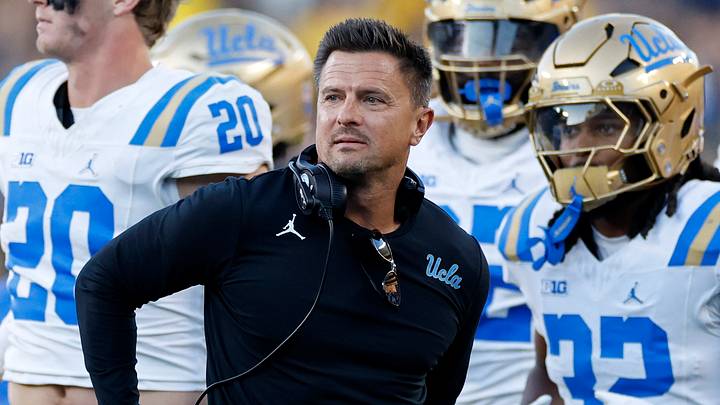
1. UCLA couldn’t handle a real defensive line

- First course: A classic Big Ten rock fight and a hilarious top 5 win for Kyle Whittingham
- Tasting note: The bitter taste of a first loss that UCLA has been flirting with and the harsh reality of life down to QB3
- The takeaway: UCLA widely outperformed the talent on its roster as it got to 10-0, winning with slim margins and a steep turnover margin, but if you play with fire, eventually you’re going to get burned, and the best defensive line UCLA has faced since Ty Dieffenbach’s first start against Wisconsin burned the Bruins. 18-16 Michigan in OT.
When a first-year coach levels up from the Group of Six to the Power 4, they can bring a lot of good stuff with them, but the offensive line is usually the thing that lags behind. It was the spot that Curt Cignetti worked hardest to upgrade (aside from quarterback) from Year 1 to Year 2 at Indiana, and it will be the same for Bob Chesney this offseason.
Ty Dieffenbach has managed the pocket well this year, but Michigan’s defensive line is just a little bit different, and it ate him and his offensive line alive in the Big House. Without starting center Riley Robell and amid continued shuffling along the front, Dieffenbach was pressured on a season-high 14 of his 37 dropbacks and was sacked five times.
Two of those sacks came on dropbacks of less than 2.5 seconds.
Ty Dieffenbach | Weeks 7-11 (all starts) | Week 12 |
|---|---|---|
Blitz rate | 31.7% | 29.7% |
Pressure rate | 31% | 37.8% |
Pressure-to-sack rate | 6.8% | 35.7% |
Sack+INT% | 4.2% | 16.2% |
Turnover worthy play rate | 6.4% | 21.4% |
Michigan defensive end John Henry Daley recorded seven pressures and two sacks with a 20.7% pass-rush win rate. UCLA right tackle Jaylan Jeffers allowed five pressures, and between Jordan Davis and Jensen Somerville, UCLA’s left tackles allowed six pressures.
Dieffenbach was under siege constantly; the run game was smothered, and the team that entered the week +16 in turnover margin, up there with New Mexico, Notre Dame, and Louisiana Tech as the highest turnover margin teams in the country, gave it away three times to Michigan’s one, and that was enough. It’s hard to protect the ball if you can’t win the line of scrimmage to produce consistently down-to-down. UCLA has hunted explosives to offset its plummeting success rate, but that inherently ups your risk profile.
This was coming. It took one of the best defenses in the Big Ten to make it happen, but it was coming. To make matters worse, after Chesney decided not to go for two and the win at the end of regulation, Dieffenbach injured his knee and was carted off in overtime, so it seems to be Madden Iamaleava with Big Ten Championship Game and playoff lives on the line against USC next week.
2. Grant Wilson wasn’t Indiana’s savior

- Second course: A QB change and an OT loss for the defending champs at Washington
- Tasting note: A bitter defeat and the chaos that comes with it
- The takeaway: Grant Wilson led Indiana to a win over USC in Week 11, but if the Trojans had just held onto the interceptions he tried to throw, it would have been a different story. It was in a 27-24 OT loss to Washington.
The overreaction to Grant Wilson’s performance in Indiana’s win over USC is one of the moments this college football season that had me genuinely wondering if I had watched the same game as everyone else. Okay, it wasn’t quite everyone, but there were a lot of people lining up to tell you that Indiana had its QB after Wilson produced a 9.1% turnover-worthy play rate in his lone start.
Then, I confirmed that I’m not crazy as Indiana’s offense sputtered under Wilson on Saturday and Curt Cignetti benched his 25-year-old career backup for Josh Hoover. Hoover was undoubtedly better, and had he started, the game may have gone differently, but there are still glaring accuracy issues in his game that lends to boom-or-bust results and far too many Indiana drives to stall out.
Hoover ranks No. 168 among 175 QBs in the country with an uncatchable ball rate of 32.3%. He had an adjusted completion rate of just 58.3% against Washington, and while Charlie Becker made a few big plays, Hoover and Wilson didn’t give their star receiver duo enough chances to win the game.
Indiana had just one successful late-down passing play in the game and ranks No. 81 in the country in late-down success rate. This team’s superpower last year was how it strung drives together. Now they’re reliant on explosive plays, ranking top 10 in explosive play rate, and producing an 11% explosive play rate against Washington with a 36% success rate and gaining just 40% of their available yards.


3. If Gunner Stockton keeps playing like that, it’s over for everyone

- Third course: Another Georgia flattening, 34-6 over South Carolina
- Tasting note: Fried Gamecock with some heat from the veteran QB
- The takeaway: Gunner Stockton was absurdly efficient, torching South Carolina’s pressure packages and taking big chunks out of their defense down the field.
For much of the Gunner Stockton experience at Georgia, it has been fair to call him a tough game-manager+. He operates well within the confines of the Bulldogs offense, but early this season that was with a low ADOT, plenty of yards after the catch, and in some of the bigger games he’s played, he still has a penchant for putting the ball in harm’s way.
Those fears haven’t been entirely exorcised, but it’s hard to watch what Stockton did in Columbia on Saturday night and not come away feeling like he’s substantively additive force over a replacement-level QB, even for all the contextual factors working in his favor.
Stockton was blitzed on 12 of his 25 dropbacks and went 10/11 for 186 yards (16.9 ypa) with an average depth of target of 12.9 yards downfield and a time to throw of just 2.19 seconds.
Stockton has always been better against the blitz because it clears up the picture for him on the back end, and he’s certainly not afraid to take a hit to deliver a throw. His issues have tended to be more reading throw zone coverage from a muddy pocket and layering throws between the numbers. You can still get him that way, but he has just a 1.5% turnover-worthy play rate when not blitzed this year, so very few teams have.
He’s also blitzed at the highest rate in the SEC (49.1%) and sees a low rate of two-high, cloud zone coverages because all the heavy formations Georgia deploys force the defense to answer with big bodies. As does the game script, with Georgia almost always in control because of a dominant defense, which gave LaNorris Sellers an incredibly difficult time with a blitz-heavy plan of its own.
Again, there are contextual and structural advantages to Stockton’s circumstances, including an elite offensive line and the fifth-shortest average third-down distance in the country, but similar to Brock Purdy on the 49ers (though nobody would confuse Mike Bobo for Kyle Shanahan), he’s breaking out of the system QB talk.
4. Notre Dame’s red zone variance may finally be leveling out

- Reservation: The season isn’t over yet, but this team has all but locked up a spot in the CFP
- Booking: Notre Dame had 3 real tests on its schedule: BYU, Miami, and SMU. The former two were certainly of a higher caliber than the latter, but by going 2-for-3 with a stifling 24-3 win over the Mustangs, the Irish are all but locked into the CFP field.
- Cancellation policy: A loss to Syracuse in Week 12 would be disastrous, but with how the field has broken, it probably wouldn’t even drop Notre Dame from the top 12 (which guarantees them an automatic bid into the field).
Heading into the week, Notre Dame was No. 76 in the country in drive success rate on red zone trips, meaning that just 92.2% of their drives that reached the opponent’s 20-yard line ended in either a touchdown or a field goal attempt. That was with a defense that was No. 4 in drive success rate, but No. 42 in red zone drive success rate.
Obviously, teams have agency in their red zone performance, but there’s also a fair bit of variance in red zone effectiveness, so it can be difficult to parse what’s signal and what’s noise. For Notre Dame, there’s a lot of noise, and in Week 12, SMU was on the receiving end of some positive regression.
The Mustangs, which, to their own credit, are No. 92 in red zone drive success rate, reached the Notre Dame 12, six, and two-yard line on three separate drives and came away with zero points, with a bad snap on a field goal attempt and two stops on downs. That’s with a Kevin Jennings interception from the Notre Dame 24-yard line that was picked by Jayden Sanders at the goal line.
It was a heavy man coverage, high blitz rate game plan from Chris Ash, which was seemingly still viable once star CB Leonard Moore went down with an injury. And while it surrendered a few more explosives between the 20s than Ash would’ve preferred, it held SMU to a 33% success rate with a 20% havoc rate and a 22% stuff rate. In other words, it was smothering, especially when the field got tight.
5. Josh Heupel is a shape-shifter like few other head coaches

- Reservation: The season isn’t over yet, but this team has all but locked up a spot in the CFP
- Booking: Tennessee has ridden its dominant defense to a 9-2 start, and an FPI 89.3% chance to make the CFP heading into a Week 12 matchup with Vanderbilt that’s probably too low.
- Cancellation policy: Tennessee’s win over Alabama still looms as the best win a potential bunch of three-loss teams has, so in many scenarios, even a loss to Vandy doesn’t end the dream.
Josh Heupel deserves more credit than he’s getting for this season. Few offensive-minded head coaches off the Art Briles veer-and-shoot tree would be able to so willingly accept an identity as a defense- and run-game-led team, and thrive with it. Heupel hasn’t only done that; he’s navigated a two-quarterback system like it’s the SEC of the 1990s.
This week, it was Faizon Brandon’s legs that created the offense, but the offense, which generated -0.28 EPA/play and a 35% success rate, was not the story of the 27-13 win; it was a defense that sacked Sam Leavitt eight times and had 13 tackles for loss. LSU's run game produced one explosive play and just six successful runs.
Up front, Tennessee did an excellent job of forcing Leavitt to play from the pocket so Knowles could confuse him on the back end with his coverage disguises and rotations, making him hold the ball and take sacks. Tennessee converted 50% of its pressures into sacks, most of them coming as Leavitt tried to scramble only to find Vols covering his typical escape hatch.
8 sacks.
— Tennessee Football (@Vol_Football) November 22, 2026
13 TFLs.
3 takeaways.
The Tennessee Defense. pic.twitter.com/CG0ibfCc8P
It was not dissimilar to the game plan Knowles threw at Keelon Russell, another scramble-happy out-of-structure creator, and it worked just as well.
6. Gio Lopez is playing like the best quarterback in the country



- Head of the table: The best individual performance of the week earns a seat at the head of the table
- The resume: 17/22, 324 yards, 2 TD, 93.4 QBR, 5 rush, 18 yards, 2 TD
- The takeaway: Gio Lopez has led the Wake Forest offense to average 51.9 points over its last seven games, and he is closing in on Darian Mensah’s lead for EPA/dropback (0.44 to 0.42) and QBR (86.3 to 86.0). By total EPA, pass and rush, Lopez is No. 2 to Texas State’s Brad Jackson and ahead of Mensah (82.5 to 76.4)
It’s hard to comprehend just how good Gio Lopez has been this season. It’s not just about playing lesser competition, though you will note that the two leaders in most statistical efficiency-based categories at quarterback do happen to occupy the same conference.
Against Georgia Tech, Lopez averaged 14.73 yards per dropback, 0.67 EPA/dropback and led his offense to average 6.00 points per opportunity (offensive drives with at least one play inside the opponent’s 40-yard line). He managed an 86.4% adjusted completion percentage with a 10.4-yard average depth of target, and as a runner, he produced 1.00 EPA/carry.
Lopez is simply outplaying everyone right now, and if it weren’t for Jeremiah Smith, I’m not sure he wouldn’t be deserving of the Heisman Trophy. Even Devon Dampier, the preeminent dual-threat QB of the season, has less raw rushing EPA than Lopez. He’s simply been the best quarterback in the country.
7. LJ Martin looking healthy is a huge deal for BYU

- Heimlich Maneuver: Sometimes a CFP contender chokes on their food, but the best teams know the Heimlich
- The choking hazard: The Cougars haven’t been nearly as good on the road, but nearly had another wild-boy dual-threat QB take them down as Isaiah Marshall and Kansas pushed BYU to three overtimes before falling 31-29.
BYU came into Lawrence as a conspicuous 4.5-point favorite, and nearly let Isaiah Marshall pull a Keyone Jenkins to ruin their CFP hopes. Marshall’s two picks led to 10 BYU points, enough to give the Cougars a chance at a game-winning field goal that Matthias Dunn duck-hooked to keep the game tied at 16.
Are there structural issues for a BYU defense that has struggled with multiple mobile QBs now? Maybe? Is that bad news for a possible, though unlikely, Big 12 Championship Game against either Dampier or Tommy Castellanos? Absolutely. But the bigger story is that LJ Martin is back healthy, and he toted the rock 25 times for 127 yards and a touchdown.
BYU managed a 50% rushing success rate and 0.28 EPA/rush against an above-average Kansas run defense. He should help a sputtering red zone offense and take pressure off Bear Bachmeier to carry the entire unit. It didn’t happen in Week 12, but if a more diverse run game can mean better than the 3.86 points per red zone trip BYU produced against Kansas, it could expand the slim margins Kalani Sitake’s team has been living on all year.
8. You can’t let TCU run the ball on you, unless you have Devon Dampier, of course

- Heimlich Maneuver: Sometimes a CFP contender chokes on their food, but the best teams know the Heimlich
- The choking hazard: A lifeless TCU run game showed more than just a pulse as the Horned Frogs pulled even 17-17 in the fourth quarter before Utah scored 21 unanswered in the final 10 minutes.
Utah had a 20-play drive in the second quarter that ended in a missed field goal, but aside from that drive, they converted just three third downs the rest of the game and averaged just 4.4 plays per drive. It was either quick scores or three-and-outs, which isn’t exactly the norm for a Utah offense that ranks No. 15 in available yards percentage and No. 5 in late-down success rate, two marks of a team that sustains long drives.
The good news is that Devon Dampier needed just nine plays in the fourth quarter to lead the offense to 21 points, so a defense that allowed 0.42 EPA/rush to the worst rushing offenses in the Big 12 got bailed out.
A few weeks ago, against BYU, Utah didn’t produce a single tackle for loss. Now, against TCU, the Utes allowed a 56% rushing success rate. The defensive line also ranks No. 68 in line yards/rush at 3.11, so trench play in Salt Lake City is worth monitoring when considering the national championship viability of the Utes.
9. Texas Tech’s defense is good enough to survive bad Tommy Castellanos

- The fajita plate: Nothing draws attention quite like the sizzle of fajitas being carried through the restaurant. These teams are as hot as the fajita plate your waiter warned you not to touch.
- The temperature: The Red Raiders offense has been scorching since Tommy Castellanos took over, but the defense carried him through a shaky outing in Waco, and if that side of the ball has found its footing again, Texas Tech is the scariest team in the Big 12 and a nightmare CFP matchup.
Texas Tech has only really gotten good Tommy Castellanos since he took over this team in Week 9 against Arizona. In Week 12, though, Joey McGuire experienced the downside of his Jekyll-and-Hyde quarterback, as Castellanos threw two picks and had a cool 9.1% turnover-worthy play rate.
Yet, the Red Raiders kept Baylor and DJ Lagway at arm’s length with a defensive performance that was up to last year’s standard, sacking Lagway three times and accounting for 10 tackles for loss.
Even without David Bailey and Romello Height screaming off the edges, Texas Tech has remained one of the lowest blitz-rate teams in the country. Even against Baylor, the pressure wasn’t consistently there, but there was enough to kill drives, take the run game off the table, and buy time for an offense that is suddenly one of the most explosive in the country.
It’s his style to begin with, but that more conservative defensive approach of DC Shiel Wood is probably well suited to be paired with this offense, providing a higher floor as the offense rides the wave of Tommy C’s volatility.
10. Oregon is win and in to the Big Ten Championship Game

- The fajita plate: Nothing draws attention quite like the sizzle of fajitas being carried through the restaurant. These teams are as hot as the fajita plate your waiter warned you not to touch.
- The temperature: The Ducks aren’t just the hottest team in the Big Ten; they’re the best team in the Big Ten, and they control their own destiny.
Oregon pounded Michigan State on Friday night and threw in a fake field goal for good measure. At 8-3 and 6-2 in the Big Ten, the Ducks now have the inside track to the Big Ten Championship Game, and, according to the sportsbooks, have the best odds to make the College Football Playoff of any Big Ten team, even better than Indiana.
Here’s how the scenarios play out for the Big Ten title game based on Week 12 results.
If: USC beats UCLA, Oregon beats Washington, Indiana beats Purdue, and Iowa beats Nebraska
Then: Oregon vs. Iowa
If: USC beats UCLA, Oregon beats Washington, Indiana beats Purdue, and Nebraska beats Iowa
Then: Oregon vs. Indiana
If: UCLA beats USC, Oregon beats Washington, Indiana beats Purdue, and Iowa beats Nebraska
Then: Oregon vs. UCLA
If: UCLA beats USC, Washington beats Oregon, Indiana beats Purdue, and Iowa beats Nebraska
Then: UCLA vs. Indiana
It’s win-and-in for UCLA and Oregon, which is wild after I and everyone else left the Ducks for dead after their third loss.
11. Tim Lester has done a nice job with the Iowa offense

- Dessert: Whether it’s a rich play design or a decadent athletic display, here’s a sweet football treat
- Tasting note: A bit of creativity in Iowa City, a town accustomed to eating the same run game and defense for the past 20 years.
Iowa’s best wins are against Michigan, Wisconsin, and, as of Saturday evening, Illinois. At 10-2, that’s probably not enough for an at-large, but the way the conference title scenarios opened up, we have to take Iowa seriously now.
That’s a bit more palatable because of what OC Tim Lester has done with the offense this year, maximizing his two talented tight ends and his dynamic wide receiver Tony Diaz with a play-action-heavy approach that’s been complementary and surprisingly efficient despite a fourth-percentile explosive play rate.
This fake QB sneak on fourth down is the perfect encapsulation of how they’ve taken the classic Iowa stuff and sprinkled just enough creativity onto it to keep winning games.
Clever Short Yardage Wrinkle from Iowa
— Coach Dan Casey (@CoachDanCasey) November 22, 2026
Motion the TE in like he's going to Push, reverse out with TE Fast to Flat! pic.twitter.com/zSw8OD8LuD
12. Boise State has a cushion, but Spencer Danielson still shouldn’t have wasted it

- Kid’s menu: The CFP saves one spot at the big kids’ table for the Group of Six
- The takeaway: Boise State climbed to No. 17 in last week’s rankings, and now the Broncos will plummet after inexplicable game management allowed San Diego State to walk them off.
Boise State head coach Spencer Danielson probably didn’t sleep very well last night. Not only was he recounting a disastrous bit of game management late that yacked up the game to San Diego State, but he was likely wondering how big his team’s CFP cushion is heading into the final week, as no other G6 teams have cracked the rankings.
Is UTSA at No. 26 ready to jump in after a two-point win over UAB? Probably not, and over the past two weeks, New Mexico, Memphis, and North Texas have all bowed out of the race with ugly losses. It’s probably UTSA and Liberty as the top challengers, so it’ll still be Boise, but it should’ve been with a bullet.
every big play from San Diego State's stunning finish 🤩 pic.twitter.com/sCq3QJ9M2R
— Pac-12 Conference (@pac12) November 22, 2026
 Add us as a preferred source on Google