
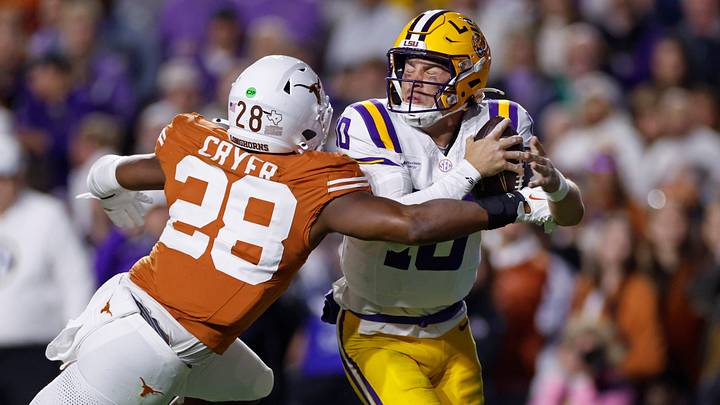
Week 10 had all the big-time matchups, but Week 11 brought clarity to college football’s murky playoff picture, even if the sport’s travel plans weren’t always the most certain. Seven of the CFP selection committee’s Top 25 teams lost in Week 11, two of them to unranked teams.
With Oklahoma State, Missouri, South Carolina, and LSU taking their fourth loss, and Kentucky, Arizona, and USC taking their third, we can effectively cross off all seven as CFP contenders, if we hadn’t already.
The winners are also starting to make it clear they belong in the field. By FPI, five teams have a 90% chance or greater of making the CFP: Georgia, Miami, Notre Dame, Alabama, and Utah. I’ll add Texas and Indiana to that list of practical certainties, and we’ve suddenly got over half the field sorted out.
With two weeks to go, we have eight teams: UCLA, Tennessee, BYU, Texas Tech, Wake Forest, Iowa (I guess), Oregon, and Ole Miss (pending Sunday afternoon’s result in Norman), vying for four spots. That’s not nearly the chaos we thought we’d have. But I’m sure this sport will find a way to spice things up.
1. Wake Forest finishes you early

- First course: The rare ACC blowout that preserves the league’s best-case postseason scenario
- Tasting note: The distinct taste of blood that Jake Dickert craves
- The takeaway: Wake Forest is an absolute wagon, and after pounding SMU 49-7 in Dallas on Kevin Jennings’ senior night, the Demon Deacons are going to be tough to keep out of the CFP field.
Jake Dickert had his Wake Forest team up 42-0 on SMU, widely considered the third- or fourth-best team in the ACC, at halftime and said, “We're not finished with them yet. We came for 60 minutes, and they've got nowhere to hide." That’s the type of quote you get from a coach who can legitimately throw punches with the big dogs.
It was a comprehensively dominant outing from a team that hasn’t allowed a first-half point since October 10 and has outscored its opponents 145-0 in the first half of its last four games. By net EPA/play, only Notre Dame is better this year. Sure, it’s been a soft schedule, but Wake Forest is treating lesser opponents the way great teams treat lesser opponents. And we weren’t quite sure before this game kicked off, but it became clear within a few minutes that SMU is a lesser opponent.
It’s not just Gio Lopez and Carlos Hernandez either. Langston Hardy had six pressures on Kevin Jennings with a 31.6% pass-rush win rate, and Gabe Kirschke and Zach Lohavichan both had a sack and a TFL apiece for a unit that managed an 18% havoc rate despite blitzing just seven times all game and operating in garbage time for much of the night. There are dudes all over this team in a way that terrifies the rest of the ACC and may even send a shiver down Miami’s spine for a likely rematch in Charlotte.
2. The Monster Energy Big XII after dark delivered

- Second course: A quarterback duel for the ages between Devon Dampier and Noah Fifita
- Tasting note: The absolute electricity a Mountain Dew High Voltage could only dream of delivering. A McDonald’s Sprite and a taser might not even come close.
- The takeaway: For all the good Morgan Scalley is doing in Salt Lake City, Utah has a chance in every game because of Devon Dampier.
Utah and Arizona had to play past midnight in Tucson because Utah’s travel was delayed, like many other teams in the country, by the FAA’s nationwide ground stop on Friday afternoon. Honestly, that may have been for the best because these two former Pac-12 teams delivered some don’t call it Pac-12 after dark because it’s the Monster Energy Big XII after dark for the ages.
Devon Dampier, even after a night when he completed just 13 passes and threw an interception, absolutely deserves to be in every Heisman Trophy conversation he’ll be mentioned in. He’s a true running back with the ball in his hands, unlocking the Utah run game to, without Wayshawn Parker, produce 296 yards and three touchdowns, average 8.5 yards per carry, and 0.55 EPA/carry, a 99th percentile outcome.
Sure, they were exposing an Arizona defense that was statistically flimsy, floated by timely blitzes early in the season, but remarkably susceptible to explosive plays to the tune of 9.4% (No. 126). But all the creativity and explosiveness of the Utah offense, every two-quarterback set OC Kevin McGiven can dream up, is made possible by the singular talent that is his 5-foot-11 (generous) 215-pound quarterback.
3. Houston got out third-down’d by Colorado

- Check, please: When it’s clear there won’t be a seat for you at the CFP table, it’s time to pay your check and leave
- The cost: Willie Fritz’s team still had a path to the Big 12 Title game, even with losses to Texas Tech and Utah, but a third conference loss is too much to overcome for a team with one of the best offenses in the country.
No offense in the country is better at stringing drives together than Houston, with a fifth-year QB Connor Weigman playing the best football of his life and maybe the best guard-center combination in the country in left guard Shadre Hurst and center Anthony Boswell. The Cougars are No. 1 in the country in available yards percentage and No. 2 in third-down success rate.

Yet, in Boulder on Friday night, the Cougars got out third-down’d by a Brennan Marion Colorado offense that ranked No. 110 in third-down success rate. While Houston went 9/16 on third down, averaging 5.8 yards per play and gaining 62% of their available yards in the 42-32 loss, Colorado went 10/14, averaging 14.9 yards on third down and 2/3 on third-and-9+ as they ran for 249 yards. It was a disastrous late-down outing from a Cougars defense that ranks No. 103 in the country in third-down success rate.
It’s been a year of classic Big 12 shootouts, and it’s not easy to live that way, especially with a relative lack of explosives. Marion’s go-go offense hasn’t exactly been a big-play machine either, but anyone can move the ball in chunks when the defense tackles as poorly as Houston did in the second and third levels.
4. South Carolina without LaNorris Sellers is just Mississippi State without Kamario Taylor

- Check, please: When it’s clear there won’t be a seat for you at the CFP table, it’s time to pay your check and leave
- The cost: A chance to get flattened by Georgia in front of a raucous crowd in Columbia next week. Instead, the Gamecocks will get flattened by Georgia with their slim CFP hopes already thoroughly squashed.
South Carolina’s star QB LaNorris Sellers injured his ankle in last week’s win over Texas A&M and was listed as probable heading into Fayetteville in Week 11. Yet, Sellers was sidelined as sophomore Cutter Woods made the start against a program whose fans would rather be in the woods for the first weekend of hunting season in Arkansas than watching their Razorbacks, and demonstrated just how valuable Sellers really is.
Sellers entered the week No. 39 in the country in total passing EPA and No. 6 in the country in rushing EPA. It’s not easy to replace that player, but whatever low bar you set for his understudy, Woods fell remarkably short of. For the game, he produced -15.28 total EPA and -0.35 EPA/dropback, going 24-for-44 for 271 yards with no touchdowns and three interceptions in a 34-6 loss to SP+’s No. 88 team in the country. That’s rough.
5. Kentucky just doesn’t have the athletes

- Check, please: When it’s clear there won’t be a seat for you at the CFP table, it’s time to pay your check and leave
- The cost: A truly magical first season for Will Stein is now only memorable for Kentucky fans are a 21-14 loss to Florida in Lexington
There will almost certainly be at least one three-loss team in the CFP field, though it’s looking less and less likely that there are two or more. Regardless, Kentucky won’t be one of them. The Wildcats just don’t have the wins to stay ahead of a three-loss Oregon, and will be boxed out by Tennessee and wherever the Vols finish after falling 34-6 in Knoxville a week ago.
Will Stein has done a really impressive job cobbling together a quality SEC offense with a sound decision-maker at QB, an elite left tackle in Lance Heard, whom he weaponizes like no other, and an unremarkable group of pass catchers. But a few times this year, against Alabama, Tennessee, and now Florida, the lack of dynamic athletes on offense has been too much for Stein to overcome.
Kentucky, which ranks No. 111 in the country in passing explosiveness, managed just one explosive play against Florida by GameOnPaper’s EPA threshold and just two 20+ yard passes. I’d bet on Stein getting this team there. He gives them such a high floor already. But when you live on such thin margins as a team with two wins on two-point conversions, you’re eventually going to end up on the wrong side.
6. That’s an awful lot of money for more of the same at LSU

- Check, please: When it’s clear there won’t be a seat for you at the CFP table, it’s time to pay your check and leave
- The cost: Brian Kelly’s $54 million buyout, Lane Kiffin’s $1.5 million buyout from Ole Miss, Kiffin’s new $13 million-a-year salary, and a $50 million roster to lose as many games as Kelly ever did in a full season in Baton Rouge, with a trip to Knoxville still looming.
Sure, we can diagnose Sam Leavitt’s particular strain of pressure sensitivity or pick apart the lack of a quick response to Raleek Brown’s motion on the game-winning score. But honestly, both quarterbacks were under duress all night in a sloppy football game, and Kiffin gave his QB more consistent answers against pressure than Sarkisian did for his.
LSU had a slim edge in success rate, a big one in explosive plays, and Blake Baker’s defense at Texas’s offensive line and Arch Manning alive. LSU is a remarkably talented team with an offensive scheme built for efficiency and an elite DC. Yet, once again, the Tigers came up on the short end of the slim margins of SEC play, averaging 2.80 points per red zone trip to Texas’s 5.00.
That’s the difference: a missed field goal and two red zone interceptions from Leavitt. A week after the offense moved it with ease between the 20s, only to self-destruct repeatedly in the red zone.
The No. 3 team in the country in net available yards percentage (.283) and No. 11 in offensive available yards percentage (.603), LSU ranks No. 110 in the country with just 88.6% of its drives that reach the opponent’s 20-yard line resulting in a touchdown or a field goal attempt (BCFToys).
Maybe that’s all on Leavitt, a quarterback Kiffin seemingly wasn’t entirely sold on during the portal window. But maybe it’s on a head coach who turned the entire sport on its head 12 months ago just to turn down a bid to the Birmingham Bowl, because that’s where this is heading, and unlike Kiffin, his QB has been to a CFP before.
7. A vintage Lincoln Riley performance from USC




- Check, please: When it’s clear there won’t be a seat for you at the CFP table, it’s time to pay your check and leave
- The cost: A roster with enough talent to win the big game, once again foiled by a coach and a program that cannot get out of its own way.
Two missed field goals, four dropped interceptions, and three interceptions from Jayden Maiava were enough to sink the Trojans in Bloomington. That’s -7.20 EPA on turnovers, -4.61 EPA on special teams, and 10 Indiana points directly off Grant Wilson passes that went into and out of the hands of USC defensive backs. That’s more than enough to allow the defending national champs to pull away for a 27-13 win.
Lincoln Riley actually had a great offensive plan against the Indiana defense, influencing aggressive linebackers with the RPO game and attacking zone voids with a precise intermediate passing attack. Maiava did a great job checking into runs to neutralize some of Bryant Haines’ most exotic pressure packages, a few times hitting big plays against a slanting front. That was good for a 48% success rate against one of the best defenses in the country and an offense with a backup quarterback. Somehow, that wasn’t enough to stay within a touchdown.
The Trojans still have an opportunity for a statement win against UCLA in Week 13, but with three losses and a head-to-head loss to Oregon, USC is completely boxed out of the field. Now, the big question in LA is whether Riley gets another shot. It’s not easy to pay a $70+ million buyout, but a performance like that is pretty good motivation.
8. Bryant Haines’s defense keeps carrying the Hoosiers

- Reservation: The season isn’t over yet, but this team has all but locked up a spot in the CFP
- Booking: Behind another advantageous defensive outing and a 27-13 win, Indiana rode DC Bryant Haines and his unit to 9-1 and the closest thing to a signature win they’ll have this year.
- Cancellation policy: The resume isn’t impressive, but with Washington and Purdue left, Indiana is going to get to 11-1 and play in the Big Ten Championship Game. Even if they drop one down the stretch, the defending champs are probably getting in at 10-2. The only way to miss the field is to lose out.
USC had a clear plan to get the ball out of Jayden Maiava’s hands quickly. He finished the game with an average time to throw of 1.86 seconds. So, none of Haines’s blitz packages got home, but that doesn’t mean they didn’t make an impact on the outcome. Two of Maiava’s three interceptions came with Tobi Osunsanmi dropping in coverage on a simulated pressure, which confused Maiava’s read.
Bryant Haines has the clamps on Lincoln Riley and USC in the 1st half and gave IU's offense a short field with this brilliant simulated pressure to force a Jayden Maiava interception.
— Josh Yourish (@JYourish3) November 14, 2026
Best in the business. pic.twitter.com/YjjJoAxZy2
USC, especially early on, did a lot of hurry-up and wait, offensively. Essentially playing in the no-huddle, but only to get to the line and see Indiana’s defensive look before the in-helmet communication shuts off at 15 seconds on the play-clock, so Riley could help Maiava with adjustments.
Riley isn’t the wunderkind play-caller he once was, but he’s still on the short-list of the best offensive minds in college football. Yet, on critical downs, Haines beat him on the chalkboard. On Maiava’s red-zone interception, once the MIKE blitzes, he should have the slant, but Osunsanmi takes the flat, and Jones immediately breaks to undercut the route. It’s brilliant stuff, baiting Maiava into the turnover.
B1G TIME TAKEAWAY FOR ISAIAH JONES AND @IndianaFootball ‼️
— Big Ten Network (@BigTenNetwork) November 14, 2026
Watch on CBS pic.twitter.com/atfynn4Wz9
9. Oregon is back in the mix after bullying Michigan

- A seat at the bar: When all the tables are full, sometimes you can grab a seat at the bar, and maybe these emerging contenders will be seated soon
- The takeaway: With LSU falling away, and Kentucky and USC taking their third losses, Oregon is suddenly at the front of the line of three-loss teams to get an at-large bid.
When Oregon lost to Illinois in Week 8, it looked like it was finished. I made Oregon pay their check and leave. Now, it looks like Oregon is still boxed out of the Big Ten Championship Game, with Indiana and UCLA winning this week, but an at-large bid is absolutely in play, and the Ducks would be a terrifying matchup for whoever winds up at the No. 6 seed if they sneak in.
Michigan probably isn’t going to make a bowl, but hanging 31 on a defense that hadn’t allowed more than 21 this season and averaging 7.31 yards per play is noteworthy.
Dylan Raiola is still one of the most pressure-sensitive quarterbacks in the country. He went 2-for-8 for 17 yards with two sacks when pressured against Michigan. But on his 22 clean dropbacks, brother, Raiola was scorching hot. He went 18-for-20 for 324 yards and four touchdowns with a 9.0-yard ADOT. The screen game has been excellent since Jay Johnson replaced Drew Mehringer as play-caller, but Raiola is hitting shots downfield too. He went 3-for-4 for 157 yards and two scores on throws over 20 yards downfield.
Over the last three games with Johnson on the headset, Raiola’s numbers are absurd. He’s 8-for-12 on throws over 20 yards downfield for 316 yards and five touchdowns. When he’s been kept clean, which Johnson has done for him much more by keeping in additional blockers, he’s been a killer.
Dylan Raiola last 3 weeks | Kept clean | Under pressure |
|---|---|---|
Dropbacks | 77 | 29 |
Comp/Att | 59/75 (78.7%) | 8/24 (33.3%) |
Yards | 844 | 90 |
YPA | 11.3 | 3.1 |
TD/INT | 8/0 | 1/0 |
ADOT | 8.6 | 8.1 |
Sacks | N/A | 3 |
10. Nate Sheppard poked at Miami’s pressure point

- Hors d’oeuvres: A little something to chew on from the week that was in college football
- Nutrition facts:
- Miami was charted with 14 missed tackles, eight from cornerbacks
- Nate Sheppard averaged 5.63 yards after contact per attempt (4.13 yco/a for season)
- Sheppard forced 4 missed tackles on runs and 7 on 12 receptions with 107 yards after the catch
- 50% of Sheppard’s runs went off tackle (8.5 ypa) vs. 7.9 ypa
Nobody in college football quite forces missed tackles like Nate Sheppard, but it doesn’t take an elite running back for Miami’s defense to let a ball carrier slip away from first contact. Through 10 games, the Hurricanes have been credited with 117 missed tackles, with four players — safeties JJ Dunnigan and Zechariah Poyser, cornerback Omar Thornton, and defensive end Marquise Lightfoot — with 10 or more.
Duke has a 50% run rate on the year, so it’s not as if this is a service academy offense. But it was still a surprise to see the Blue Devils come out and throw the ball on 20 of their first 24 offensive plays. The plan was clear, though: get the ball to Sheppard, who was targeted 13 times and finished with 12 catches for 93 yards, in space and dare Miami to tackle.
It was the same in the run game, as Duke, typically a spread offense, leaned into more condensed sets and heavy personnel, forcing Miami DBs into the run fit. Miami’s defensive tackles, Justin Scott and Ahmad Moten, are the strength of the defense, and without Rueben Bain Jr. and Akheem Mesidor on the edge, they aren’t just worse, but they’re a lot lighter. That means more runs get to the edge, and any tackling issues are more prevalent. It’s a real flaw for a surefire CFP team.
11. UCLA’s blitz packages are going to carry it to the CFP

- Dessert: Whether it’s a rich play design or a decadent athletic display, here’s a sweet football treat
- Tasting note: A fearless philosophy from UCLA DC Colin Hitschler has birthed one of the most aggressive and effective defenses in college football.
After a 10-0 start, with Michigan and USC on deck, UCLA is probably in the CFP field. But at just 71.2% to make the field by FPI, it’s not a certainty. So, I’ll wait until the Bruins get to 11 wins to reserve their seat at the table, but with this defense, I have every reason to believe it’s coming.
According to MatchQuarters, UCLA has the third-highest blitz rate in the Power 4 (48%) and blitzes on over 50% of opponents’ passing plays. Much of that pressure comes against heavy personnel and condensed formations, which are on the rise across college football. Illinois deployed many of them on Friday night at the Rose Bowl, and Hitschler blitzed Illinois quarterback Katin Houser on 56.4% of his dropbacks, forcing three interceptions.
My favorite pressure of the day was Houser’s second pick bringing a linebacker up the A-gap to occupy the guard and the center, then bringing a safety from depth. The Illinois had six to block five, and Hitschler still manufactured a free rusher who forced Houser to throw a pick to Derrick Barksdale, who was in man coverage and began the play on the opposite side of the field.
Most of UCLA’s pressure packages send just five or six, but the trouble is figuring out which five or six are coming. That’s even tougher in condensed sets or with heavy personnel because UCLA can more easily walk linebackers and DBs down to the line of scrimmage.
Intercepted by Derrick Barksdale to get the ball back for @UCLAFootball! pic.twitter.com/JiMm4gHz7A
— FOX College Football (@CFBONFOX) November 14, 2026
It was another masterful outing from a defense that ranks No. 3 in the country in busted drive rate, and No. 5 in havoc rate. This blitz-heavy approach kills drives, and they hardly get burned for it, ranking No. 2 in EPA/blitz.
12. The CFP committee likes to keep it a mystery

- Kids' menu: The CFP saves one spot at the big kids’ table for the Group of Six
- The takeaway: Boise State won, maybe, the game of the year in the Pac-12, taking down Oregon State 46-41 on the Smurf Turf on a day when New Mexico dropped its first Mountain West game of the year to UNLV. If the Broncos trip up, who is next in line?
It’s honestly ridiculous that the CFP committee doesn’t release a Group of Six ranking. It’s one of 12 spots in a playoff, and we have no idea how the race looks beyond Boise State because the committee wasn’t interested in ranking New Mexico, as the AP Poll had.
So, will it still be New Mexico after this loss to UNLV? Is UTSA up next after bouncing back from a loss to beat North Texas in the Alamo Dome on Saturday? Do Liberty or Louisiana Tech deserve a second thought in the race? We have absolutely no idea.
It probably won’t matter because Boise State, which had a true freshman wide receiver, Raseasn Jones, outplay Jesse Legree. Jones went for 230 yards and three touchdowns as Maddux Madsen threw for 371 yards and four scores in his return from injury.
 Add us as a preferred source on Google