
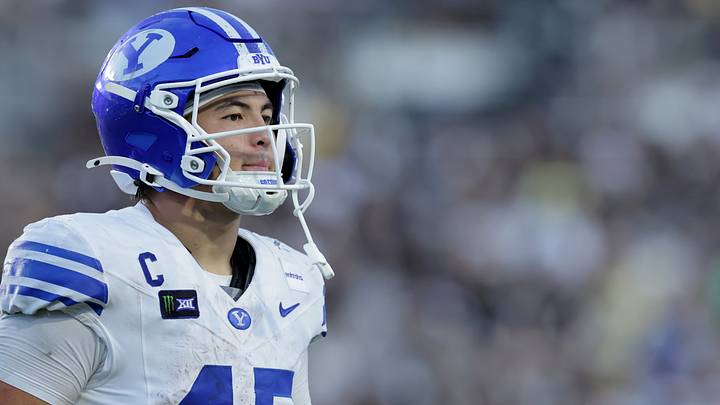
It’s the season of the hangover in college football, and that’s not just from all the fan bases who have celebrated upset wins of late. As the gap between the best teams in the country and everyone else shrinks, every power-conference schedule has fewer “off” weeks than ever before. Add in some cross-country travel thanks to realignment, and letdown spots feel more inevitable than ever
All three teams that knocked off top-10 opponents last week and were in action this week — Auburn, BYU, and Tennessee — lost on Saturday. Over the last two weeks, teams coming off a win over a top-10 opponent are 1-5. The four losses by AP top two teams in the last three weeks are the most in the history of the poll.
It may be cranked up to 11 this year in particular, but it feels like this could be the new normal for the sport moving forward. Good teams will take a few losses, and that’s okay. The great ones will bounce back. Which brings us to the defending champs, who won the program’s first game at the Big House since 1967.
1. Indiana’s offense can’t grind you down this year

- First course: A Big Ten bloodbath in the Big House
- Tasting note: It’s not pretty, but it’s a new win streak started for the Hoosiers after surviving Michigan 13-6 in overtime
- The takeaway: Indiana misses Fernando Mendoza most of all, but over the past two weeks against two of the Big Ten’s best defensive lines, it misses center Pat Coogan almost as much.
Along with its Heisman Trophy-winning QB, Indiana also lost its starting center and the Offensive MVP of the Rose Bowl, Pat Coogan, from last year's squad. Curt Cignetti and offensive coordinator Mike Shanahan have kicked Bray Lynch from right guard to center amid a significant shuffle up front, and in the two biggest tests of the year for that group, the Hoosiers posted a 36 percent rushing success rate against Ohio State and a 38 percent rushing success rate against Michigan.
Josh Hoover was banged up and struggled against the Wolverines, throwing his first interception of the year in the OT win. He didn’t complete a pass after halftime until overtime and managed a 1st-percentile output of -0.62 EPA/dropback. Maybe that’s the biggest story, but unlike last year when the run game could impose its will, Indiana hasn’t controlled the line of scrimmage.
Against an even better Ohio State defense in 2025, Indiana had a 23 percent rushing success rate and an 86 percent pass rate on late downs, converting just one of its two late-down rushes. Against Ohio State this year, Indiana went back to that well, throwing it 16 times to two runs with just one rushing conversion.
Against Michigan, Shanahan went for more balance, running the ball 24 times, including a 43 percent late-down run rate, but with just a 33 percent late-down rushing success rate. That’s a lot of numbers to throw at you; maybe a table will help illustrate it better.
Indiana offense | 2025 | 2026 |
|---|---|---|
Rushing success rate | 47% | 45% |
Late-down rushing SR | 11% | 14% |
Non-explosive EPA/rush | -0.05 | -0.12 |
Stuff rate | 69% | 48% |
So why is the Indiana offense struggling? Well, it’s Hoover, but it’s not just Hoover. It’s more runs going for no gain, and fewer third-down conversions, meaning shorter drives and fewer chances to hit explosives in the passing game. And when the explosives aren’t hitting, this offense isn’t the meat grinder it was last year.
2. An "edgy" Arch Manning isn't a better Arch Manning, at least not for a full game

- Second course: Texas' two-faced top-10 win over Ole Miss
- Tasting note: The Horns' stale second-half performance could make a sensitive stomach queasy
- The takeaway: Texas escaped with a 34-27 win after blowing a 21-point halftime lead, but just because Trinidad Chambliss had his first multi-interception game as a Rebel doesn't mean this defense and run game can carry Manning the rest of the way.
After a week of talk about an “edgy” Arch Manning potentially being benched, Texas came out firing offensively, scoring 24 points in the first half behind 13-of-19 passing for 171 yards and a touchdown from its beleaguered QB. The Longhorns even left six more points on the field with an ugly Cam Coleman drop.
Then, almost immediately, the good vibes in Austin disappeared as Manning was strip-sacked on the fourth play from scrimmage in the second half. Texas went scoreless on its first five possessions after the break, with two Manning turnovers and just 37 yards of offense. The run game and Raleek Brown bailed the Longhorns out, but Manning went 5-for-11 for 41 yards with an interception in the second half.
Manning finished the game at -0.57 EPA/play, a second-percentile output and by far his worst of the season (though that's heavily weighted by the strip-sack touchdown), to go with a 28 percent success rate. Prior to this week, Manning’s previous worst EPA/dropback this season was -0.11 vs. Oklahoma. Almost impossibly, you can argue that this was statistically his worst game.
Manning got involved in the run game, making his first two trips to the end zone this season after rushing for 10 touchdowns in 2025, and the involvement of Michael Masunas, who caught his first three targets of the year for 37 yards and two first downs, is a positive development. But this offense and its quarterback are far from fixed, and surely losing left tackle Trevor Goosby and wide receiver Cam Coleman to injury in this win won’t have a lasting impact.
3. Utah is the last undefeated team standing in the Big 12

- Third course: Devon Dampier’s dynamic outing at Rice-Eccles Stadium
- Tasting note: A high-stakes battle on a bloody day at the top of the Big 12
- The takeaway: With BYU and Texas Tech both going down in Week 8, Utah catapulted itself to the top spot in the Big 12 with its 21-13 win over Houston, and with Devon Dampier at QB, the Utes are a nightmare to game plan for every week.
Devon Dampier may not be the best running quarterback in the country, but may not be another offense that’s better at weaponizing its quarterback’s mobility than Utah’s behind new OC Kevin McGiven.
Dampier ran the ball 15 times for 150 yards and two touchdowns against Houston, which stubbornly ran a lot of man coverage on the back end and left lanes for Dampier to scramble when the play broke down. Despite scoring just 21 points (and none in the first half), Dampier had a 79 percent success rate when he took off as Utah managed a 59 percent success rate for the game.
With Houston in man coverage more than expected against a mobile QB, motion at the snap had a massive effect on the numbers game, such as on the game-winning touchdown run from the 5-foot-11 QB.
#GoUtes | #RSNB | 📺 @ESPNCFB https://t.co/N2StHzcyiy pic.twitter.com/f3vl6Y8pSP
— Utah Football (@Utah_Football) October 25, 2026
Dampier’s two interceptions had more than a little to do with the low point total, as did Houston’s ability to shrink the game by going 9-of-17 on third down. Still, with a 14 percent net success rate edge, the Utes controlled this game — and, after coasting into the top 10 against a soft schedule, finally stamped a quality win on their resume. As one of just three unbeaten teams left in the FBS, they could vault into the top five this week and set up an incredibly high stakes Holy War in two weeks.
4. Oregon never had it this year, and now it’s over

- Check, please: When it’s clear there won’t be a seat for you at the CFP table, it’s time to pay your check and leave
- The cost: Maybe the most talented roster in the country and certainly one of the most expensive, Dan Lanning’s internal coordinator promotions, the injury bug, offensive line issues and recent a wave of suspensions have torpedoed the preseason No. 2 team in the country.
A two-loss Oregon team getting Dante Moore back at some point this season had a chance to sneak back into the picture of a College Football Playoff that will almost certainly have multiple three-loss teams in the field. However, a three-loss Oregon team, with one of those losses coming against an Illinois squad down to its true freshman backup quarterback, is officially finished.
And good riddance to this team. It was ugly from the start and never really figured itself out, even when Moore was healthy. Losing by two scores to a team that averaged 2.73 yards per dropback, a third-percentile output, is such a fitting end. The only other team in the country this year before Week 8 to average fewer than 3.0 yards/dropback in a win was Air Force, which averaged -3.0 yards/dropback in its 28-7 victory over Northern Illinois. (But in Week 8, Wisconsin also beat USC with sub-3.0 yards/DB.)
5. Malachi Toney is uniquely dominant in the year of the wide receiver

- Head of the table: The best individual performance of the week earns a seat at the head of the table
- The resume: Toney caught 16 of his 17 targets for 194 yards and 3 TDs in No. 1 Miami’s 52-23 win over Pitt
- The takeaway: Malachi Toney, Jeremiah Smith and Jesse Legree are in a league of their own this year, but Toney is doing it at a higher volume and a lower average depth of target than his counterparts.
Malachi Toney broke Miami’s single-game receptions record against Pitt in Week 8, and reasserted himself in the Heisman race alongside Jeremiah Smith (who just lost his quarterback, potentially for the year). He’s matching Smith’s efficiency without the downfield ability.
Over the previous 10 seasons, there have been six receivers to average over 4.0 yards per route run for the season, a mark Toney, Smith and Legree are all well clear of this year. Only Jaxon Smith-Njigba in 2021 did it with an average depth of target under 10 yards downfield, and only JSN finished with a reception percentage over 84 percent.
Receiver, Team | Year | Yards/route run | ADOT | Reception % |
|---|---|---|---|---|
Jeremiah Smith, Ohio State | 2026 | 4.78 | 15.4 | 71.2% |
Malachi Toney, Miami | 2026 | 4.62 | 8.3 | 89.2% |
Jesse Legree, Oregon State | 2026 | 4.48 | 16.8 | 69.2 |
Jaxon Smith-Njigba, Ohio State | 2021 | 4.01 | 9.3 | 84.8% |
DeVonta Smith, Alabama | 2020 | 4.39 | 10.7 | 80.7% |
Jaelon Darden, North Texas | 2020 | 4.31 | 10.4 | 66.1% |
Tutu Atwell, Louisville | 2019 | 4.33 | 11.1 | 67.3% |
Andy Isabella, UMass | 2018 | 4.15 | 12.1 | 69.2% |
Michael Gallup, Colorado State | 2016 | 4.34 | 13.3 | 67.9% |
Toney leads the country with an 89.2 percent reception rate. Over that same 10-year sample, five qualified receivers finished at greater than an 84 percent; among that sample, three had an average depth of target less than four yards downfield, and only Ole Miss’ Elijah Moore in 2020 and JSN in 2021 did it with a higher ADOT than Toney.
Pitt had no answer for Toney 🌴
— ACC Digital Network (@theACCDN) October 24, 2026
Malachi Toney hauled in a Miami single-game record 16 catches for 194 yards and three TDs to help Miami cruise past Pitt, 52-14, and remain undefeated.@CanesFootball | @MiamiHurricanes | #GoCanes | @DrPepper pic.twitter.com/wvbtvf2fu5
Of Toney’s 194 yards on Saturday, 123 came after the catch, and he had a 5.7-yard ADOT. Simply put, he’s the most dynamic security blanket in the last 10 years of the sport.
6. Don’t look now, but Wisconsin has a real path to 10-2

- A seat at the bar: When all the tables are full, sometimes you can grab a seat at the bar, and maybe these emerging contenders will be seated soon
- The takeaway: Wisconsin put Lincoln Riley’s offense in a headlock, limiting the Trojans to 3.56 yards per play in the Badgers’ 24-7 win at Camp Randall. With Iowa, Rutgers, Maryland, Wisconsin, Purdue and Minnesota left on the schedule, a 10-2 finish with losses to Notre Dame and UCLA would almost certainly be good for a CFP bid.
Outside of Athens, there’s not a better off-ball linebacker duo than Wisconsin’s Cooper Catalano and Mason Posa. Catalano led the way with 10 tackles against USC, while Posa added 2.5 of Wisconsin’s nine tackles for loss and the Badgers held 40 percent of USC’s 20 carries to 0 or fewer yards.
If you include the 57 yards Jayden Maiava lost on five sacks, USC ran for -17 yards in Madison. Sack-adjusted, that’s still just 40 yards on 20 carries. As a passer, Maiava averaged just 5.2 yards on 50 attempts. That's 3.56 yards per play for an offense that ranked No. 32, averaging 6.1 yards per play coming in.
Badgers QB Colton Joseph has been brutal since making the leap from the Sun Belt to the Big Ten. He finished with 58 passing yards, the second straight week with fewer than 100. but Havoc, turnovers (two interceptions of Maiava) and a 49 percent rushing success rate were enough for Wisconsin to dominate the proceedings.
7. Texas Tech’s defense isn’t the same beast, and it might not be close

- Bad spill: It’s not a party until somebody spills, and these teams might need a change of clothes after their major mishaps
- The mess: Texas Tech took a big swing at QB to offset its inevitable defensive attrition, and without Brendan Sorsby, a downgraded defense leaves the Red Raiders vulnerable in the Big 12.
In 2025, behind David Bailey — who ranked No. 2 in the country with 19.5 tackles for loss — and a loaded defensive line, Texas Tech ranked No. 16 in the country with a 20 percent stuff rate and No. 13 in the country with a 5 percent explosive rush rate allowed.
Despite losing most of that D-line along with do-it-all linebacker Jacob Rodriguez to the NFL, through Week 7 the Red Raiders ranked No. 25 with a 20 percent run stuff rate and No. 6 with a 3 percent explosive run rate allowed.
Those numbers, however, may have been a bit misleading, as Oregon State, at No. 90 in the FBS with a 5 percent explosive run rate, was the most explosive run game Texas Tech had faced thus far. Cincinnati came into Week 8 at No. 28, with an 8 percent explosive run rate, and managed an 11 percent explosive run rate on the day — averaging 6.4 yards per carry with totes of 58, 51 and 22 while being stuffed on just two of their 35 rushes.
We know by now what the Texas Tech offense is with Will Hammond at QB, and why Joey McGuire and Cody Campbell fought so hard for Brendan Sorsby, whose name was chanted alongside expletives at Nippert Stadium all day. So this defense can’t afford to be merely good; it needs to be elite, and it can’t give up 427 yards to a Bearcats team with Sorsby’s replacement, JC French IV, at QB.
8. The dam finally broke on Jim Knowles' defense

- Bad spill: It’s not a party until somebody spills, and these teams might need a change of clothes after their major mishaps
- The mess: Tennessee’s defense was an absurd blend of two-high shell, bend-don’t-break in the secondary and drive-killing chaos in the backfield. That couldn’t continue, at least not against a QB like LaNorris Sellers, who dominated on the ground in a 27-24 Gamecocks win.
When Tennessee met Alabama on the third Saturday in October, Keelon Russell entered as the No. 2 scrambler in the country with 286 rushing yards on 21 scrambles. Against the Vols, he scampered for 43 yards and a touchdown on five scrambles, but Jim Knowles’ defense just shut off everything else enough to hold the Crimson Tide to 10 points. Part of that success was sacking Russell five times for 36 yards and turning him over twice.
In Columbia on Saturday, Tennessee forced LaNorris Sellers into a bad interception and sacked him five times, but those sacks accounted for just 13 yards as Sellers used his mobility and physicality to limit the damage. Sellers, now the No. 1 scrambler in the SEC, also did damage of his own with his legs, rushing for 96 yards and two touchdowns on 18 carries — 86 of which came on his five scrambles.
When Sellers ran the ball in Week 8, excluding sacks, he averaged 0.73 EPA/carry. That’s nearly three-quarters of an expected point every time he took off. His runs added 43 percent win probability, according to Gameonpaper’s formula.
It seems running QBs are the weakness of Knowles’ latest dominant defense. Through seven weeks, Tennessee ranked No. 1 in havoc rate and No. 4 in explosive play rate, which is a nearly unfathomable combination. In Week 8, Tennessee generated a 20 percent havoc rate, but the dam finally broke on explosives, allowing a 16 percent explosive play rate.
That’s the thing about the SEC right now: Even South Carolina is spending about $35 million on its roster and has superstar talent. There was Sellers looking like Cam Newton on the goal line, and Dylan Stewart calling game with a bull rush strip-sack of Vols QB George MacIntyre. And that’s why unranked South Carolina was favored by 2.5 over No. 11 Tennessee.
RELENTLESS pic.twitter.com/Jk2yxvqmbZ
— South Carolina Football (@GamecockFB) October 24, 2026
9. Scott Frost’s aggressive game plan buried BYU

- Bad spill: It’s not a party until somebody spills, and these teams might need a change of clothes after their major mishaps
- The mess: No. 2 no more, BYU is the latest top team to trip up against an unranked opponent, falling 39-31 in 2OT after making the cross-country trip to UCF — just a week after knocking off then No. 2 Notre Dame.
Another letdown loss for a top team coming off a massive win. While we could focus on the factors at play for a BYU team traveling cross-country after the program’s biggest win in years, instead let’s focus on the sequence at the end of regulation, and particularly the decision-making by UCF head coach Scott Frost.
Facing fourth-and-goal from the one-yard line in a tie game with 1:42 and all three timeouts in his pocket, Frost left his offense on the field, opting not to go ahead by three with a chip-shot field goal. His quarterback, Keyone Jenkins, was stuffed on a sneak instead, but it was still the right decision.
If you kick the field goal, you give the ball back to BYU, likely at the 25-yard line at worst, with about 1:40 and one timeout, needing just a field goal to tie the game and with a chance to win it with a touchdown.
Stopped on fourth down, UCF instead gave the ball to the Cougars at its own goal line, forcing BYU to run the ball three times to avoid a safety. UCF burned two of its three timeouts to get the ball back with 55 seconds left; a fortuitous bounce for BYU backed the Knights up to their own 31-yard line, an extremely unlikely outcome, and still UCF was able to march into field goal range. If not for a block and some incredibly messy officiating, it likely would’ve resulted in a game-winner. And even with a miss, Frost's team still had a chance to win the game in OT.
If UCF had scored a touchdown, it would’ve forced BYU into an incredibly difficult spot, down seven with one timeout and about 1:40 left. Going for it maximized upside and control for a Knights offense that controlled the game all day, finishing with a 59 percent success rate. Credit to Frost for his aggressiveness and an excellent offensive game plan to take advantage of a BYU team that looked physically and emotionally spent from last week.
10. Lane Kiffin is taming Sam Leavitt

- Hors d’oeuvres: A little something to chew on from the week that was in college football
- Nutrition facts:
- Sam Leavitt went 16-of-21 for 150 yards and 2 TDs on dropbacks under 2.5 seconds vs. Auburn
- Leavitt’s ADOT on dropbacks under 2.5 seconds has risen from 4.3 in 2025 to 5.9 in 2026 and was 7.7 in Week 8
- Leavitt averaged 0.44 EPA/dropback and 1.05 EPA/carry vs. Auburn for 28.08 total EPA
Sam Leavitt has always been talented, a twitched-up undersized QB with plenty of arm talent — not dissimilar to the Zach Wilson archetype. However, even during Arizona State’s CFP run in 2024, Leavitt never played the position; he let his athletic traits carry him. In 2025, without Cam Skattebo sharing the backfield in Tempe, that led to a lot of trouble. In 2026, Lane Kiffin and an arguably timely hamstring injury seem to have tamed the wild horse.
Against Auburn, Leavitt was surgical from the pocket, carving the Tigers in the quick game and trusting his receivers to make plays after the catch (210 YAC). Aside from one ill-advised heave that nearly went for an interception, he played under control out of structure, with his average depth of target coming down, his completion percentage coming up and the negatives starting to disappear. Over the last two weeks, his sack+interception rate is 1.1 percent, only rising to 2.7 percent on dropbacks over 2.5 seconds.
Sam Leavitt on DB over 2.5 seconds | 2025 | 2026 |
|---|---|---|
Dropback % | 51.7% | 48.6% |
ADOT | 15.8 | 10.9 |
Time to throw | 4.02 | 3.80 |
YPA | 8.8 | 10.1 |
Pressure/sack % | 26% | 19.1% |
Sack + INT % | 14.9% | 12.6% |
11. Alabama is back to running the “Ty Simpson, save us” offense with Keelon Russell

- Hors d’oeuvres: A little something to chew on from the week that was in college football
- Nutrition facts:
- Alabama has just 16 “successful” runs over the last two weeks with center Racin Delgatty out (35.6 percent success rate)
- Alabama generated -0.35 EPA/rush vs. Tennessee and -0.28 EPA/rush vs. Texas A&M with Delgatty out, after averaging 0.15 EPA/rush in Weeks 1-6
- From the point Texas A&M took a 20-17 lead with 8:38 left in the 3rd quarter, Alabama running backs ran the ball three times for nine yards until the Tide took a 31-20 lead at 10:01 in the 4th quarter
With Mal Waldrep Jr. starting in place of Racin Delgatty at center for the second straight week and Kaden Strayhorn playing 44 of the 62 offensive snaps for William Sanders at left guard — who was carted off with an injury and will likely be “out for a little bit” according to Kalen DeBoer postgame — Alabama once again struggled to run the ball outside of QB Keelon Russell.
The Tide rushed for just 78 yards (sack-adjusted), but running backs accounted for just 61 of those rushing yards, 23 of which came on the final drive when the game was effectively finished. This is the Russell show right now, and that’s a lot to ask of a 19-year-old.
Ryan Grubb simplified things with a lot of play-action bootlegs for Russell in the second half, plus more empty sets to force Texas A&M out of its exotic pressure packages. Russell went 9-for-13 for 185 yards (14.2 ypa) and two touchdowns with play action, proving its effectiveness even without a run game to speak of. But Grubb, DeBoer, Russell and everyone in Tuscaloosa would prefer that the Tide get healthy and back to the physical run game that defined their offense through the first six weeks.
12. New Mexico’s defensive dominance can carry the Lobos

- Kid’s menu: The CFP saves one spot at the big kids’ table for the Group of Six
- The takeaway: New Mexico has gone deep into its QB depth chart, but it doesn’t matter with one of the best defenses in college football.
It looks as though the Group of Six representative is going to come out of the Pac-12, either Boise State or Oregon State, especially after James Madison’s loss on Thursday night. However, Jason Eck’s New Mexico Lobos could thrust the Mountain West into the conversation.
The Lobos lead the country in havoc rate and takeaways. They got two more turnovers, including a game-winning pick-six, against North Dakota State on Saturday night. But it wasn’t just the splash plays: NDSU had a first-percentile 26 percent success rate and a first percentile -0.31 EPA/play, and New Mexico posted a 99th percentile 46 percent stuff rate.
 Add us as a preferred source on Google