
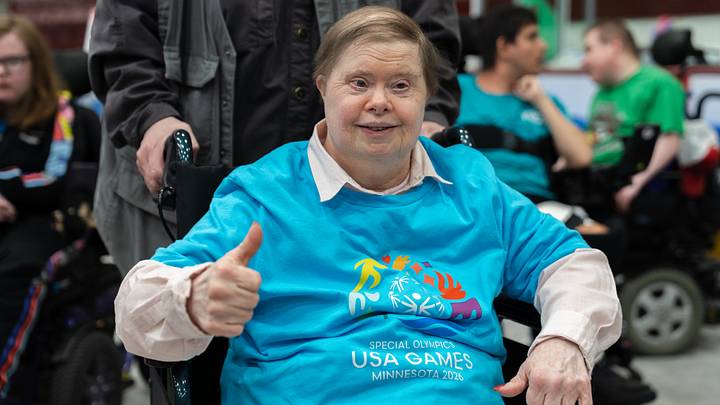
True Inclusion takes a lot more than just an open mind and a welcoming attitude. It takes work, planning, creativity and ... sometimes ... a whole lot PVC pipe.
The Motor Activity Training Program (MATP) demo at the Special Olympics 2026 USA Games featured dozens of athletes with profound intellectual disabilities and high support needs navigating adaptive stations that challenged their physical skills, but at a level that was just right for them. Like a PVC-pipe frame that hung a ball for an athlete to hit with a bat, or a PVC-pipe catapult that allowed an athlete to launch a bean bag at a corn hole board, simply by pulling on a rope.
"At the striking station," explained Brock Banos, senior manager of delegation and sports services for Special Olympics North America, "You have everything from a ping-pong-ball sized paddle where you're hitting a ping pong ball, it's a small ball. You also have a set-up where you're hitting a beach ball with a tennis racket. But maybe an athlete can't pick it up. We have a station where you can actually blow the ball with a leaf blower if you can just press the button."

The idea is to meet every athlete where they are, no matter how profound their disability or complicated their health needs. MATP focuses on what an athlete CAN do, not what they can't do, and provides opportunities for them to build and grow their skills. And — to be fair — not every activity station involved PVC pipe.
The myriad stations were clustered around four physical skills — kicking, striking, dexterity and mobility — and the activities at each station were meant to mirror each of the 16 different sports that are part of the 2026 USA Games. For example, the striking station included activities that were adapted from golf, pickleball, softball, tennis and volleyball. Some of these activities are common and you'll see them at many MATP events, but others are one-offs, which is part of the fun.
"What I've loved about MATP is how creative you can be," said Banos. "It is very individualized. What we normally see out of a lot of our programs is they have a challenge day where they're able to work with their athletes for 6 to 8 weeks leading up to it. They learn the athlete, they learn where they are. They know where their skill set is so that they can continue to push them."
That creativity comes into play adapting sports specific skills, sometimes literally building the materials you need from the ground up. Expertise can be just as important as creativity which is why a lot of the staff who support MATP work in related fields like physical therapy, recreation therapy and adaptive physical education. And they don't always know the athletes. MATP also hosts "Try Days" like this demo, where new athletes get a chance to experience the program and hopefully find something that keeps them coming back.

"We make sure that we have options for everyone to participate," said Banos. "And the goal from an event like this is actually so that when they leave here, they can actually begin training in their local programs. A lot of our state programs or programs across Canada or the Caribbean have these trial events and then when they leave, their local program now knows the ability level and what they need to work on."
That interface between the expertise and resources at state or national programs and those at the local level can be one of the biggest challenges with growing MATP. These athletes are unique with unique needs and programs are naturally clustered where there are the most athletes, which can be hard depending on where you live.
"Sometimes we see barriers with transportation, having to travel long distances," said Banos. "Some of our programs that are not in metropolitan areas, more rural, you have longer distances to go. That can be a barrier to participation, but Special Olympics International has done a great job providing more resources recently so that we can start to grow these programs across the board — resources that you can use at home, resources you can use in a school setting, in a community setting, to encourage everybody, no matter who they are, to to do this program."
These programs are often powered by the enthusiasm and energy of volunteers, people who see a need and take the initiative and step up to help. Over half of Special Olympics programs at the state-level are offering MATP but, according to Banos, most programs have a staff member dedicated to MATP. If you're interested in learning what it might take to help expand the program into your area, all you need to do is reach out to your local Special Olympics office.

Whether you're the friend or family member of someone who could benefit from MATP, a medical professional looking for ways to get more out of your specialized knowledge, an amateur engineer with a passion for PVC, or just someone who would just like to make some new friends and spread some positive energy — MATP has something to offer.
Remember, the program is not about what's the best. It's about what's your best. Or, as Special Olympics Chairman Tim Shriver said in his opening remarks, "In our world, the definition of greatness is giving everything you have."
Why We Play features stories about the power of sports to bring us together, overcome obstacles, make positive change and reach everyone. Read more here.
 Add us as a preferred source on Google