
Key Points
Bullet point summary by AI
- Three athletes from different backgrounds converged at the 2026 Special Olympics USA Games in Minneapolis.
- Each started as competitors seeking inclusion but evolved far beyond the playing field.
- Their journeys reveal how the organization transforms athletes into advocates, mentors, and leaders.
On paper, Special Olympics athletes Vince Egan, Garrett Utz, and Kristine Hughes don't have much in common.
They found Special Olympics in different ways. They're involved in different sports. They come from different backgrounds. Their stories couldn't be more different if they tried. Yet somehow, all three ended up using their opportunity to prove that sports are really just the beginning.
At the 2026 Special Olympics USA Games in Minneapolis, their stories offer a glimpse into what keeps athletes coming back to compete year after year. Because while sports might've been the initial stepping stone, they're almost never the reason they stay.
Before they were leaders they were competitors

Long before they became mentors, advocates, and leaders within the Special Olympics organization, all three started out as competitors. They were just looking for a place to play, an opportunity to compete and an environment where they felt included.
Kristine joined after learning she had an intellectual disability later in life, even though sports had already played a major part in her life well before then.
She competed in tennis, soccer and softball throughout high school and college. And because Kristine eats new challenges for breakfast, she even spent a summer serving as a forest firefighter with the California Conservation Corps and serving in the United States Navy — because why not. But through every chapter of her life, athletics remained a constant.
“The sports got me through the hard parts of my life,” Kristine said.
Meanwhile, Garrett's introduction couldn't have been more different.
While on spring break in San Diego during college, he received an out-of-the-blue Facebook message from a friend who needed players for their soccer team. What seemed like a simple "hey, can you help me out," quickly turned into a path Garrett could not have seen coming.
“I said, sure, why not?” Garrett recalled. “And 10 years later, here we are."
Here we are indeed, just officiating soccer for the 2026 USA Games. If the Garrett of 10 years ago could see where present Garrett is now, he probably wouldn't believe it.
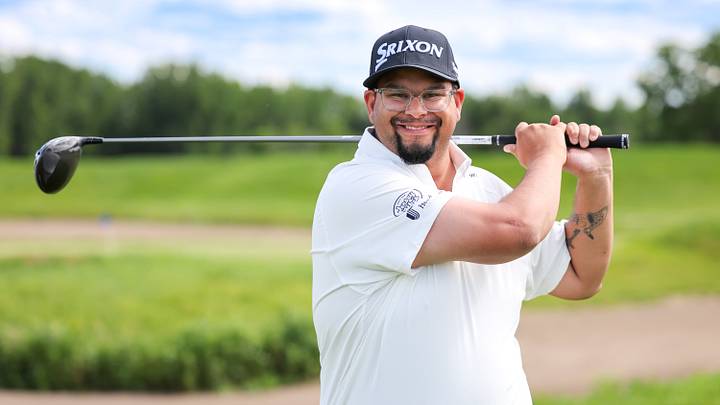
Vince's journey began at a Law Enforcement Torch Run over two decades ago. That single event led him to become a multi-sport force of nature. Over the years, the 2026 USA Games golf official has taken the field -- or the slopes -- in golf, alpine skiing, soccer, flag football and tennis. Like Kristine and Garrett, he arrived looking for an opportunity to compete.
Looking back now, it's easy to focus on where their journeys ultimately brought them. But at the time, none of them were thinking about leadership positions, mentoring fellow athletes, or helping shape the future of the movement ... at least not right away. They were there for the same reason athletes all around the US sign up every year: They wanted to play and feel included.
Why Special Olympics became more than a place to compete

What happened next looked a little different for each athlete. For Vince, the competitions eventually took a backseat to the people he used to compete against.
“It’s not about the disabilities,” Vince said. “It’s more of the ability to have the opportunity to do your own sport and have an opportunity to share that to our community.”
It's a feeling that was shared throughout all three of their stories. Garrett was thinking he was just going to help out his buddy's soccer team, but over the years he found something much bigger than playing striker on the pitch.
“If you’re passionate about sports, if you’re passionate about being in a group of people with inclusion, the sky’s the limit,” Garrett said.
The more he became involved, the more he realized Special Olympics was not simply about what happened between the lines. It was about the people who showed up before, during, and after it. Coaches. Teammates. Volunteers. Fellow athletes.
As for Kristine, her experience challenged assumptions she had spent years tackling out in the world.
“The world sees us that we’re not capable,” Kristine said. “And that’s not fair.”
Through Special Olympics, she saw a very different reality unfold.
“These athletes are very capable of doing things,” she said. “They’ve just got to be given that opportunity.”
The friendships, support systems and opportunities they found throughout the organization won't be measured by a scoreboard or a boxscore. Those experiences eventually became the starting point for everything that happened next.
The athletes became advocates mentors and leaders

For all three athletes, there eventually came a point where their focus and priorities changed. It stopped being just about what they were getting out of Special Olympics and became about what they could do to pay it forward to the next generation.
Garrett is a perfect example of how that happens.
“Without Special Olympics, my life would not be where it is now,” Garrett said. “And so I think it’s me saying, 'hey, now it’s my turn to give back.'”
That mindset can be found throughout Special Olympics, but few stories show it quite like Kristine’s. What began as an athlete competing in events eventually grew into something so much bigger. She became an official. A Global Messenger. A speech coach. An athlete leadership manager.
And today, she serves as an Assistant Technical Delegate, helping oversee volleyball competitions at some of the largest Special Olympics events in the world. The woman who once believed there was “no way in heck” she would ever stand in front of a room and speak now spends much of her time helping other athletes find their own voice. Her mission is simple.
“If we don’t get athletes in those roles, other athletes may never see that there’s other opportunities,” Kristine said.
Whether it's athlete leadership, officiating, coaching, public speaking or event operations, she wants athletes to see possibilities they may never have considered before. Because sometimes all it takes is seeing somebody else do it first.
That same spirit exists throughout the entire Special Olympics community. Athletes become role models. Competitors become mentors. Participants become leaders. And at some point, many find out they are capable of far more than they ever imagined.
Sports were only the stepping stone

Sports might have been the common denominator that originally brought Vince, Garrett, and Kristine to Special Olympics.
But the reason they stayed, had almost nothing to do with finishing first, second, or third. Over time, competition gave way to something a whole lot bigger and more meaningful.
Vince found a community built around ability and opportunity. Garrett found a place where inclusion is an every day thing. Kristine found a path that carried her from athlete to advocate to mentor to leader.
None of them could have known where their first step would lead, but they all took it.
It led to friendships.
It led to confidence.
It led to leadership.
It led to careers.
It led to purpose.
And somewhere along the way, sports became only part of their stories.
Their stories are different. Their journeys are different. Yet each one points to the same truth. Special Olympics is so much more than what you see on the field. It's about what happens when athletes are given the chance to grow into the absolute best versions of themselves and be put in positions to help others do the same.
If we're not looking out for one another, what are we even doing?
While medals and podium finishes are settled on the field, the most important victories happen behind the scenes and long after the games are over. For Vince, Garrett, and Kristine, Special Olympics became something much bigger than sports.
Why We Play features stories about the power of sports to bring us together, overcome obstacles, make positive change and reach everyone. Read more here.
 Add us as a preferred source on Google