
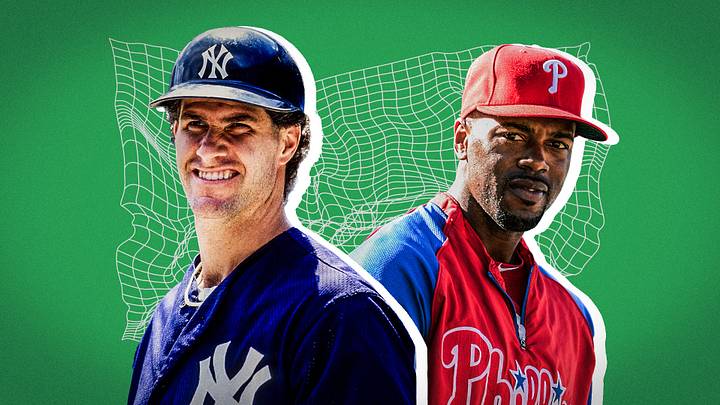
Baseball still has a special place in our hearts, and we know it does because you’re here reading this fun little article about cult heroes. Every other sport has stars, but baseball builds regional stars that turn into stars in the city. Even with Jalen Brunson’s championship, Aaron Judge is still the King of New York and can get any seat in any restaurant. Shohei Ohtani is one of the most popular athletes in any sport.
Even some of the smaller stars are beloved in their city. Pete Crow-Armstrong just put forth one of the best seasons we’ve ever seen, and he is beloved in Chicago. Bobby Witt is one of the most popular people in Kansas City. Juan Soto is … erm maybe skip that one.
That said, we love our historic stars more than anything. Growing up watching those greats is better than anything we can think of. And those guys are still on our minds even today. Which guys are going to make the list? These are the players we would get into shouting matches about if anyone underrated them. We would not let a soul slander them, because he was our guy.
1. Barry Bonds: San Francisco Giants
We understand that starting with Barry Bonds might feel absolutely wild for this list, but that’s because it’s very likely you are not a San Francisco Giants fan. The Giants fanbase would play in traffic if it would make Bonds’s life a little easier. They stan for this man, and why shouldn’t they? He’s probably the greatest marvel in the history of the sport. He didn’t have the attention that the 1998 Home Run Race had, but he has the home run record. All of them, actually.
And that mattered to Giants fans. It might not matter to the Baseball Hall of Fame for a myriad of reasons, but Bonds’ demeanor and stature (and his rumors about performance-enhancing drugs) never bothered Giants fans. They only cared about Bonds dragging his team to the World Series and putting up the most ridiculous performance in the history of the championship (.471 batting average, 1.294 slugging percentage, four home runs, and 13 walks).
To this day, Giants fans welcome Bonds with open arms. His antics in another uniform likely doesn’t lead to the same result. However, the Giants fans are fiercely loyal to the players who are loyal to them. Bonds has a reputation, but he never forced his way out of the Bay Area. He embraced it, and they embraced him.
2. Don Mattingly: New York Yankees

Don Mattingly was one of the best baseball players of the worst generation of New York Yankees baseball. How does one rectify that? Well, Yankees fans, who are often irrational about winning and the players who never got them there, treat Don Mattingly completely differently. They not only embrace him, but they celebrate him and yell at Cooperstown for not putting him in the Hall of Fame.
Mattingly played with the Yankees from 1982 to 1995. His final numbers aren’t insane or anything. He had 222 home runs and finished with a .307 career batting average. He won one batting title and one MVP in is career. He is a six-time All-Star, a three-time Silver Slugger, and a nine-time Gold Glove award winner. Mattingly was as effective as any first baseman of the era.
Mattingly might be the best defensive first baseman in the history of the sport. He showcased his glove as much as his bat, and he was as gritty as they come. Mattingly felt like a microcosm of the Bronx. He was scrappy and fought through injuries, which shortened his career. The fact that the Yankees started their 90s dynasty the year after he retired has probably helped his standing with the fanbase.
3. Jose Cruz: Houston Astros
Jose Cruz was the first Houston Astros star, and we never forget our first (baseball star). The Astrodome spent most days filled with CRUUUUUZZZ chants, a staple during those early years. He stuck with Houston through the lean years and eventually turned it into a reliable playoff contender.
His first All-Star season coincided with the Astros’ first playoff run. During the NLCS against the Philadelphia Phillies, he hit .400 with four RBIs, six hits, eight walks, and just one strikeout. Not bad for your first playoff appearance! Cruz is a legitimate star for a team that needed one.
Cruz would play with the Astros until 1987, before signing with the Yankees (and eventually getting released). He went on to serve as a special assistant and community outreach ambassador, solidifying his time with the Astros franchise even further. He was the Astros until the days of Jeff Bagwell and Craig Biggio. He put the new team on the map and set up for an era of great players. The Astros retired his number 25 jersey in 1992, allowing generations of Astros fans to know his story.
4. Paul O’Neill: New York Yankees
On a team with Derek Jeter, Jorge Posada, Mariano Rivera, and Bernie Williams, Paul O’Neill always stood out. No water cooler was safe when he was around, and Yankees fans loved that level of passion. He was very reliable both at bat and in the field. He had a knack for understanding the game at another level, doing things like drawing walks when a pitcher is reeling, setting up the rest of the lineup for success.
When it was clear that O’Neill was going to retire, the fans took time out of cheering for a World Series victory to give him his own standing ovation. He was a dominant figure during a dynasty in the most important franchise in sports. The Yankees love winners. They haven’t won nearly as much since O’Neill retired in 2001, and that’s only helped his legacy grow.
Jeter only has one World Series without O’Neill. His clutch hitting and impeccable fielding pushed him to another level of fan favorite. After he retired, Yankees fans would boo anyone wearing number 21. It’s no wonder the Yankees finally retired the number in 2022, more than two decades after he retired.
5. Felix Hernandez: Seattle Mariners
King Felix was one of the most electric pitchers of his time. His stuff was NASTY, and the Seattle Mariners loved baseball once every five days. This isn’t the best era of Mariners baseball, but between Ichiro Suzuki and Felix Hernandez, there was always a reason to tune in.
Hernandez received Cy Young votes in six of seven years from 2009 to 2015. He was as dominant as they come. He won the 2010 Cy Young and finished second twice. He regularly hit more than 200 strikeouts, and he finished in the top 10 in MVP voting in 2014. His fastball was insane, and he could drive pitch counts in his favor almost always.
We will talk about loyalty a lot on this list, but Hernandez takes the cake in that category. He probably could have made more money, and he definitely would have had more playoff appearances if he played for another franchise. He was so popular, he had his own fan section. The King’s Court was a must for any Safeco Field attendee. Any star player who got his own section deserves a spot on this list.
6. Yadier Molina: St. Louis Cardinals

Cult heroes come in all shapes and sizes. They can be with a team for a few years, or they can spend two decades in one city. There are few players who have become an entire franchise’s personality, especially a franchise with the history of the St. Louis Cardinals, like Yadier Molina. He became synonymous with Missouri baseball. He was not only one of the most popular players in St. Louis, but he was beloved across baseball.
It helped that he played catcher, one of the most visible positions in the league. Molina wasn't always the flashiest player on the field. He wasn't hitting 50 home runs a season or chasing batting titles. Instead, he built his legacy through a grit that really fit the personality of the Cardinals fanbase. Loyalty, leadership, and defensive excellence made him one of the most respected catchers of his generation.
Molina spent his entire 19-season Major League career with the Cardinals, helping the franchise win two World Series championships in 2006 and 2011. In an era when players frequently changed teams and free agency dominated the conversation, Molina remained a Cardinal. He didn’t need to make the most money despite 10 All-Star Games and nine Gold Gloves. He just needed the Cardinals, and the Cardinals needed him. Still, to this day, it’s weird to see the lineup without him in it.
7. Kyle Schwarber: Philadelphia Phillies
It feels strange putting a current player on here, but this feels incomplete if it doesn’t have Kyle Schwarber on it. This has every element we want from a cult hero. Schwarber chose the Philadelphia Phillies, a city that is known for… rationality. Being real, Phillies fans are some of the most passionate in the league, and while they will tell you how they feel in the moment, they will also defend you to the end of the Earth, and there’s no player in their city today they will defend more than Schwarber.
Just look at the Home Run Derby this past season. Fans were excited to see Bryce Harper hit at Citizens Bank Ballpark, but they were ecstatic to see Schwarber hit some dingers. He got a rousing ovation.
Prior to joining the Phillies, Schwarber bounced around. He appeared to be another Adam Dunn type: a guy with immense power who struck out way too much. After stops with the Chicago Cubs, Washington Nationals, and Boston Red Sox, Schwarber signed a four-year deal with the Phillies. He’s been an All-Star three times since. He’s led the National League in home runs three times since joining the Phillies in 2022, and people love him for his ability to crush the baseball. Few players have been embraced in the City of Brotherly Love as much as Schwarber.
8. Sean Casey: Cincinnati Reds
There’s just something about Sean Casey. He felt like the adult in the room at all times. When chaos hit Cincinnati, Casey brought levity to the situation. He never got too hot or too cold. Fans called him "The Mayor," and honestly, there might not have been a more fitting nickname in baseball.
Casey arrived in Cincinnati before the 1998 season in a trade that initially raised plenty of eyebrows. The Reds had dealt Opening Day starter Dave Burba to Cleveland for a young first baseman with very little major league experience. It didn't take long for that decision to look like a steal. Do you remember Mr. Burba? Probably not, but Casey's hitting ability sticks in many minds. Casey brought an infectious personality and a dangerous bat, even if his focus was more on volume over flash. He quickly became a fixture in the lineup and a favorite among Reds fans.
He would make three All-Star teams during his Cincinnati tenure, establishing himself as one of the National League's most reliable hitters. But the numbers were just part of the story. His personality is what drew Cincinnati, a smaller town in terms of sporting cities, to him for so long.
9. Michael Young: Texas Rangers
Every franchise has that one player who represents an entire era of baseball. Michael Young represents the Texas Rangers about as well as anyone in the 21st century. Long before Texas won a World Series, Young built the foundation that led them there. He wasn't necessarily the flashiest superstar in baseball, but in Arlington, he was the reason to go to the ballpark.
He didn’t start his career with the Rangers. The Baltimore Orioles drafted him first, but when he didn’t sign, the Toronto Blue Jays drafted him. In 2000, he was traded for Esteban Loaiza. It’s not considered one of the worst trades ever. Young gave the Rangers 13 seasons of reliable superstardom, and Loaiza was out of the Blue Jays organization by 2002.
What made Young such a beloved figure in Texas was his willingness to put the team ahead of himself (we’re sure you’re sensing the selfless theme that comes with this list, well, outside of Barry Bonds). When the Rangers needed him to move from second base to shortstop, he did it. When Elvis Andrus arrived and the organization wanted to give its young star the position, Young moved to third base. Later, he accepted other changes to his role as the roster evolved. Young was the leader and the star, but he was also the putty that filled the gaps in the roster. He was whatever the Rangers needed him to be.
10. Robin Yount: Milwaukee Brewers

Robin Yount was one of the best baseball players in Milwaukee Brewers history, and yet he often feels like one of the most underrated superstars of his generation. How does one rectify that? Brewers fans, who have spent decades waiting for their team to get over the hump and win a World Series, have always had a special place for Yount. So many stars shone and quickly faded, from Prince Fielder, Ryan Braun, and even Christian Yelich to the very incredible, but short, run of CC Sabathia; most Brewers superstars come with a prominent “but.” That’s not the case with Yount, and that’s why he’s the cult member of the Brewers.
Yount might be the ultimate symbol of Brewers baseball. He started his career as a teenage shortstop and eventually moved to center field, proving he could excel just about anywhere on the diamond. He was the kind of player fans could watch grow up with the franchise, and his loyalty made him an icon in Milwaukee.
Yount helped lead the Brewers to their first American League pennant in 1982, coming within one win of a World Series championship. The fact that he spent his entire career in Milwaukee and became the first Brewer inducted into the Baseball Hall of Fame only strengthened his place in the hearts of Brewers fans.
11. Mark Buehrle: Chicago White Sox
The most popular pitchers of most eras dominated with 99-101 MPH fastballs, insane off-speed pitches, and just ridiculous “stuff.” Mark Buehrle never really hit 90 on the radar gun. Rather than relying on high velocity, Buehrle relied on a rapid pace of play, pinpoint command, and mixing his speeds and locations to induce weak contact. He would have been perfect for the pitch clock era. Or, it might have destroyed him. Either way, he was a marvel for the Chicago White Sox, becoming one of the most unlikely number-one starters of his era.
That’s why he’s a cult hero to White Sox fans. For one, they have that syndrome where they feel like imposters in their own city, competing with the Cubs for fans in Chicago. Buehrle played with the White Sox from 2000 to 2011. It’s interesting how many players kind of stuck around with the White Sox. Players like Frank Thomas, Eddie Collins, and Paul Konerko are a few examples across eras that stuck with the White Sox despite a lack of postseason success (well, not so much for the latter).
Buehrle gave Chicago its first World Series championship in 88 years. He became the first pitcher in World Series history to start and save consecutive games, earning a no-decision in Game 2 and his first career save in Game 3. That was an insane decision by Ozzie Guillen, but it worked out. And now, Buehrle is a legend.
12. Johan Santana: Minnesota Twins
Johan Santana was a true ace for the Minnesota Twins. He wasn’t just one of the 30 best pitchers in the league; he was the Twins' top guy. Santana was probably the league's best pitcher for a time. He led the league in pitching WAR for three straight years. Santana won two Cy Youngs and even got MVP buzz during the 2004-2006 stretch. He was untouchable, both theoretically and literally.
2004, Santana went 20-6 with a 2.61 ERA and 265 strikeouts, putting together one of the best seasons by a starting pitcher in franchise history. He followed it up with another Cy Young campaign in 2006, leading the league in wins, ERA, and strikeouts. He did it all with a lackluster demeanor. Somehow, that was endearing to the fanbase. He never got too hot or too cold, and that’s very Minnesota.
He was eventually traded to the Mets, and he was dominant for a short time before injuries really hurt his impact. He pitched the Mets' first no-hitter, a known missing piece of their history. However, it took 147 pitches to do it, and he was never the same after that. The “what if” that consists of keeping Santana in the Twin Cities will always live over his legacy.
13. Richie Ashburn: Philadelphia Phillies
Richie Ashburn was one of the most beloved players in Philadelphia Phillies history, becoming a fan favorite during an era when the franchise was still searching for an identity. Phillies fans have always appreciated players who know how to play the game, and Ashburn did just about everything right. And unfortunately, they never put any type of supporting cast around him. This is why people in Philadelphia talk about him like he’s Mickey Mantle.
Ashburn played with the Phillies from 1948 to 1959. He finished with 2,574 hits and a .308 career batting average, won two National League batting titles, and made five All-Star teams. His biggest claim to fame was carrying that Phillies team to the 1950 pennant. They were swept by the Yankees in the World Series, but just getting there meant everything to that city.
Unfortunately, they never got close again with Ashburn on the roster. The Whiz Kids were a short-lived phenomenon. After retiring, he returned to the Phillies as a broadcaster, extending his resume for more modern-day fans.
14. Ozzie Smith: St. Louis Cardinals

The Wizard is one of the greatest nicknames in sports because there are few nicknames that fit better than the one that describes Ozzie Smith. The St. Louis Cardinals shortstop was the best ever at the defensive side of his game. He had moments when we wanted the Cards to strike out just so we could see the best part of the game, which is the marvelous moves of Smith. He was doing what the Savannah Bananas are doing, but in a Major League Baseball game.
Smith wasn’t known for hitting 30 home runs or putting up huge RBI totals. Smith played with the Cardinals from 1982 to 1996 after beginning his career with the San Diego Padres. It remains one of the biggest fumbles of the 1980s. While the Padres were desperate for an identity at that time, the Cardinals got to be fun for almost two decades.
His range, instincts, and ability to make throws from seemingly impossible angles made him a constant source of excitement at Busch Stadium. He also knew how to entertain a crowd, famously performing a backflip during his introduction on Opening Day. That moment became part of his identity, but it was the consistency of his defense that made him so valuable to the Cardinals. Smith helped lead St. Louis to three National League pennants during his time with the team, and his presence became synonymous with Cardinals baseball.
15. Harold Baines: Chicago White Sox
Dependability is the key indicator of a great cult hero. Someone who was both clutch and consistent, and we knew he would step up in big moments. Harold Baines had the situation handled. Baines didn’t demand attention, but we’re giving it to him because of how good he was. If he were boisterous or dominated the headline cycle, we might be having a different conversation.
Baines became a fan favorite because he was a professional in every sense of the word. He rarely disappointed fans on or off the field, and he consistently produced at the plate. Baines would play the outfield or serve as the designated hitter. He played the game with no ego, and that is why he’s a legend on the South Side. Teddy Roosevelt once said, “Speak softly and carry a big stick.” That big stick is a baseball bat, and Baines carried it well.
The White Sox retired his No. 3 in 1989. He was still an active player! Years later, his election to the Baseball Hall of Fame through the Today's Game Era Committee sparked plenty of debate among baseball fans, but it also underscored the lasting respect he earned throughout the game. Baines spent much of his career in Chicago, returned to the organization after retirement, and remained a recognizable figure for decades after his final game.
16. Lance Berkman: Houston Astros
Lance Berkman might be the most interesting name on the list, because he missed the peak of the Houston Astros twice. He missed their current championship-level peak, and he missed the best years of Craig Biggio and Jeff Bagwell. Still, he joined that Astros team that built the Killer Bs, and that might still be the most fun era of Astros baseball. No garbage can necessary.
Berkman was one of the most productive hitters in Houston Astros history, and he was a big reason the franchise became a serious contender in the National League during the 2000s. Berkman was clutch and dangerous at the plate. Those are fans two favorite attributes for players on their team. They don’t care if you strike out with the bases empty as long as you crush the ball when men are in scoring position. Berkman earned his reputation by driving in 100+ runs seven times in 12 seasons in Houston.
The fact that Berkman played so well and never got MVP consideration only builds on the cult following. He should have been in those conversations every year, but he was always on the outside looking in. And that’s why the Astros’ dynasty means so much. Their players are thought of aptly, but they are also still criminally underrated.
17. Mike Piazza: New York Mets
Mike Piazza was a star when he came to the Mets. He was traded from the Dodgers to the Marlins, and just days later, he was headed to Queens. It was a strange season, but he was already a six-time All-Star. He was well on his way to becoming the best power-hitting catcher in league history. He came to the Mets to bring star power to the Big Apple.
And he did just that. Unlike many of the Mets’ massive contracts or trade pieces (looking at you, Bobby Bonilla), Piazza might be the one who worked out better than anyone. He showed up to Shea Stadium, crushed balls all over the ballpark, and left a legend. Piazza was not even in New York as long as you remember. He was only there for eight years. He felt like he was there so much longer.
His moments were unforgettable. His home run after the September 11th terrorist attacks remains one of the greatest sports moments of all time. He brought the Mets to the 2000 World Series which was a Subway Series with the Yankees. He dominated when he did play the Yankees, clearly taking sides in the rivalry. He even fought Roger Clemens, which many wanted to do during that era.
18. David Wright: New York Mets

As crazy as it sounds, David Wright felt like the King of New York during his peak. As Derek Jeter’s peak began to wane, Wright was on the rise, and while they played for different franchises (and nobody really wanted Alex Rodriguez to take the mantle), He quickly became one of the city's most famous players, especially in Queens. The Mets were always given the “little brother” moniker for so long, but Wright was finally giving the Mets someone to love.
At his peak, Wright was a 30-home-run, 100-RBI guy. He’s a seven-time All-Star and two-time Gold Glove winner. Wright had all the statistics that a fan favorite should have, but his loyalty and
To this day, Mets fans still opine about the glory days of David Wright. Part of that is that the end of his career was stolen away by injuries. But Wright never wore another jersey, starting and ending his career with the Mets. He wasn’t some guy who came for the money or left for the glory. He believed in the Mets, and the fans reciprocated the feeling.
19. Boog Powell: Baltimore Orioles
Boog Powell was one of the most recognizable players on some of the best Baltimore Orioles teams in franchise history. When we see many of these teams win championships with stacked rosters, there’s always a player who has been here through thick and thin. Powell was there before the 1966 and 1970 championships.
He earned four All-Star selections and won the American League MVP award in 1970. That season, Powell hit .297 with 35 home runs and 114 RBIs, helping lead the Orioles to a World Series championship. He also played a key role on Baltimore’s 1966 and 1971 pennant-winning teams, making him a fixture during one of the most successful periods in the franchise’s history.
Powell delivered, which is the easiest way we can explain it. There hasn’t been much of a core to celebrate since then, which is why his legacy continues to stay relevant in Baltimore.
20. Joe Carter: Toronto Blue Jays
“Touch em all, Joe.” It’s one of the most iconic calls in the history of sports. Joe Carter hit a home run that won the Toronto Blue Jays the championship. He didn’t spend much time in Toronto, but that championship meant everything to the city. Before the Blue Jays, Carter had an up-and-down career. He made the Wichita State University Pizza Hut Shocker Hall of Fame, but beyond that “honor,” awards and recognition were few and far between.
Carter was starting to make headway in his career, but when he turned 30, the Blue Jays sent him away. In his first year north of the border, Carter made his first All-Star team. It was one of five All-Star appearances, and he won his first Silver Slugger award.
Interestingly enough, Carter’s overall numbers in those two postseason runs weren’t legendary. His OPS was actually under .800 in both runs. However, the moments were legendary. He technically ended both World Series, catching the final out of the 1992 World Series. Then, there’s the home run. With Rickey Henderson and Paul Molitor on base, Carter came up with the Jays down by one run in the bottom of the ninth of Game 6. It was the Jays' final home game, and Carter crushed the ball over the wall. It was a no-doubter, and Toronto was a back-to-back champ.
21. Mike Sweeney: Kansas City Royals
Mike Sweeney is another example of the small cities facing the big spenders with homegrown stars. Kansas City was never outspending the Yankees or the Red Sox, but they could develop players. And Mike Sweeney was their Sisteen Chapel of development. He was exactly what a team needed in the American League at the time. He was always on base, could hit the ball a mile, and he could hit the ball perfectly with runners in scoring position.
In 2000, Sweeney officially became a star. That season, he had 144 RBIs. That put him in the conversation with George Brett for the greatest seasons in Royals history. Since then, Salvador Perez and Bobby Witt Jr. have joined him. His contributions didn't stop there, though he never reached those heights.
Sweeney became the first player to wear the captain’s “C” on his jersey, a distinction that was deserved for what he brought to this franchise. At the end of his Royals career, he was able to say goodbye, which is rare for a player with some time left. He took out a whole-page advertisement thanking the city, and he got a standing ovation in his final home game. Sweeney was beloved. He still is.
22. Torii Hunter: Minnesota Twins

There are certain moments in baseball that become bigger than the game itself. They become part of a city's identity, even if it doesn’t happen in that city. For Minnesota Twins fans, Torii Hunter's robbery of Barry Bonds in the 2002 MLB All-Star Game was one of those moments. It was at Milwaukee’s Miller Park, and Hunter went back to the center field wall in the first inning, had the vertical of a basketball player, and stole a moment from a man who has countless of them in his career.
Another guy who could be on this list, Kirby Puckett, is the reason why Hunter feels so important to the franchise. For an entire decade, it felt like someone was missing. Hunter and Puckett are very different players, but they were embraced one in the same.
In the early 2000s, Hunter won his first Gold Glove, hit 27 home runs, and became one of baseball's most exciting players. He made his first of five All-Star teams in 2002, and he wouldn’t make it again until he joined the Angels. It just goes to show how underappreciated the stars of the Twins were in this era, and pretty much all eras.
23. Eric Chavez: Oakland Athletics
Eric Chavez was one of the defining faces of the A's during their early-2000s resurgence. He was a left-handed power hitter who could change a game with one at-bat and a Gold Glove-caliber defensive play that he made look routine. He was the homegrown star who emerged alongside the Moneyball-era Athletics, helping turn a small-market franchise into a perennial contender. Somehow, despite all of that, Eric Chavez never made an All-Star team.
Seven consecutive seasons with at least 20 home runs and four seasons with 100 or more RBIs wasn’t enough to the get the recognition he deserved. Even with the “every team has a player representative” rule, the A’s fan favorite did not get a chance to represent his team on a national stage.
The early-2000s Athletics were known for Billy Beane and his antics to get a low-budget team to contention through scouting and savvy signings had this homegrown star for most of their run. And he stayed there for 13 seasons, showing a commitment that no other A’s player had at this time. Hopefully, his story remains when the Athletics settle in to Vegas.
24. Chase Utley: Philadelphia Phillies
This honestly should be three players. Philadelphia Phillies fans will fight you if you say a bad thing about Ryan Howard, Jimmy Rollins, or Chase Utley. Honestly, today's Phillies, who might be just as talented as those teams, are still paying attention to the 2000s team. That’s because they won a World Series, and this team has not (although they got close).
There was something about Utley that made him the top cult hero, and that’s probably why the Phillies recently called to see if he'd be willing to return to Philadelphia as their next manager (which ended up going to Don Mattingly, another guy on this list). He was one of the defining players of the Philadelphia Phillies’ golden era, becoming a fan favorite in a city that has always appreciated players who leave everything on the field.
This is the team with the most losses in MLB history, playing in a city that, prior to the 21st century, had the longest history of losing. The Phillies jump-started all of this. All of the Eagles' championships. LeBron James coming to Philly. The Flyers… never mind. It started with this trio of players coming to Philadelphia and dominating. And that 2008 World Series and the 2009 pennant will live on forever, just like Utley’s legacy.
25. Andrew McCutchen: Pittsburgh Pirates
Seeing Andrew McCutchen in another uniform just felt wrong. Don’t get us wrong; it felt inevitable. This is the Pittsburgh Pirates. We expect star players to leave the Steel City as ownership tries to keep the roster together like it’s trying not to pay an ATM fee. Two dollars to take out my own money? No thank you. And that’s how McCutchen ended up on the Yankees, Giants, Phillies, and Brewers. When McCutchen returned in 2023, he was home.
McCutchen first played for the Pirates from 2009 to 2017. All five of his All-Star selections came during this run, and his MVP performance stands the test of time for Pirates fans and Pirates fans only. McCutchen finished the 2013 regular season batting .317 with 21 home runs and 87 RBIs. It’s a very… strange MVP selection, but it matters to Pirates fans.
See, McCutchen brought the only relevant era of Pirates baseball in decades. This is an area of America where they still make their baseball team appointment television. Win or lose, the Pirates are on, and people are watching. So, when a player comes in and takes them to relevance, he will be THE guy forever. We expect to see a retired number in PNC Park as soon as Cutch retires.
26. Jon Lester: Boston Red Sox

When Jon Lester joined the Red Sox, the monkey was already off their back. That entire 2004 Red Sox team is a cult hero. Dave Roberts, Curt Schilling, Pedro Martinez, Manny Ramirez, David Ortiz, Johnny Damon, Jason Varitek, Kevin Millar, Trot Nixon, etc. etc. etc. all never have to pay for a dinner in Boston ever again. However, this franchise never settled. They didn’t win that one and let things fall apart, as the Cubs, White Sox, Angels, or Washington Nationals did. Jon Lester was a big reason for that.
Lester won three championships in his career. Two were with the Red Sox, and one was with the Cubs, allowing him to go to two cities with free drinks. And it all could have gone to hell if the Red Sox really did include him in the rumored Alex Rodriguez deal. During his rookie season, he was diagnosed with Lymphoma, getting the fans even more behind him.
That battle and the way he battled on the mound became his calling card. He wasn’t overpowering with his stuff, but he knew exactly what pitch to throw and when. Just months later, he won his first World Series, pitching in the defining Game 4 against the Rockies. His career is built by moments, including his 2016 NLCS MVP (albeit with the Cubs) and his 2008 no-hitter.
27. Omar Vizquel: Cleveland (Guardians)
During the late 1990s, there was this fun discussion about who the best shortstop in baseball was. Derek Jeter had the glitz and the glamour of New York. Alex Rodriguez was the five-tool player who did everything right. Miguel Tejada was playing with flair on a team that kept getting ironic headlines. Nomar Garciaparra was the grit-and-grime type player who didn’t take no for an answer.
Vizquel played for Cleveland from 1994 to 2004, helping the club reach the postseason in six consecutive seasons from 1995 through 2001. He won eight of his 11 career Gold Glove awards while with the Indians and made three All-Star teams. He played a ridiculous 24 years during his career, so he had a lot of years with different teams, but his time with Cleveland was his peak.
Vizquel became a fan favorite because he made defense an event of its own. His range was remarkable, his hands were reliable, and his ability to throw from awkward angles made him one of the most entertaining shortstops of his generation. He also brought a playful personality to the field, occasionally flipping the ball into the air or making difficult plays look almost casual. Honestly, we wish he could have had a double-play tandem with Ozzie Smith.
28. Endy Chavez: New York Mets
Endy Chavez was never a superstar, never an All-Star, and never the scariest guy in the lineup, but he just kept making plays. It felt like catching lightning in a bottle, but Chavez’s career was so fun to watch. And that’s the main thing here; he was incredibly fun for a city that usually rejects fun on the baseball field. This is the city of George Steinbrenner. For a few weeks every year, it seems like it was taken over by Endy Chavez.
Chavez played for the Mets from 2006 to 2008, by far the shortest time of anyone on the list. Mets fans still talk about losing him. Chavez never needed a long résumé to earn a place in Mets fans' hearts, but he did need one play.
His defining moment came in Game 7 of the 2006 National League Championship Series against the St. Louis Cardinals. With the Mets trailing by two runs in the sixth inning, Scott Rolen hit a deep drive to left-center field that looked destined to become a home run. Chavez raced back, leaped at the wall, and made an incredible catch before throwing the ball back toward the infield to double off Jim Edmonds. It was a jaw-dropping play that briefly gave the Mets a chance to swing the game in their favor, even though they ultimately lost the series.
29. Luis Gonzalez: Arizona Diamondbacks
Getting a walk-off hit is great. Doing it in the World Series is even better. Doing it off Mariano Rivera and sending the New York Yankees home disappointed was beyond comprehension. In Game 7 of the 2001 World Series, with the bases loaded in the bottom of the ninth, Luis Gonzalez stepped to the plate. It was already one of the most exciting World Series of all time, but it was going to go up a notch.
He was a productive hitter for years, but his place in baseball history was secured with one swing that changed the future of an entire franchise. Interestingly, we forget that Gonzalez spent much of that season in a home run race with Barry Bonds. He “fell off” as Bonds hit 73 home runs that season, but Gonzalez still put up one of the best seasons of that era.
Gonzalez played for the Arizona Diamondbacks from 1999 to 2006 and became one of the National League's most consistent hitters. He finished his career with 2,591 hits, 354 home runs, and a .283 batting average. But it’s still that one clutch moment against the greatest closer in the history of baseball that remains his legacy.
30. Fernando Valenzuela: Los Angeles Dodgers

Even with everything going on with the Dodgers in this current era, there was something about Fernando Mania that had us going back to the “Glory Days.” Fernando Valenzuela was more than a pitcher for the Los Angeles Dodgers. He was a phenomenon who captured the attention of an entire city and became a hero to millions of baseball fans, particularly within the Mexican American community in Southern California.
When Valenzuela arrived in the majors in 1981, nobody could have predicted the excitement he would generate. Fans packed Dodger Stadium to watch a young left-hander with an unusual delivery, a remarkable assortment of pitches, and a habit of looking toward the sky before every throw. What followed became a cultural moment that made Valenzuela one of baseball's most recognizable athletes and made his stories one we continue to tell today.
In his first season, he won the Rookie of the Year, the Cy Young, and led the Dodgers to a matchup with the Yankees in the World Series, in which they won. No wonder they love him! His career did not sustain, but the moments meant more than a 300-win career could have done.
 Add us as a preferred source on Google