
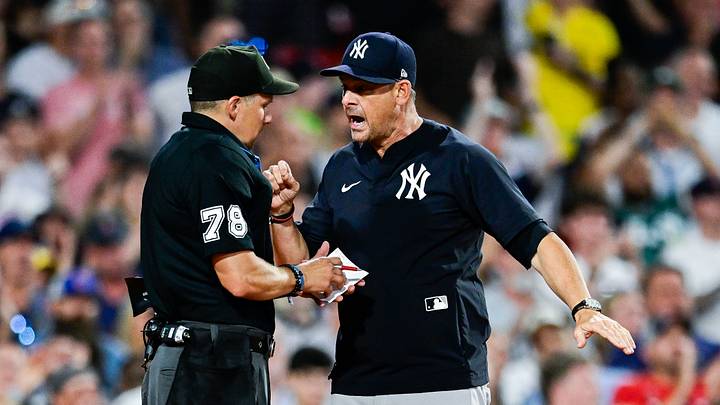
Key Points
Bullet point summary by AI
- A New York manager faced mounting criticism after a series of baffling decisions in a crucial extra-inning game.
- His refusal to use a reliable bench option in the 10th inning and a questionable bullpen choice in the 11th cost the team a winnable contest.
- With the team mired in a deep slump, the front office now faces a pivotal decision about whether to make a change in leadership.
Look, I really don't want to be a prisoner of the moment here. It's important not to overreact over the course of a long and winding MLB season, and it's also all too easy to place the blame at a manager's feet when things inevitably go wrong. It's not primarily Aaron Boone's fault that his New York Yankees have now lost seven in a row after falling to the Detroit Tigers in extra innings on Wednesday afternoon; if New York wants to get back on top of the AL East, they're going to need Aaron Judge, Giancarlo Stanton, Max Fried, Trent Grisham and others to come off the IL sooner rather than later.
And yet ... sometimes a mistake is so crippling, so mind-bogglingly poor, that it's hard to come back from. Which brings us to Wednesday's debacle, in which the Yankees manager appeared to be actively sabotaging his team's attempt to win — a baffling series of errors for which he has to be held accountable.
Aaron Boone's blunders in latest Yankees loss are downright inexcusable

For most of the game, New York was once again moribund offensively, held scoreless through eight innings and trailing 2-0 with just three outs remaining. But then came a miraculous rally: first a homer from Amed Rosario, and then Jazz Chisholm Jr. singled, stole second and third and came home to score on a wild pitch. Suddenly, miraculously, the Yankees had life.
It seemed like their losing streak would finally come to an end just one inning later, after Fernando Cruz held Detroit scoreless in the top of the 10th and a sac bunt from Jose Caballero put the winning run 90 feet from home with only one out. That's when Boone decided to fall asleep at the switch: Rather than bring a reliable situational hitter like Paul Goldschmidt off the bench, the manager instead decided to let No. 9 hitter Oswaldo Cabrera take his at-bat. Cabrera promptly struck out, as did catcher Ali Sanchez to end the threat.
But wait, there's more! In the top of the 11th, Boone stood by and watched as Camilo Doval melted down, allowing three straight walks and a three-run single — all with two outs. Plenty of options, notably lefty Tim Hill, remained in the bullpen, and yet Boone opted for none of them, instead watching an eminently winnable game go up in flames.
Lest you thought, there's a reasonable explanation for these decisions — maybe Goldschmidt was dealing with some sort of injury, or a bout of the food poisoning that reportedly ripped through the Yankees clubhouse this week — don't worry: He made sure to tell reporters afterward that this is exactly how he wanted the game to play out.
Paul Goldschmidt was available off the bench. Had confidence in Cabrera to get the job done there.
— Chris Kirschner (@ChrisKirschner) July 1, 2026
Generally speaking, managers are all-too-convenient punching bags. While their in-game tactics can certainly have a bearing on the results of individual games, for the most part it's the players on the field — and the executives who built the roster — who are responsible for a team's fate. This, though, is about as clear-cut as you can possibly get. Cabrera just came back from Triple-A and was hitless in eight at-bats; Goldschmidt has been one of New York's most reliable hitters all year long. Sure, it would've created defensive issues if he came up empty and the game continued into the 11th, but how is that not a worthy gamble to take — especially when your team is desperate for a win?
The idea that Boone sat back and determined that Cabrera gave the Yankees their best chance is so indefensible that it can scarcely be believed. It's rarely good process for a team to make such a significant decision based off of one particular piece of evidence, but how can Boone keep his job after this? A manager's job is to put his team in the best possible position to succeed and to help right the ship when things go wrong; Boone was 0-for-2 on Wednesday in a way that genuinely 95 percent of the general population would have managed to get right. New York has too much riding on this season to let that sort of mistake slide.
 Add us as a preferred source on Google