
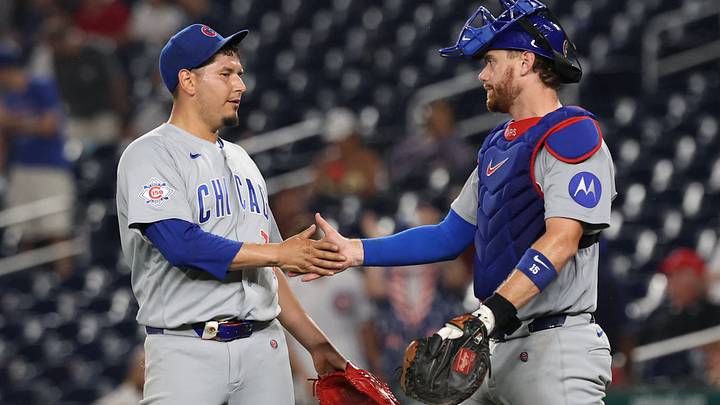
The margin for error in the MLB postseason is incredibly slim. As we saw in last year's playoffs, one mistake (like, say, giving up a home run in the ninth inning of Game 7 to Miguel Rojas or not getting a good enough jump off third base) can send you home. There's a real possibility that making a mistake with MLB's new ABS system can cost you a game — and therefore, your season.
Given that harsh truth, which playoff teams are best suited to handle the pressures that come from introducing ABS into October? Let's dive in.
ABS success rate of MLB playoff teams
Below is a look at how teams performed with the ABS system during the regular season and where they ranked against their peers.
MLB Playoff Teams | Regular Season ABS Success Rate | Overall MLB Rank |
|---|---|---|
Atlanta Braves | 53.1% | 17th |
Boston Red Sox | 54.8% | 11th |
Chicago Cubs | 58.9% | 4th |
Chicago White Sox | 49.4% | 28th |
Cleveland Guardians | 48.7% | 29th |
Houston Astros | 52.2% | 20th |
Los Angeles Dodgers | 54.5% | 14th |
Milwaukee Brewers | 52.8% | 19th |
New York Yankees | 54.7% | 13th |
Philadelphia Phillies | 57.4% | 7th |
San Diego Padres | 50.1% | 25th |
Tampa Bay Rays | 52.8% | 18th |
There are a couple of standout teams, like the Chicago Cubs and the Philadelphia Phillies. There are also a few teams that stand out for the opposite reasons, like the Cleveland Guardians, Chicago White Sox and the San Diego Padres. For the most part, however, the postseason-bound clubs ranked in the middle of the pack at challenging in the regular season.
Playoff teams to feel good about with ABS

As mentioned above, the Cubs and the Phillies should feel rather confident when using ABS, and a big reason for that has to do with their catchers. For Philadelphia, J.T. Realmuto hasn't been producing much at the plate, but he has gone 71-for-93 challenging behind the plate. He's won 76 percent of his challenges this year, which ranked sixth in the Majors. None of the five catchers in front of him challenged more than 11 pitches, showing just how impressive Realmuto was in the regular season.
For Chicago, Carson Kelly went 64-for-93 (69 percent) and Miguel Amaya went 50-for-77 (65 percent). Both of them were as efficient as any catcher not named Realmuto, and you'd be hard-pressed to find a more efficient tandem behind the plate.
With that being said, these teams aren't perfect by any means. For example, no hitter has lost more ABS challenges than Bryce Harper, who was unsuccessful on 26 of his 47 challenge attempts. Michael Busch went just 7-for-20, proving to be as inefficient as any position player who challenged at least that many pitches.
Playoff teams that need to be careful when using ABS

Just like there are playoff teams we should trust almost fully when using ABS, there are some we should be second-guessing. For that, look no further than the Guardians, who ranked second-to-last in overall success rate. Their hitters ranked 26th in the Majors, thanks largely to guys like Chase DeLauter and Travis Bazzana winning less than half of their attempts on fairly large sample sizes.
The White Sox are one of the worst teams in this regard as well, but that should be taken with a grain of salt. Chicago is the only team that finished the season with more lost challenges from their catchers than successful ones. A big reason for that has to do with Edgar Quero (49 percent) and Drew Romo (46 percent) struggling mightily. Well, neither Quero nor Romo is the primary catcher for the White Sox. That's Kyle Teel, who was correct on 35 of his 66 challenges (53 percent). That isn't great, but it's better!
An underratedly awful team to keep an eye on is the Atlanta Braves. They rank 17th overall, which isn't awful, but their hitters have a 41.7 percent success rate, which is dead last in the Majors. Matt Olson went just 6-for-20. Guys like Michael Harris II, Ozzie Albies and Mauricio Dubon also struggled. If you don't see the Braves challenge many pitches at the plate, their regular-season struggles might be why.
 Add us as a preferred source on Google