
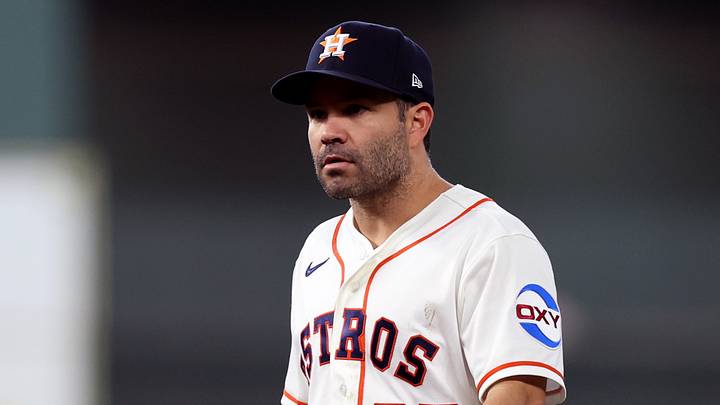
For a brief moment on Wednesday afternoon, the AL West-winning Houston Astros looked like they were on the verge of channeling their 2017 form. Jose Altuve smashed a fifth-inning home run to left field, bringing the Astros within one run of the Chicago White Sox.
But these were the 2026 Astros, the team that stumbled into the postseason at 81-81 and had looked overwhelmed in their Game 1 loss. Immediately following Altuve’s homer, the White Sox responded with second baseman Chase Meidroth’s three-run blast in the top of the sixth. Chicago held on for a 7-3 win and clinched its first ALDS appearance since 2021.
Changes are certainly coming in Houston, and lead baseball executive Dana Brown already left the organization in August. Joe Espada spent the year managing in the final year of his contract, and the first-round playoff exit won’t help his case to stick around. The only reason Altuve is safe is that he wisely signed a long-term contract two years ago.
So what went wrong for the Astros? When building lists like these, it’s incredibly easy to fall into the “revisionist history” trap. Although the Christian Walker signing hasn’t exactly gone as planned, the context and timing of the move — not to mention the three-year, $60 million contract itself — made sense.
But some moves, when you look at them objectively after the fact, warrant a conversation, though this first decision isn’t among them.
Why did the Houston Astros overpay Jose Altuve?

The answer is most likely sentimentality winning out over common sense, and we can’t blame Altuve for accepting a five-year, $125 million contract in 2024, just months before beginning his age-34 season.
Look, we understand wanting to keep Altuve in Houston until retirement. He still has an outside chance at 3,000 hits, and he very well might become the final player to join that exclusive club. But even in a non-capped sport, you don’t pay that much money to someone his age, especially when he already has a no-trade clause.
Even factoring in his Game 2 home run, there’s no arguing that Altuve has become dead weight for the Astros. He finished with a 0.0 bWAR and a .701 OPS, the latter marking his worst since 2013.
Would firing Joe Espada earlier have helped the Astros?

As we said in the intro, some of Houston’s decisions aren’t as simple as “they were wrong.” Bringing back Espada following the 2025 season, when the Astros finished 87-75 but missed the playoffs, stirred some mild debate at the time. Eyebrows were raised further when management let him spend this year as a lame-duck manager.
If anything, the Astros should have fired Espada over the summer. They were 47-54 and four games back in the AL West on July 19; by then, both the Red Sox and Phillies had salvaged their seasons after making managerial changes in April.
That’s nothing personal against Espada, of course. But it’s hard not to wonder what could have happened if the Astros had switched managers and played well enough to earn the AL’s No. 2 seed instead of Cleveland.
The Astros failed to build a consistent rotation

Allowing Framber Valdez to walk is part of the problem here, though it’s not the sole cause. Cristian Javier has missed much of the last three years to injury, and Lance McCullers Jr. had a Las Vegas-style residency on the IL before being traded to Milwaukee earlier this year.
The Astros gambled on Hunter Brown and a ragtag group behind him, and their reward was a 4.45 ERA that ranked seventh-worst leaguewide. For perspective, the White Sox and Cubs finished second-worst in ERA (4.12) among the 12 postseason teams.
Critiquing the Tatsuya Imai signing falls into the aforementioned revisionist history narrative, though it raises a significant conversation ahead of the winter. There’s a trend leaguewide of Japanese starting pitchers — Imai, Roki Sasaki, the Rockies’ Tomoyuki Sugano, and the Mets’ Kodai Senga, among others — struggling with control and workload. Could that affect how MLB teams approach the posting system moving forward?
Taylor Trammell and the Houston Astros’ lack of depth

We mentioned this after the Astros’ Game 2 loss, but the fact that Trammell — a journeyman outfielder with a lifetime .182 average and .626 OPS — worked his way into 100 games (counting the Game 1 loss to Chicago) is a glaring indictment of Espada and Brown. How can you justify keeping someone around who had -0.6 bWAR? Oh, and Trammell entered the season with -0.6 bWAR over 178 career games.
The issues are far deeper than just Trammell’s presence. Outfielder Brice Matthews mustered a .587 OPS and 31.8 percent strikeout rate in nearly 250 plate appearances. Cam Smith gets a slight pass for being a full-time starting right fielder at only 23 years old, but Houston should have had a better backup outfield option for someone who had a .279 on-base percentage.
But hey, the Astros know best.
 Add us as a preferred source on Google