
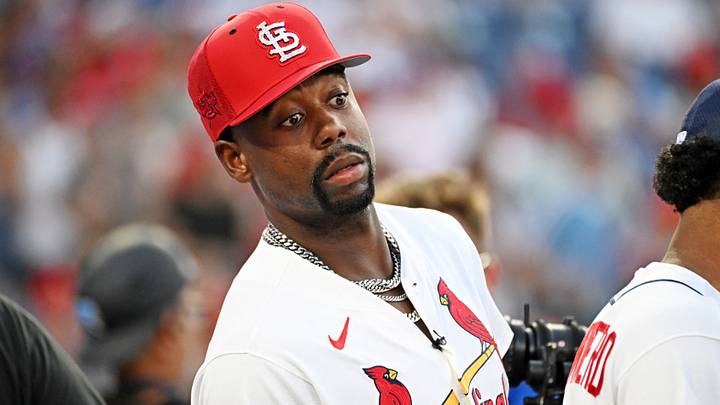
As Jordan Walker hoisted the Home Run Derby trophy this past July, we imagine that those around the St. Louis Cardinals felt their mouths hurting from the strength of their grins.
But you know what they say about smiles, right? They’re nothing more than an upside-down frown.
And to say that the Cardinals are likely grimacing feels generous. Walker has seen his power completely evaporate in the second half, and he entered the season’s final week with only six homers, 26 RBIs, and a .680 OPS in nearly 250 plate appearances over that time.
Now in fairness to Walker, he did hit .305 with five homers and 18 RBIs in August. But that means he’s been dreadful for the other 33 games since play resumed on July 17.
So much for the happy faces around Busch Stadium.
Should the Cardinals be concerned about Jordan Walker?

There’d be plenty of instances where our answer would be an immediate “no.” All-Star selections, especially those who participate in the Home Run Derby, are often prone to slumps later that year. Then-Phillies outfielder Bobby Abreu immediately comes to mind, having won the 2005 Derby but managing just six homers and a .787 OPS — well below his lifetime .870 average — over the second half.
And although Abreu remained a steady hitter for the next six seasons, he never exceeded 20 home runs or 4.0 bWAR in that time. There’s a reason why he went from a potential shoo-in for the Hall of Fame to a divisive candidate among voters.
Honestly, even that feels too unrealistic to be a best-case scenario for Walker. Let’s not forget he was worth -2.6 bWAR and had a .680 OPS through his first three years. So the second-half counting stats are more in line with what most of us would have expected entering the season.
Even in a best-case scenario, Walker profiles as a long-term fourth outfielder lacking the consistent power needed for a full-time DH role. The same goes for his lack of plate discipline, and he’s almost exclusively played right field in the majors.
We’ve repeatedly said that all is forgiven with a championship, but the Cardinals aren’t exactly close to contending. They’re still leagues behind the Brewers and Cubs in the NL Central, and that’s not even factoring in the Braves, Phillies, Dodgers, and Padres. Heck, even the Reds feel like more of a 2027 playoff threat than the Cardinals.
The best thing the Cardinals have going for them is that Walker never signed a long-term deal. He’s under team control through 2030, and there’s no reason for management to offer him a team-friendly extension this coming winter.
Could a trade save Jordan Walker’s career?

Much like when your computer runs into issues, a hard reset sometimes works best for all parties. Walker is still young enough that he could fetch a decent return, albeit one unlikely to feature any top-100 prospects.
But if you’re a contender like the Yankees or Braves who’d benefit from additional outfield help, do you really want to take a chance on Walker? That’s especially true for those in major media markets; if he can’t play well in St. Louis, then why have faith that he’d thrive in New York or Los Angeles?
And to be clear, we don’t necessarily blame Walker. There have never been any credible allegations about his work ethic or maturity. He’s well-respected enough that the Cardinals nominated him for the Roberto Clemente Award.
But the second half has exposed Walker for who he is: a disappointing outfielder prone to the occasional hot streak, but nothing more. Talk about a frustrating outcome.
 Add us as a preferred source on Google