
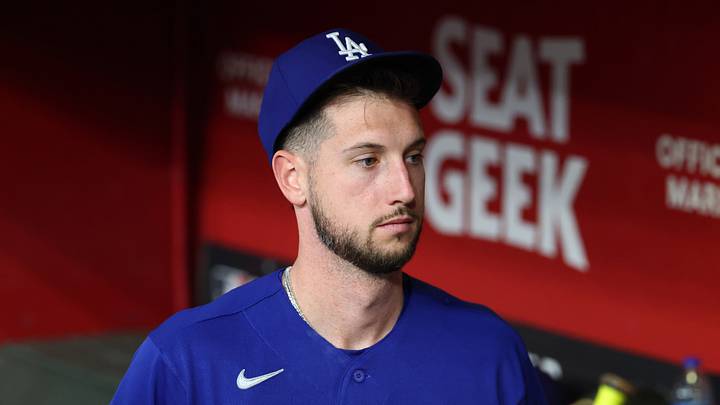
Even the best MLB front offices stumble into the occasional mistake. From the high-spending Los Angeles Dodgers, to savvier markets like Arizona or Atlanta, there are plenty of expensive "stars" who could factor negatively into the postseason race.
Let's focus on six names in particular — all making north of $20 million this season — who are working against their teams' competitive aspirations right now.
3B Austin Riley, Atlanta Braves

Contract details: 10 years, $212 million ($21.2 million AAV)
Austin Riley has always taken an aggressive approach at the plate, but he was once able to compensate for a lot of strikeouts with a .303 average (and .898 OPS) back in 2021. That started a stretch of three straight top-seven MVP finishes for the third baseman, which rightfully earned him a hefty chunk of change.
Riley has gradually fallen off these past couple years, however, reaching a new low in 2026. He's hitting .222 (with a .214 expected average) and has ballooned to a career-worst 31.4 percent strikeout rate. Riley can still generate hard contact and put a ball over the fence, with 15 homers and 58 RBI on the season, but he's extremely volatile on a night-to-night basis. His .663 OPS and 83 wRC+ are also career-worst numbers; in fact, he has never posted a sub-.700 OPS over a full season. Unfortunately, this feels like a worrying trend that might stick for the Braves third baseman.
LHP Eduardo Rodríguez, Arizona Diamondbacks

Contract details: four years, $80 million ($20 million AAV)
After two miserable seasons with an above-5.00 ERA to begin his Diamondbacks tenure, Eduardo Rodríguez was born anew in 2026. He made his first All-Star appearance, with a sterling 2.71 ERA and 1.21 WHIP across 25 starts and 149.1 innings. Few pitchers have been more durable and consistent in terms of results.
And yet, Rodríguez's below-the-hood numbers leave room for skepticism. The Diamondbacks rotation in general is quite unstable, with Rodríguez working overtime all season to keep them afloat. Corbin Burnes' imminent return could help, but counting on an aging star fresh off Tommy John surgery is not without risk.
Rodríguez does not miss many bats. He has done a solid job of limiting hard contact, but opponents put the ball in the air regularly and Rodríguez — according to the metrics, at least — has benefitted from extreme batted-ball luck. His expected ERA (4.72) and opposing batting average (.266) both point to inevitable regression. Opponents are hitting .193 against his fastball, compared to .287 a year ago. That has been the major change in his success, with Rodríguez commanding his primary offering far more successfully. Just know that, when the rubber meets the road in October, he will look more vulnerable than the baseline stats suggest.
DH Giancarlo Stanton, New York Yankees

Contract details: 13 years, $325 million ($25 million AAV)
Giancarlo Stanton has begun a running program and is expected to rejoin the Yankees lineup in time for the playoffs — not unlike last season, when the former MVP made a triumphant and productive late return. But while the 36-year-old remains more than capable of slugging up a storm, it's fair to wonder at what point the wheels fall off.
Stanton is going to run the bases in slow motion. He is already a full-time DH, which complicates the setup for New York after acquiring a second left-handed hitting first baseman in Luis García Jr. at the deadline; you cannot bench Ben Rice, and Paul Goldschmidt remains dominant as a right-handed platoon option. For all of Stanton's power, his 34.2 percent strikeout rate was among the highest in MLB last season. He is prone to extended cold spells as a result. Given the mounting injury rust on top of what is already a boom-or-bust profile, Stanton's return may not be the salve Yankees fans expect.
RHP Aaron Nola, Philadelphia Phillies

Contract details: seven years, $172 million ($24.6 million AAV)
Aaron Nola has now allowed 30-plus home runs in three of the last four seasons. He has a 5.33 ERA and 1.45 WHIP, which are slight improvements on 2025's numbers (although his expected ERA has crept up from 4.13 to 4.26). He still has 138 strikeouts in 130.0 innings, with a signature knuckle curveball that tumbles out of the zone with great deception. But any time Nola dials up a fastball, he's putting himself at risk.
Nola has put together a solid month or so, looking more like the semi-dependable fourth starter the Phillies so desperately need. But it's probably a mirage. Nola is basically a one-pitch pitcher, but Philly isn't willing to completely nuke the fastball diet. And he still needs the heater to set up the curve, while his very solid changeup is only thrown 15 percent of the time — a distant fourth in his arsenal.
He has the highest qualified starter ERA in baseball and is prone, as ever, to serving up meatballs and letting runs pile up quickly. There's still something left in the tank, but until Nola dramatically reworks his approach — which probably won't happen this season, and may never happen — the Phillies can't rely on him in big spots.
OF Kyle Tucker, Los Angeles Dodgers

Contract details: four years, $240 million ($60 million AAV)
It speaks to the Dodgers' absurd spending power that Kyle Tucker has completely tanked on one of the largest annual contracts in MLB history and Los Angeles is still the heavy favorite to win a third straight World Series title. Tucker's struggles feel like a blip on the radar in L.A., but a rotten August has at least put a spotlight on the 29-year-old, who's especially inconsistent at Dodger Stadium (.558 OPS at home this season).
Tucker's recent skid — one hit in his last five games — has brought his season-long OPS down to .693 with a 95 wRC+. He's a below-average hitter right now; his strikeouts are up, his walks are down and the underlying metrics basically confirm the eye test. Tucker just isn't hitting the ball as hard nor as consistently as he has in the past.
Factor in increasingly worrisome gaffes on defense, and it feels like Tucker is in his own head. Whether he can course correct with all the pressure inherent to a Dodgers World Series pursuit remains to be seen, but the Tucker signing has turned into an abject disaster that even the two-time defending champs can't ignore.
LHP Framber Valdez, Detroit Tigers

Contract details: three years, $115 million ($38.3 million AAV)
Framber Valdez was a late and surprising addition for the Tigers, who sought another ace to complement Tarik Skubal ahead of his potential final season in Detroit. Well, the Tigers wound up trading Skubal to Los Angeles at the deadline after a disastrous first half of the campaign, only to rebound in dramatic fashion this month and reenter the wide-open AL Wild Card race.
The youth movement in Detroit's rotation has taken center stage, with Troy Melton, Jackson Jobe and Keider Montero all flashing major talent. But Valdez has become more of a liability than a stabilizer, with a 4.35 ERA and 1.39 WHIP plus 111 strikeouts in 138.2 innings.
Valdez's appeal has always been rooted in durability and consistency. Prior to this season, he put together four straight years with at least 176 innings pitched and a sub-4.00 ERA. He's still a tremendous ground-ball pitcher who benefits from a stout Tigers infield, but Valdez is giving up a lot of hard, loud contact, with opponents slugging .424 against his sinker (compared to .376 last season). It seems like the 32-year-old may be on the downswing of his career at the most inopportune time, as Detroit rarely shells out so much cash.
 Add us as a preferred source on Google