
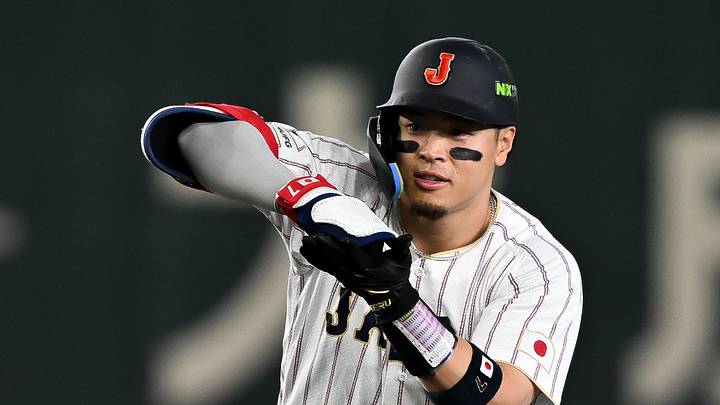
This year's MLB free agent class just got a much-needed boost on the position player side, as word broke on Monday that the Hanshin Tigers had agreed to post star third baseman Teruaki Sato — clearing the way for Japan's reigning Triple Crown winner to jump to the States this offseason.
Sato's numbers are eye-popping: a a .306/.383/.609. slash line with 39 homers and what will almost certainly be his second straight MVP award. That was enough for our own Robert Murray to rank the slugger all the way up at No. 4 in his list of the top 26 free agents available this winter, calling him "the best power hitter on the market".
That power, plus his corner profile defensively, makes comparisons to last year's star Japanese import, Munetaka Murakami, all too easy. But just what sort of market might Sato command, and where might he wind up? Here's everything to know.
Teruaki Sato to be posted: What happens next?
First, let's go over just exactly what "posting" means. When an NPB player decides he wants to come to the Majors, he requests to be posted — i.e., to be made available to big-league teams as a free agent. His Japanese team has the right to either grant or deny that request. If the request is denied, the player remains in NPB until next offseason; if the request is granted, MLB's commissioner is notified, and the player gets set to enter free agency.
The Tigers granted Sato's request. Whenever that decision becomes official, a 45-day window is initiated in which that player can negotiate and sign a contract with any Major League team. If that window comes and goes without a deal being reached, the player reverts back to his NPB team for one more year. If the player does reach an agreement with an MLB club, his Japanese team is compensated in the form of a posting fee — an additional sum of money on top of the new contract, much like a transfer fee in soccer.
How much that posting fee is worth depends on how much the contract is worth. If it's $25 million or less in total value, the posting fee is 20 percent of the deal. If between $25 million and $50 million, it's 20 percent of the first $25 million plus 17.5 percent of the value exceeding $25 million. And for all deals worth more than $50 million, it's 20 percent of the first $25 million, plus 17.5 percent of next $25 million, plus 15 percent of everything exceeding $50 million.
Sorry, we should've warned you that there'd be math involved. But let's walk through an example to help make things clear. When Yoshinobu Yamamoto signed his $325 million contract with the Los Angeles Dodgers after the 2023 season, L.A. also had to pay his NPB team, the Orix Buffaloes, a posting fee of $50.65 million — $5 million for the first $25 million, $4.4 million for the next $25 million and $41.25 million for the remaining $275 million. So that's a total outlay of more than $375 million, when combined with the actual contract.
So, how much will teams be willing to pay for Sato's services? That all depends on how much you believe in his power — and how much you'll overlook some red flags in his profile, much like Murakami had before he came over.
Teruaki Sato's scouting report has echoes of Munetaka Murakami

Sato doesn't have quite the prodigious pop that Murakami has, but he's pretty much Japan's next best thing in that department. When he gets a ball in his wheelhouse, he does major, major damage. (He's also much more than a one-year wonder; he hit 40 dingers last season.)
Of course, Sato shares some of Murakami's red flags as well. Like Murakami, he's spent most of his career to date at third base but will likely have to shift over to first (or, at best, left field) in the Majors. And like Murakami, he's got real swing and miss concerns; his 66 percent contact rate this year was in the bottom third of NPB hitters, and well below the 77 percent MLB average. Translate that against even tougher pitching, and it's fair to have questions about whether he'll whiff too much to get that power into games consistently.
We asked those questions about Murakami too, which is why he had to settle for a short-term deal with the Chicago White Sox. It's worth noting that there is a difference betwen the two: Whereas Murakami hardly ever chased, most of Sato's contact issues come from chasing outside the zone, a product of an extremely aggressive approach at the plate. After seeing Murakami fade in the second half of this season due to whiff concerns, will front offices be similarly ambivalent about paying Sato?
He'll turn just 28 years old in March, and with the dearth of impact bats available this winter — especially impact bats in their 20s — don't be surprised if his market really picks up steam, swing-and-miss be damned.
Most likely Teruaki Sato landing spots in MLB free agency

New York Mets
Enough ink has been spilled about the disaster that was the Mets' first-base situation this season in the absence of Pete Alonso. Jorge Polanco is still under contract for one more year, but New York can't possibly rely on him for regular at-bats in 2027 given his injury history. Plus, they could always cycle Sato through the DH role if need be. This team needs more power, however they can get their hands on it, and Sato figures to not command quite as much as other big corner bats like Randy Arozarena and Seiya Suzuki.
New York Yankees
Granted, this one comes down to where you think Sato's ultimate defensive home will be. If he's not viable at third base, the fit here becomes very wonky: Aaron Judge, Spencer Jones, Cody Bellinger and Heliot Ramos have the outfield corners well-covered, and there's Ben Rice, Luis Garcia Jr. and Giancarlo Stanton to account for at DH. If they buy Sato's glove at third base, though — or if they, say, flip Jones in a trade for a center fielder or second baseman — then suddenly he'd be a pretty enticing in Yankee Stadium.

Philadelphia Phillies
The Phillies need to get younger, and they need to replace Alec Bohm's bat in the lineup. The lefty Sato wouldn't solve their right-handed problem, but he'd offer some much-needed length while also fitting in at either third base (pending top prospect Aidan Miller's development) or first base (pending where Bryce Harper winds up).
Detroit Tigers
Spencer Torkelson is a legitimate non-tender candidate in Detroit this winter, and there's a question mark in right field and at DH as well unless the Tigers want to give Colt Keith a very long leash. Sato has the power to play in the spacious confines of Fifth Third Park, and he should be affordable enough to fall into Detroit's price range.

St. Louis Cardinals
Jesus Baez will be coming sooner or later, but before then, there's a real question mark at third base in St. Louis — where Nolan Gorman simply cannot be given any more of a runway. Sato on a short-term deal would be kind of a perfect fit, and would give the Cardinals a pretty fearsome lineup behind Alec Burleson, Jordan Walker, Ivan Herrera, JJ Wetherholt and Joshua Baez.
 Add us as a preferred source on Google