
The NL West hierarchy is undeniably warped in favor of the reigning champs from Hollywood. But the Los Angeles Dodgers are not indestructible, despite appearances. Toronto outplayed them for the majority of the World Series. And the division as a whole, though unproven, offers several viable threats to L.A.'s crown.
The San Diego Padres are loaded with power bats and led by MLB's most aggressive front office. The San Francisco Giants are replete with quality defenders, and now have their cornerstone bat in Rafael Devers. The Arizona Diamondbacks are quietly deep across almost every position, with the means to improve. The Colorado Rockies — well, they're here too! Here's how each club can take that next, transformative step via trade.
Colorado Rockies: 1B Bryce Eldridge

The Rockies should look within their own division, to the Giants of San Francisco. Rookie first baseman Bryce Eldridge is reportedly on the block, for the right price. The 20-year-old made a brief MLB cameo last season, producing a 68.8 percent hard-hit rate and an 18.9 percent walk rate.
On the surface, it's unclear why exactly the Giants are willing to discuss a trade of their No. 1 prospect before he even reaches arbitration. But Rafael Devers' move to first base does complicate his path to consistent reps. Eldridge is a future Home Run Derby participant, boasting incredible raw power. The exit velocities are off the charts. He struggled to generate consistent contact during his first MLB stint — 3-for-28, seven walks, 13 strikeouts — but the underlying metrics paint a picture of imminent explosion. It's only a matter of time until Eldridge settles in and begins converting his consistent hard contact rate into eruptive results.
He'd immediately become the best prospect in Colorado's system and their Opening Day first baseman. Really, everyone is on the table. Keeping Ethan Holliday would be preferable, but there isn't anyone in that organization who is truly untouchable. Eldridge's profile would play extremely well at Coors Field and it's rare for such a major talent to become available so early in his contractual life. If Colorado can hammer out an early extension, that's the dream. Eldridge is the future star the Rockies so desperately lack. This combination of control and talent only becomes available once in a blue moon; Colorado should go above and beyond.
Arizona Diamondbacks: SP Hunter Greene

The Diamondbacks hope to welcome Corbin Burnes back by midseason after re-signing Merrill Kelly in free agency, but starting pitching remains a huge area of need. Their reported interest in Alex Bregman is an encouraging sign, as this front office is sneakily among the most aggressive mid-market front offices in the sport.
A potential Ketel Marte trade looms large. The Diamondbacks clearly took issue with Marte's manner of conducting himself in the locker room last season. Trading your best player in the middle of a competitive window seems less than ideal, but if the D'Backs can make the most of it, this roster still has the bones of a contender.
Arizona should at least explore the possibility of working Marte into the framework of a larger Hunter Greene trade with the Cincinnati Reds. Cincy needs the infield upgrade and would surely appreciate the mix of affordability and control Marte provides. Greene, meanwhile, is one of the best starters in MLB at 26 years old. He finished last season with a 2.76 ERA and 0.94 WHIP, notching 132 strikeouts in 107.2 innings.
Under control through 2028, with an exceedingly reasonable $21 million club option in 2029, Greene falls well within Arizona's budget and gives the Snakes another frontline arm to build the rotation around. In terms of contract length, age and statistical profile, Greene might be the best pitching asset available this winter. It would take a king's ransom to pry him out of Cincinnati, but it's Ketel Marte or a boatload of prospects, the D'Backs ought to place their bid.
San Francisco Giants: SP MacKenzie Gore

The Giants should put in a competitive bid for Tatsuya Imai, but it's unclear if Buster Posey actually has the necessary freedom to spend at that level. Trading for MacKenzie Gore qualifies as a strong alternative. The 27-year-old has a couple years of control left and some of the best swing-and-miss stuff in MLB.
It's clear that the Washington Nationals are ready to cash in and kick the can down the road when it comes to Gore, who'd never re-sign in DC. The Giants would have a much better chance of competing financially once Gore hits the open market. In the meantime, he offers two years of ace-level potential.
Robbie Ray is a free agent next winter, so building in contingency plans is the smart move. He forms an incredible one-two punch with Logan Webb (for now), but rotation depth is a point of weakness for San Francisco. Gore gives them a third postseason-level arm, leaning heavily on his fastball-curve combo to produce an 80th percentile K rate last season.
Gore has struggled to fully unlock his potential in DC, but a change of scenery should do him good. The Giants are closer to making noise in the NL West than a lot of folks realize, and Gore moves the needle substantially in the right direction.
San Diego Padres: SP Freddy Peralta

The Padres are marred in financial turmoil and fresh out of top prospects after their chaotic, all-in, and ultimately unsuccessful 2025 trade deadline. Mason Miller's sudden appearance in trade rumors is not the best sign of organizational health; San Diego dealt Leo De Vries, one of the best prospects in MLB, in order to control Miller — maybe the best closer in MLB — through 2029. There's no chance the Padres can receive comparable value in return.
That said, if A.J. Preller can smell the chickens coming home to roost, he needs to act desperately. Re-signing Michael King was a pleasant surprise, but the Padres still need pitching depth in lieu of Dylan Cease. Freddy Peralta probably represents San Diego's best chance at adding a genuine ace.
The Padres are hamstrung by their barren farm system — Milwaukee can expect a lot of fruitful offers for Peralta — but Preller has never shied away from an all-out, go-for-broke maneuver. On an expiring contract, Peralta's trade value is somewhat limited relative to Greene, Gore and other more controllable stars. That at least gives the Padres a hope, a prayer.
Last season was pure dominance from Peralta on the NL's No. 1 seed, completing 33 starts with a 2.70 ERA and 1.08 WHIP. Milwaukee is unlikely to extend him and has a long track record of flipping stars for depth and control. San Diego might only get him for a year, but Peralta moves the needle for a team virtually guaranteed to rank near the top of MLB in most offensive categories.
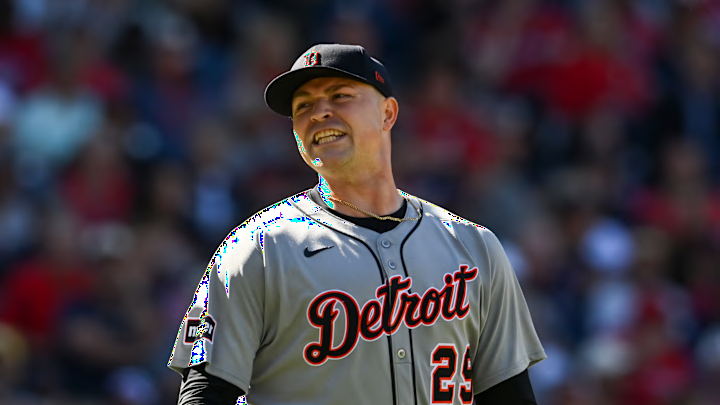
Los Angeles Dodgers: SP Tarik Skubal

The Dodgers continue to run laps around MLB. The Edwin Díaz signing was entirely predictable, and a reminder that this team is never out of the mix with star free agents. The Dodgers also happen to boast one of the best farm systems, giving GM Brandon Gomes ample trade ammo. Why not direct it at the offseason's biggest (potential) prize: Tarik Skubal.
Maybe the Detroit Tigers decide to let Skubal finish out his contract and focus all their efforts on winning in 2026, but there's strong incentive to cash in now. The odds of Skubal, a potential $500 million pitcher, re-signing next winter are practically zero. Meanwhile, the Dodgers offer an appealing collection of MLB-ready pitching (Emmet Sheehan, River Ryan, etc.) and up-and-coming bats (Alex Freeland, Zhyir Hope, Daulton Rushing, etc.). I'm not sure another team can outbid the Dodgers if motivated.
L.A. can also dangle Tyler Glasnow, himself an established, All-Star ace, to sweeten the pot or to replenish prospect depth in a separate deal. The Dodgers are one of the few teams that can operate with the confidence that re-signing Skubal is a realistic end goal. He won't find a better path to multiple World Series titles. He also grew up in California, so it's a homecoming of sorts.
Skubal, Blake Snell, Yoshinobu Yamamoto, Shohei Ohtani and Rōki Sasaki immediately becomes the most fearsome rotation in MLB — in addition to an explosive offense with endless postseason pedigree. Does this break baseball? Quite possibly, but there's nothing stopping the Dodgers from piling on, running up the tab, and schooling the rest of MLB for the next decade-plus.
More MLB news and analysis:
 Add us as a preferred source on Google