
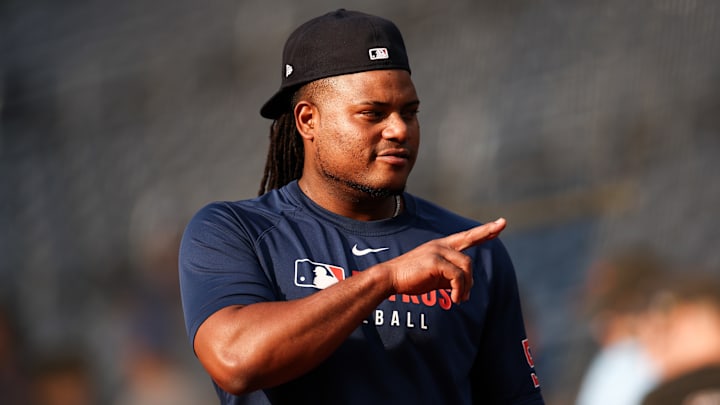
All the nine-figure MLB free agents are off the board, with the probable exception of All-Star southpaw Framber Valdez. We are at the point in free agency where the big spenders step back and the market opens up. That's not to say the Mets, Dodgers and others won't still swoop in for the occasional upgrade, but those teams have more or less concrete rosters. Members of the MLB middle class aren't so lucky.
That means one of the offseason's sweetest phrases — "mystery team" — will take center stage in the days and weeks ahead. Let's dive into some of the best remaining free agents and determine which teams could come out of nowhere to sign them.
1B Paul Goldschmidt: Arizona Diamondbacks

The Arizona Diamondbacks never fully replaced Josh Naylor at first base. Lefty Pavin Smith can hammer right-handed pitching, but the D-backs need a platoon option. Paul Goldschmidt is 38 years old and only has so much left in the tank, but he posted a .981 OPS against left-handed pitching in 2025. That's not too shabby.
His defense has declined with age, of course, but on a fundamental level, Goldy can still play the position or soak up the occasional matchup-based DH start for Arizona. This Diamondbacks team is closer to contending than most folks think. Goldschmidt can provide situational value on the field and a ton of intangibles and leadership skills in the clubhouse.
3B Miguel Andujar: Seattle Mariners

Miguel Andujar absolutely mashed last season, and while he vastly outperformed his metrics and is probably due for some regression, there ought to be plenty of interest in a flexible defender who can hit lefties especially well. The Seattle Mariners might be done with Eugenio Suárez experience; Andujar can pingpong between third base, the corner outfield and DH as needed, plugging multiple gaps and providing a slightly more consistent (if less explosive) offensive profile than Suárez.
Andujar's expected slugging (.383) fell almost 90 points short of his actual slugging (.470) last season, so again, temper expectations. But he's a smart hitter who doesn't strike out much, and the defensive concerns are less front and center when he's replacing one of the worst defensive infielders in MLB.
RHP Justin Verlander: San Diego Padres

Justin Verlander wants to pitch again. Common logic would point toward the 42-year-old former Cy Young winner landing on an established contender, which a lot of folks tend to read as New York, Los Angeles or Philadelphia. But the San Diego Padres remain right in the thick of contention on a yearly basis and AJ Preller desperately needs cheap innings to solidify his rotation. Verlander pitched 152 of 'em last season, with a healthy 3.85 ERA.
Expectations should be thoroughly tempered at this stage of Verlander's career. He's liable to get knocked around a bit, as his stuff just does not bite the way in did a decade ago. Even so, he's still in the league for a reason. This is one of the greatest pitchers in recent history and his level of command, poise and experience could deliver real value for a Padres team in need.
DH Marcell Ozuna: Cleveland Guardians

The Cleveland Guardians desperately need some pop to balance out their lineup. The "Guards Ball" philosophy can only get you so far, and Cleveland's wealth of technique and finesse has consistently proven moot in the face of more explosive lineups come October. Enter Marcell Ozuna, who'd no doubt like to join a contender. The Guardians won their division and don't have a particularly concrete plan with the DH spot.
Ozuna fell in and out of the Braves lineup last season, but he still hammered 21 home runs with a .756 OPS and 113 OPS+. The season prior, Ozuna hit .302 with a .925 OPS, notched 39 home runs and finished fourth in NL MVP voting. There's only so much value in a mid-30s righty DH, but Ozuna still generates lots of hard contact and could far exceed the value of his contract for Cleveland in particular.
RHP Chris Bassitt: A's

The Athletics are really, really close to taking the American League by storm. This is still a young lineup, so plan on variance, but the core of this group — Nick Kurtz, Shea Langeliers, Tyler Soderstrom, Brent Rooker — is positively crackling with offensive firepower. Where the A's are unfortunately lacking, however, is pitching.
The Luis Severino signing last winter backfired spectacularly and the A's rotation is otherwise inexperienced and inconsistent. Sutter Health Park proved quite unfavorable to pitchers in 2025, so a 36-year-old Chris Bassitt, in the twilight of his career, might need to think twice before signing on. But Bassitt is worth the investment for the A's as a durable, steadfast vet who generates a healthy amount of ground-ball contact.
1B Luis Arráez: Chicago White Sox

The Chicago White Sox cleared out $20 million in cap space with the Luis Robert Jr. trade. Are the White Sox traditionally a team to spend all available money in aggressive pursuit of winning? No, but GM Chris Getz said he plans to reallocate those resources, and Chicago's signing of Munetaka Murakami does signal at least some desire to start building out the depth chart.
Luis Arráez can toggle between first base, second base and DH as needed. While he fits into a somewhat arcane archetype, Arráez is a three-time All-Star and three-time batting champ. He's a contact-hitting savant who can generate important hits in the middle of the lineup. This would give the White Sox a lot of left-handed bats, but Arráez can produce against lefties and righties alike.
3B Eugenio Suárez: Miami Marlins

The Miami Marlins never really made their "big" small-market splash on the level of Brandon Lowe in Pittsburgh or Murakami in Chicago. But there was reason to believe coming into the winter that Miami might spend a little bit to augment last season's 79-win team. Suárez is a deeply flawed player, but he finished the 2025 campaign with 49 home runs. That alone carries significant value.
Miami unearthed a couple young boppers last season in Kyle Stowers and Jakob Marsee. The top of that lineup features a compelling blend of raw pop and contact-savvy bats, but Miami needs to flesh out its depth chart. Planting Suárez at third base, while detrimental on defense, gives Miami a dramatic influx of power in the heart of the order.
RHP Zac Gallen: Detroit Tigers

The Detroit Tigers ought to recognize just how close they are to breaking through in a winnable American League. Their ALDS with Seattle last October went to five games, and ended in painfully close fashion. After bowing out of the Alex Bregman sweepstakes, Detroit should spend money somewhere — preferably on the rotation, which lacks stability behind Tarik Skubal.
Zac Gallen is only a couple years removed from genuine Cy Young consideration in the National League. The 2025 campaign was a disaster from start to finish, but there were enough glimmers of his former self for us to believe Gallen can bounce back. At least to an extent. If the Tigers keep Skubal and bank it all on this season, Gallen is a great No. 2 or No. 3 in the rotation, assuming things break right. If Skubal is dealt elsewhere, Gallen becomes the closest thing to an "affordable" ace on the market. Detroit will need to fill Skubal's shoes somehow.
RHP Max Scherzer: Pittsburgh Pirates

Max Scherzer enters his age-42 season with hopes of one last run, so why on earth would he pick the Pittsburgh Pirates? It's a fair question, but Scherzer also wants money, and the Pirates have a bit more spending power than we're accustomed to. Moreover, it's not unrealistic to think Pittsburgh is ready for a run — sort of. The additions of Lowe, Ryan O'Hearn and top prospect Konnor Griffin should perk up the offense, and the Pirates were quietly very competitive down the stretch of 2025 after installing new manager Don Kelly.
This rotation threatens to really take off once Jared Jones returns from his elbow surgery. Paul Skenes is a perennial Cy Young candidate already, and Scherzer might appreciate the chance to impart some wisdom on the next generation before he exits stage left. The Pirates don't have a clear No. 5 starter after the Mike Burrows trade and could use the extra bullets Scherzer provides, even if he's not the most dependable option at this point in his career. He still brings a fiery competitive spark and a wealth of experience to every game.
LHP Framber Valdez: Philadelphia Phillies

The Philadelphia Phillies are probably done spending after re-signing Kyle Schwarber and JT Realmuto, but their $200 million whiff on Bo Bichette stings. Dave Dombrowski can't earnestly feel like he has done enough to keep up with the Dodgers, Mets and Cubs, all of whom have made aggressive upgrades this winter. As Framber Valdez's market freezes over, there's a chance to snag him on a longer-term deal at an affordable AAV, which is typically the Phillies' recipe. Or the Phils can embrace the short-term, high-AAV wave. Either way works.
Ranger Suárez's departure does leave a notable hole in the rotation. Andrew Painter figures to get every opportunity to win a rotation spot in spring training, but as things currently stand, the Phillies would be starting both Painter, an unproven rookie, and Taijuan Walker, an over-the-hill vet, every week to start the year. With Valdez, the Phillies would have a four-man gauntlet of Zack Wheeler, Cristopher Sánchez, Jesús Luzardo and Valdez in October, with Aaron Nola as the low-pressure fifth starter. Painter might benefit from some patience in the end.
If Valdez wants to compete and if the Phillies want to offset their rivals' offensive upgrades, why not double down on an elite rotation? Both sides could do worse.
 Add us as a preferred source on Google