
What makes players like Mike Trout, Aaron Judge and Shohei Ohtani (to name a few) really stick out is their ability to be truly elite year after year. Putting together one great MLB season is impressive in itself, and something most players can't say they've done. But being consistent annually is what separates good players from the great ones.
The players listed below all put together one good to great year, but for various reasons, whether they're injury or performance-related, just couldn't sustain their high level of performance, making them the greatest one-season wonders in history.
OF Brady Anderson, Baltimore Orioles (1996)
- 1996 stats: .297/.396/.637, 50 HR, 110 RBI, 156 OPS+, 6.9 bWAR
Brady Anderson, a three-time All-Star, is as decorated a player as there is on this list, but he makes an appearance because of a ridiculous outlier season back in 1996 with the Baltimore Orioles. The outfielder launched a whopping 50 home runs that season, despite not ending a single one of his 14 other big-league seasons with more than 24 long balls. He drove in 110 runs, nearly 30 more than his next-best total. His 1.034 OPS was roughly 250 points above his career .787 mark. Anderson was a good player, but his MVP-caliber 1996 campaign was a clear outlier.
3B Miguel Andujar, New York Yankees (2018)

- 2018 stats: .297/.328/.527, 27 HR, 92 RBI, 130 OPS+, 2.8 bWAR
If it weren't for the unicorn that is Shohei Ohtani, Miguel Andujar would've won the 2018 AL Rookie of the Year award. He looked like a future offensive star for New York (albeit with some defensive concerns), but his 2018 campaign was his only year as a full-time starter. He's had some solid years as a platoon or bench bat, but he hasn't come close to reaching his 2018 heights, and while he's still active, it's safe to assume he won't ever do so.
SS Angel Berroa, Kansas City Royals (2003)
- 2003 stats: .287/.338/.451, 17 HR, 73 RBI, 21 SB, 2.5 bWAR, AL Rookie of the Year
Angel Berroa didn't exactly light the world on fire in 2003, but he won the AL Rookie of the Year award over Hideki Matsui. Berroa had a .789 OPS that year and never finished a single season with an OPS above .700 after that. He hit 17 home runs as a rookie and hit 29 home runs in parts of six future seasons. He stole 21 bases as a rookie and stole 24 in the years that followed.
INF/OF Emilio Bonifacio, Florida Marlins (2011)
- 2011 stats: .296/.360/.393, 5 HR, 40 SB, 107 OPS+, 2.7 bWAR
Emilio Bonifacio never did much with the bat, but he did have one above-average offensive season. His 2007 campaign saw him hit nearly .300 with a .753 OPS. Bonifacio would never finish another season with an OPS above .650. What's craziest about Bonifacio's breakout year is that he was worth 2.7 bWAR in 2003, and amassed 3.2 bWAR total across his 12-year career. In other words, he recorded over 60 percent of his career WAR in one season despite having a fairly long tenure in the bigs.
OF Domonic Brown, Philadelphia Phillies (2013)

- 2013 stats: .272/.324/.494, 27 HR, 83 RBI, 124 OPS+, 3.2 bWAR
Domonic Brown entered the Majors with star expectations, and while his career got off to a slow start, it looked like he was coming into his own in 2013 when he hit 27 home runs and was an All-Star for the Philadelphia Phillies. Unfortunately, Brown would play in just two more big-league seasons, recording a .634 OPS in each year. He never came close to the heights of 2013 before or after it happened.
OF Joe Charboneau, Cleveland Indians (1980)
- 1980 stats: .289/.358/.488, 23 HR, 87 RBI, 127 OPS+, 2.4 bWAR, AL Rookie of the Year
Speaking of players who looked like budding stars, Joe Charboneau put up ridiculous numbers as a rookie, giving him Rookie of the Year honors in the American League. What if I told you he'd play in just 66 career games after that outstanding campaign? Charboneau hurt his back in spring training the next year, and he was never the same after, going from fan favorite and future star to complete afterthought in the blink of an eye.
1B/OF Chris Colabello, Toronto Blue Jays (2015)
- 2015 stats: .321/.367/.520, 15 HR, 54 RBI, 138 OPS+
Chris Colabello's story was seemingly the stuff of fairy tales. He was undrafted and spent several years in independent ball before getting a chance with the Minnesota Twins. He didn't do much, but the Toronto Blue Jays opted to give him a look at age 31 — when he promptly came out of nowhere to post an .886 OPS while hitting behind the likes of Josh Donaldson, Jose Bautista and Edwin Encarnacion in a loaded Toronto lineup that went all the way to the ALCS in 2015. Unfortunately, there's reason to think Colabello's random breakout was aided by PEDs, as he was suspended in April of 2016. He'd never play in a big-league game again.
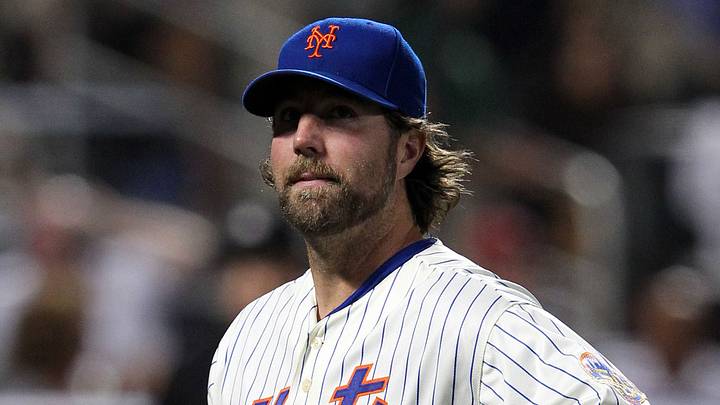
RHP R.A. Dickey, New York Mets (2012)

- 2012 stats: 20-6, 2.73 ERA, 233.2 IP, 230 SO, 139 ERA+, 5.7 bWAR, NL Cy Young
While R.A. Dickey had some good years with the New York Mets, he was never as good as he was in 2012, when he took home the NL Cy Young Award. Dickey pitched so well that the Mets were able to sell incredibly high on him, acquiring Noah Syndergaard and Travis d'Arnaud, two high-end prospects, from the Blue Jays that winter. Dickey would eat innings and take the ball every fifth day from then on, but he never again came close to those Cy Young heights.
INF/OF Hunter Dozier, Kansas City Royals (2019)
- 2019 stats: .279/.348/.522, 26 HR, 84 RBI, 10 3B, 124 OPS+, 2.7 bWAR
Hunter Dozier, a top-10 pick in the 2013 MLB Draft, had an outstanding second full big-league season, posting an .870 OPS and even leading the league with 10 triples for the Kansas City Royals. This prompted the Royals to hand him a four-year extension worth $28 million. Well, after hitting 26 home runs in 2019, Dozier combined to hit 36 home runs in 345 games over the next four years, racking up -3.4 bWAR and a .679 OPS in that stretch. Dozier's final big-league season was the 2023 campaign, and he played in just 29 games.
RHP Mark Fidrych, Detroit Tigers (1976)
- 1976 stats: 19-9, 2.34 ERA, 250.1 IP, 24 CG, 159 ERA+, 9.6 bWAR, AL Rookie of the Year
Mark Fidrych made two appearances in the bullpen to begin his career, and then the Detroit Tigers wanted him to start. All this right-hander did from there was throw six complete games in his first six starts (two of which went 11 innings) and throw a whopping 24 complete games in 29 starts that season. He had a 2.34 ERA, won the Rookie of the Year award and was the runner-up in the Cy Young balloting. He looked like a surefire star, but injuries derailed his career from there: He combined to make just 27 starts over the next four seasons, pitching to a 4.80 ERA in that span, before eventually hanging up the spikes. He's one of the biggest "what-ifs" in MLB history.
LHP Dave Fleming, Seattle Mariners (1992)
- 1992 stats: 17-10, 3.39 ERA, 228.1 IP, 117 ERA+, 5.1 bWAR
Dave Fleming didn't throw particularly hard or generate many whiffs, but he was a Rookie of the Year finalist in 1992 because he battled his way deep into games and consistently gave the Seattle Mariners a chance to win. His numbers from that season speak for themselves, but eventually, the league caught up to Fleming, who had a 5.39 ERA in 74 appearances across three seasons after that — effectively ending his big-league career.
INF Mike Fontenot, Chicago Cubs (2008)

- 2008 stats: .305/.395/.514, 9 HR, 40 RBI, 131 OPS+, 3.3 bWAR
Mike Fontenot was a valuable utility infielder for a while for the Chicago Cubs, but he looked like he'd be more than that in the 2008 season. Fontenot ended that year with a .909 OPS in 119 games and 284 plate appearances, prompting the Cubs to give him more playing time in 2009. Unfortunately, he had just a .677 OPS in 419 plate appearances that season along with a .682 OPS in the four seasons he played post-breakout. Fontenot was still a fine bench player, but never again did he perform at a star level as he did in '08.
RHP Wayne Garland, Baltimore Orioles (1976)
- 1976 stats: 20-7, 2.67 ERA, 232.1 IP, 14 CG, 123 ERA+, 3.8 bWAR
Wayne Garland spent the first three years of his big-league career as a useful yet uninspiring reliever for the Baltimore Orioles, but upon his move to the rotation roughly midway through the 1976 campaign, he lit the world on fire. He pitched so well that he'd finish sixth in the AL Cy Young balloting despite his late transition to the rotation. While his 1977 season was solid (3.77 ERA in 38 starts, 282.2 IP), his ERA went up by nearly a full run from where it was in 1976, and in the four seasons after that, he had a 5.28 ERA while not making more than 20 starts in a single season.
OF Cito Gaston, San Diego Padres (1970)
- 1970 stats: .318/.364/.543, 29 HR, 93 RBI, 146 OPS+, 5.1 bWAR
Cito Gaston is known more for his managing than his playing days, and perhaps his fall-off after his lone All-Star season is the reason why. Gaston had a .585 OPS in his first full big-league campaign but emerged from there, making the NL All-Star team and even earning down-ballot MVP votes in 1970. Unfortunately, while he was worth 5.1 bWAR that season, he was worth -0.8 bWAR in his rookie year and -4.4 bWAR in the years after his random breakout, causing him to finish his career as a negative WAR player.
INF/OF Marwin Gonzalez, Houston Astros (2017)

- 2017 stats: .303/.377/.530, 23 HR, 90 RBI, 146 OPS+, 4.1 bWAR
Everyone on the 2017 Houston Astros benefited from their cheating, but Marwin Gonzalez might've been the biggest beneficiary of all. He never hit more than 13 home runs or had an OPS above .759 in any of his first five seasons, until he suddenly hit 23 home runs with a .907 OPS in 2017 while earning down-ballot AL MVP votes. Sure enough, Gonzalez never again had a season in which he hit more than 16 home runs or posted an OPS above .733. Shocking.
INF/OF Bill Hall, Milwaukee Brewers (2006)
- 2006 stats: .270/.345/.553, 35 HR, 85 RBI, 125 OPS+, 5.8 bWAR
Bill Hall was more than a one-year wonder from a production standpoint, but the reason he's on this list comes down to the outrageous power numbers we saw from him in 2006. Hall set a career-high with 17 home runs in 2005, a modest number, only for him to hit more than double that mark the next year. Hall hit 35 home runs in 148 games in 2006, only to hit 58 home runs in 562 games the rest of his career. It's one of the most random power surges in MLB history.
3B Chase Headley, San Diego Padres (2012)

- 2012 stats: .286/.376/.498, 31 HR, 115 RBI, 145 OPS+, 6.4 bWAR, Gold Glove, Silver Slugger
Like Hall, Chase Headley had his share of productive years over the course of his 12-year career, but he went from a journeyman whose career highs were 12 home runs and a .773 OPS over his first four full seasons to a legitimate MVP-caliber player in 2012. Headley finished fifth in the MVP balloting after driving in a league-leading 115 runs with an .875 OPS while playing Gold Glove defense. From then on, though, Headley never finished a year with more than 14 home runs or an OPS higher than .758 in a single season, making his 31 homers feel like a clear anomaly.
SS Cesar Izturis, Los Angeles Dodgers (2004)
- 2004 stats: .288/.330/.381, 4 HR, 62 RB, 25 SB, 3.8 bWAR, Gold Glove
Cesar Izturis' defense allowed him to have a 13-year big-league career, but there's one offensive season that really stands out from the others. Izturis set career highs in home runs (4), RBI (62), stolen bases (25), OPS (.710) and OPS+ (88) while playing Gold Glove defense at shortstop. To show just how big an improvement this offensive season was over the others, the 62 runs Izturis drove in that season were 22 more than he had in any other year. His .710 OPS was nearly 100 points better than his next-best full-season mark of .628. His best offensive year wasn't a great year by any means, but for Izturis, it was far and away better than any other season of his at the dish.
RHP Ubaldo Jimenez, Colorado Rockies (2010)

- 2010 stats: 19-8, 2.88 ERA, 221.2 IP, 214 SO, 161 ERA+, 7.5 bWAR
Pitching in Colorado is a task that most pitchers are still trying to figure out, but for a brief period, Ubaldo Jimenez mastered it better than just about anyone ever has. The right-hander had a solid run in Colorado to begin his career but was never better than he was in 2010, when he had a sub-3.00 ERA in 33 starts and finished as an NL Cy Young finalist despite pitching half the time at Coors Field (where he somehow had a 3.19 ERA). Unfortunately, he had a 4.85 ERA the rest of the way, never making another All-Star team let alone coming close to a Cy Young.
2B Davey Johnson, Atlanta Braves (1973)
- 1973 stats: .270/.370/.546, 43 HR, 99 RBI, 143 OPS+, 4.4 bWAR
Much like Hall and Headley, Davey Johnson, another player more known for his work as a manager, was a really good player throughout his career. In fact, Johnson made three All-Star teams and won three Gold Gloves in parts of eight seasons before his ridiculous 1973 campaign. What makes his 1973 season stick out is his power that came out of nowhere: Johnson hit 43 home runs, drove in 99 runs and had a .919 OPS. For reference, he did not finish another full season with more than 18 home runs, 72 RBI or a .794 OPS. Johnson hit 136 home runs in his 13-year career, and 43 of them — roughly a third — came in one year.
1B/OF Bryan LaHair, Chicago Cubs (2012)
- 2012 stats: .259/.334/.450, 16 HR, 40 RBI, 110 OPS+
Bryan LaHair was never supposed to be anything but a placeholder for top prospect Anthony Rizzo in 2012, yet he played so well that he made the NL All-Star team. LaHair was particularly impressive in the first half, as his .884 OPS would indicate, but he hit just two home runs and had a .572 OPS in the second half and he was DFA'd and released that offseason. He never played in another big-league game. That's right: LaHair's first and only full big-league season resulted in him making the All-Star team, and it's not even as if injuries got in the way of him getting another shot. Just wild stuff.
OF Jason Lane, Houston Astros (2005)

- 2005 stats: .267/.316/.499, 26 HR, 78 RBI, 109 OPS+
A big reason why the Houston Astros made it to the World Series in 2005 had to do with Jason Lane's breakout. Lane, who entered the 2005 season with just 12 home runs in parts of three big-league seasons, hit 26 of them as a full-time right fielder for the Astros, and came up clutch in that year's postseason as well. This caused Houston to hand him the reins with an every-day job in 2006, but he ended that season hitting .201 with 15 home runs and a .710 OPS. By 2007, his playing time was cut and he was traded to the Padres for cash considerations. To give an idea of how that deal went for Lane, he'd re-emerge in the Majors as a pitcher for San Diego (and he had a 0.87 ERA in three appearances, to be fair).
RHP Esteban Loaiza, Chicago White Sox (2003)
- 2003 stats: 21-9, 2.90 ERA, 226.1 IP, 207 SO, 159 ERA+, 7.2 bWAR
Esteban Loaiza had a 4.88 ERA in 235 appearances spanning eight seasons before getting a shot with the Chicago White Sox in 2003 and seemingly turning his career around. Loaiza had a sub-3.00 ERA that season while leading the league with 207 strikeouts, 70 more than his previous career high. He was the AL Cy Young runner-up that season. Those hoping this would stick were greatly disappointed, unfortunately, as Loaiza had a 5.70 ERA in 2004 and was out of the league by 2008. Things have only gone further downhill for him off the field since.
1B/DH Kevin Maas, New York Yankees (1990)
- 1990 stats: .252/.367/.535, 21 HR, 41 RBI, 150 OPS+
Despite appearing in only 79 games for the 1990 New York Yankees, Kevin Maas was the AL Rookie of the Year runner-up thanks to his 21 home runs and .902 OPS that year. He hit 23 home runs the following season but did so in nearly double the plate appearances and watched his OPS dip to .723. From there, Maas was never a full-time starter or all that productive at the plate again, which is why the first baseman didn't last long in the Majors. Perhaps the pressure of New York got to him, who knows.
OF Daniel Palka, Chicago White Sox (2018)

- 2018 stats: .240/.294/.484, 27 HR, 67 RBI, 110 OPS+
Sure, there were hit tool concerns, but Daniel Palka emerged as a rookie and hit 27 home runs for the White Sox, proving to be an above-average hitter despite not getting on base much because of his considerable power. He even finished fifth in the AL Rookie of the Year balloting. Unfortunately, Palka went 9-for-84 (.107 BA) with two home runs and 35 strikeouts the next season, and he never appeared in a big-league game after that.
RHP Rick Porcello, Boston Red Sox (2016)
- 2016 stats: 22-4, 3.15 ERA, 223 IP, 142 ERA+, 4.7 bWAR, AL Cy Young
Rick Porcello might be the most unlikely Cy Young winner in recent memory. He had a combined 4.39 ERA in the first seven seasons of his career, only to win the award behind a 22-win season in 2016. After the Cy Young campaign, he posted a 4.87 ERA over the next four years before retiring after 2020. Don't get me wrong, he was a solid innings-eater for Detroit and Boston, but his Cy Young season was a clear outlier.
LHP Ricky Romero, Toronto Blue Jays (2011)
- 2011 stats: 15-11, 2.92 ERA, 225 IP, 146 ERA+, 6.4 bWAR
Ricky Romero looked like the ace of the Toronto Blue Jays' present and future when, in his third big-league season, he had a sub-3.00 ERA and finished 10th in the AL Cy Young balloting. Unfortunately, Romero had a brutal 2012 campaign, and then injuries limited him to four starts in 2013. He did not appear in the Majors after that, although he's been a fun social media follow for Blue Jays fans.
RHP Aaron Sanchez, Toronto Blue Jays (2016)

- 2016 stats: 15-2, 3.00 ERA, 192 IP, 142 ERA+, 5.1 bWAR
Much like Romero, Aaron Sanchez looked like a budding ace for the Toronto Blue Jays in 2016 when he finished seventh in the AL Cy Young balloting and was an All-Star in his first full season as a big-league starter. Since then, Sanchez has battled through numerous blisters and other ailments as well as persistent command issues, making it difficult for him to get back to that elite level. He's still attempting to come back, having spent part of this season in the Royals' system, but time is running out for this once-rising star.
1B/OF Jared Walsh, Los Angeles Angels (2021)
- 2021 stats: .277/.340/.509, 29 HR, 98 RBI, 127 OPS+, 2.7 bWAR
The Los Angeles Angels struggled to surround Mike Trout and Shohei Ohtani with any sort of talent, but they did so in 2021 (albeit in a year in which Trout couldn't stay healthy) by having Jared Walsh in their lineup. Walsh, who played well in the COVID-shortened 2020 campaign, looked like a future star in his first full big-league season, launching 29 home runs and making the All-Star team. Unfortunately, Walsh would combine to hit 20 home runs with a .650 OPS over the next three seasons, and that was it for him in the Majors.
C Rick Wilkins, Chicago Cubs (1993)
- 1993 stats: .303/.376/.561, 30 HR, 73 RBI, 151 OPS+, 6.6 bWAR
Rick Wilkins was not a bad player by any means, finishing his 11-year career with 81 home runs, a .742 OPS and 14 bWAR. What's crazy, though, is that he hit roughly 40 percent of his home runs and accumulated nearly half of his career WAR in just one season. The 1993 campaign marked Wilkins' first as a full-time starter and he blew through any expectations the Chicago Cubs had for him. Unfortunately, he had a .703 OPS the following year, and only had one more season in which he appeared in 100+ games. He was a fine backup, but never again a star like he was in 1993.
 Add us as a preferred source on Google