
Key Points
Bullet point summary by AI
- MLB teams and catchers halfway through the 2026 season are mastering ABS challenges by targeting high-probability situations.
- The most successful strategies involve disciplined challenge timing, avoiding late-game desperation calls that lower success rates.
- This selective approach builds a sustainable edge as the season progresses, turning challenge management into a measurable run-value advantage.
Every MLB team starts each game with two challenges. The teams at the top of the ABS leaderboard so far have learned something the rest of the league is still working out: The odds are not equal across all situations, and knowing which situations to target is half the battle.
The numbers tell the story plainly. Challenges in the first two innings succeed at a 55 to 60 percent clip. By the ninth inning, that collapses to 40 percent. The strike zone and the umpire have not changed. What has changed is the count situation, the runners on base and the emotional temperature of the game, and each of those factors cuts into the odds in a predictable direction.
With bases empty, challenges overturn at 55 percent. With runners on second and third, that drops to 42 percent. With the bases loaded, it falls to 32 percent. Full-count challenges convert at just 36 percent overall. Batters challenging to erase a called third strike on 3-2 succeed only 35 percent of the time. Catchers trying to flip that same pitch into a third strike do slightly better at 41 percent, but both are well below what early-inning spots offer.
It's intuitive, if you stop to think about it. Challenges used in higher-leverage spots, or later in games, are more likely to be the result of a hitter or catcher hoping a call was wrong rather than knowing it is. The teams and catchers who have separated themselves from the pack to this point are the ones who already know this.
The five teams who have the ABS math figured out

The most disciplined challenge teams share a specific profile: They challenge less frequently than the situation seems to call for, they pick spots with cleaner probability — and their run values at the season's midpoint reflect it.
Team | Challenges | Won | Rate | Runs Gained |
|---|---|---|---|---|
Royals | 75 | 40 | 53.3% | +25.2 |
Tigers | 80 | 43 | 53.8% | +19.1 |
Astros | 94 | 56 | 59.6% | +20.6 |
Marlins | 57 | 29 | 50.9 | +14.6 |
Reds | 89 | 49 | 55.1 | +8.4 |
Stats via Baseball Savant
The Kansas City Royals lead baseball in run value from hitter challenges despite ranking well outside the top 10 in volume, in large part because they've lost both of their challenges in the same game just once all season. The Cincinnati Reds pair discipline with volume — they challenge often, but they pick spots that hold up, and they're the only team in baseball that has yet to burn through both challenges in a single game. The Detroit Tigers have converted on 53.8 percent of their 80 challenges, results that come from going in early counts when the odds are in their favor rather than scrambling on full counts when they are not. The Miami Marlins go to the headset less than almost any team in baseball and still finish with positive run value.
Houston is the exception that proves the rule. The Astros challenge more aggressively than expected and still rank second in run value, because their 59.6 percent overturn rate is the best among heavy-volume teams. They are not disciplined; they are just accurate enough to sustain the pace. Teams trying to copy the aggression without the accuracy pay the price.
The five catchers who understand the odds

The team patterns trace directly to the catchers, who initiate ball-to-strike challenges and set the tone for how selectively a staff manages its defensive budget.
Catcher | Team | Challenges | Rate | Runs Added |
|---|---|---|---|---|
Dingler | Tigers | 54 | 68.5% | +28.6 |
Realmuto | Phillies | 31 | 80.6% | +14.7 |
Perez | Royals | 55 | 70.9% | +14.9 |
Stephenson | Reds | 65 | 72.3% | +8.7 |
Kelly | Cubs | 38 | 76.3% | +4.4 |
Stats via Baseball Savant
All five of the names above challenge at or below the expected rate. None of them are going to the helmet on impulse. The inning data makes clear what that discipline is worth: Catchers initiating ball-to-strike challenges in the first three innings, with two challenges banked and count situations working in their favor, are operating at 65 percent probability or better. The ones going late — with one challenge left, on a 3-2 count with runners on — are somewhere between 35 and 41 percent. The five catchers above have learned to live in the first situation and stay out of the second.
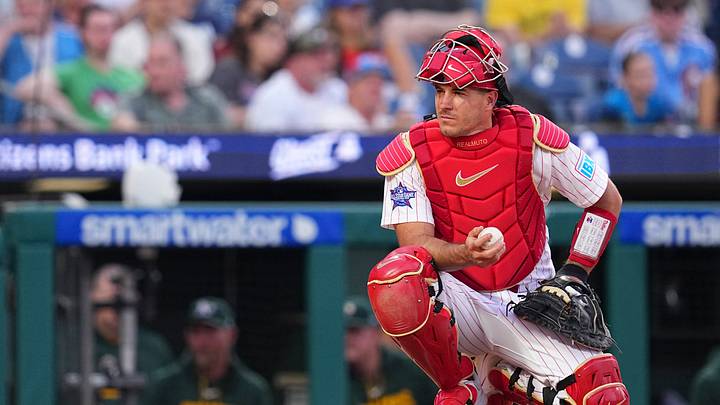
Dillon Dingler leads every catcher in baseball in run value at +28.6, not because he challenges more but because he has learned which calls are worth fighting. He has burned through both of his team's challenges in a single game just once all season. JT Realmuto converts 80.6 percent, the best rate among anyone with real volume, by going only when he is nearly certain. Carson Kelly has not cost his team both challenges in a single game all year, zero times across 38 catcher challenges, a number that reflects nearly perfect timing.
Salvador Perez is the counterpoint within this group. He has the highest challenge volume of the five and still converts at 70.9 percent, because his sense of the zone at 35 years old is accurate enough to sustain that pace. Most catchers who challenge that often see their rate fall. Perez has not.
What the second half looks like for teams who have it figured out
Overturn rates are highest in the first two innings, with two challenges banked, on empty bases, in early counts. They compress in every direction from there. The teams and catchers above have built a real edge by staying in the high-probability situations and holding the helmet when the odds turn against them.
That discipline compounds as the season goes on. A challenge saved in the third inning is a challenge available in the seventh when the game is close and the call actually matters. Cincinnati has never burned through both challenges in a single game. Kansas City has done it once. That is not luck; it is a different approach to the same two-challenge budget every team starts with, and the run values by midseason reflect exactly how much it is worth.
 Add us as a preferred source on Google