
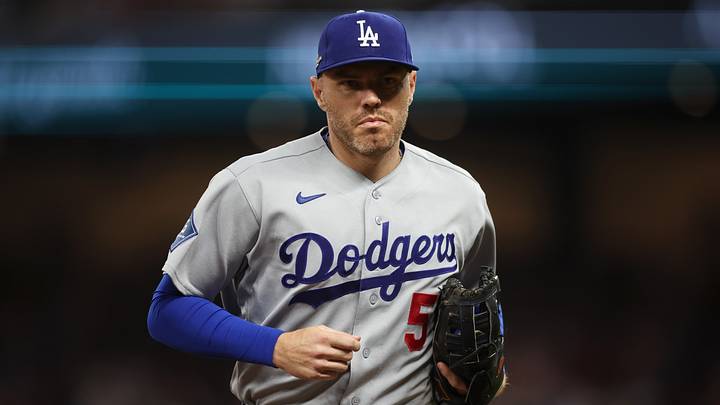
The Los Angeles Dodgers lost each of the first two games of the NLCS, and while it'd be foolish to rule the two-time defending World Series champions out completely, it's hard to believe that the team we watched in Milwaukee (and really the entire second half of the regular season) is capable of winning four of the next five games against a Brewers team that won 103 during the regular season.
The Dodgers are obviously still really good, but are they really the superteam they're made out to be? It sure doesn't seem like it, and that has nothing to do with a looming salary cap. It, instead, has everything to do with the ages of many of the team's star players.
Dodgers stars are regressing, and that was always inevitable

The bulk of this Dodgers team was built through free agency. There are some exceptions, like the trades for Tarik Skubal and Mookie Betts and the development of Andy Pages and Will Smith, but look at the list of players signed on the open market.
Player | Contract | Age | Final Contract Year |
|---|---|---|---|
Shohei Ohtani | 10 years, $700 million (with $680 million deferred) | 32 | 2033 |
Yoshinobu Yamamoto | 12 years, $325 million | 28 | 2035 (opt outs after '30, '32) |
Kyle Tucker | 4 years, $240 million | 29 | 2029 (opt outs after '27, '28) |
Blake Snell | 5 years, $182 million | 33 | 2030 (club option) |
Freddie Freeman | 6 years, $162 million | 37 | 2027 |
Tanner Scott | 4 years, $72 million | 32 | 2028 |
Edwin Diaz | 3 years, $69 million | 32 | 2029 (club option) |
Teoscar Hernandez | 3 years, $66 million | 34 | 2028 (club option) |
This list doesn't even include guys like Betts, Will Smith, Tyler Glasnow and Tommy Edman, all of whom weren't free agents but received massive contract extensions worth upwards of $70 million. The 34-year-old Betts is making over $25 million in each of the next six years; the 31-year-old Smith is just three years into a 10-year, $140 million extension, while the 33-year-old Glasnow still has one more guaranteed year on his five-year, $136 million extension.
What sticks out about these players isn't necessarily the money the Dodgers are devoting to them — it's their ages. Only Kyle Tucker and Yoshinobu Yamamoto are under 30 years of age as of this writing, and Tucker will be 30 in just three months. This core is obviously very good, but it's also quite old, and we're seeing regression in real time.
Tucker, Freeman, Betts and Smith might've all had the worst years of their careers in 2026. Snell and Glasnow remain frontline arms, but neither of them can stay healthy. Teoscar Hernandez has run hot and cold at best and remains a defensive liability. Even Shohei Ohtani clearly isn't healthy and is performing so poorly that he might get benched for Game 3 of the NLCS.
Signing free agents in their primes, as the Dodgers have, is great in the beginning. It's helped L.A. win two World Series titles. The reason teams shy away from building so heavily through free agency, though, is because of what happens as players age out of their primes. Many members of the Dodgers' core are regressing, and we're seeing them all struggle in October.
I'm not here to say Los Angeles should regret their free agency expenditures when they've won consecutive World Series titles, but at the end of the day, Father Time is undefeated. The Dodgers building through free agency to the extent that they have has resulted in them relying heavily on players who are past their prime, and what's even worse is that they're stuck with many of these veterans well beyond 2027. We may have already seen the best of this Dodgers core.
A salary cap will hurt the Dodgers, but not as much as you think

Let's make this clear: Implementing a salary cap would hurt the Dodgers, as, given the contracts they have on the books, they wouldn't have much money left to spend. However, implementing a salary cap would not stop the Dodgers from developing talent internally, and they've become a machine in that aspect as well.
Even after trading for Skubal, the Dodgers have one of the league's best farm systems — led by Josue De Paula, a 21-year-old who is such a good hitter that they're reportedly considering having him replace Ohtani in their Game 3 lineup. L.A. has found contributors out of nowhere like Andy Pages, Alex Vesia, Edgardo Henriquez and others. Lest we forget that Miguel Rojas, of all people, saved their season in 2025.
So yes, a salary cap will hurt the Dodgers to an extent, but what'll really hurt them is the fact that the players they're paying are not producing, and there's little reason to believe that things will get much better in that regard. This core is old, expensive and regressing, and that's a downside of being such major players in free agency. Unless the likes of Betts, Freeman, Smith and others can turn back the clock, the Dodgers will have trouble getting back to the World Series, whether there's a salary cap or not.
 Add us as a preferred source on Google