
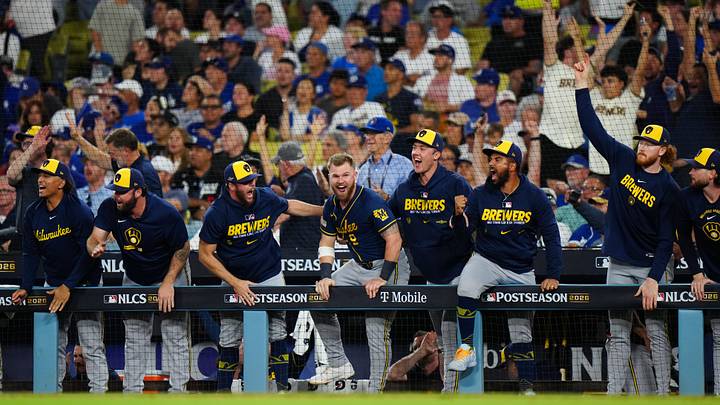
Suddenly, the days of the high-spending Los Angeles Dodgers becoming baseball’s boogeyman are on hold, if not outright over.
You can thank the Milwaukee Brewers, who are World Series-bound despite fielding the sport’s 12th-lowest payroll. What they lack in nine-figure deals was nonetheless enough to sweep the Dodgers and their No. 2-ranked payroll. So much for buying a championship.
“They may have a bunch of Hall of Famers, but we’ve got a bunch of gamers,” Brewers manager Pat Murphy said after defeating the Dodgers and their $339.3 million roster. “And the gamers won this week.”
No matter how the Guardians-Rays ALCS turns out, the 2026 World Series winner is guaranteed to have a sub-$150 million payroll.
Team | Payroll | Where does it rank leaguewide? |
|---|---|---|
Milwaukee Brewers | $146,206,320 | No. 19 |
Tampa Bay Rays | $95,615,469 | No. 28 |
Cleveland Guardians | $74,459,014 | No. 30 |
But would any of those teams have the lowest payroll among World Series champions? The obvious answer is no, because the 1903 Boston Americans (now known as the Red Sox) certainly didn’t have a nine-figure payroll.
However, when you combine the recent data with inflation, you certainly get some intriguing takeaways.
Analyzing what recent World Series winners' budgets would look like when adjusting for inflation

Spotrac's payroll data goes back to 2011, so that's where we'll start.
Year | World Series champion | Payroll (Year they won) | Payroll (Adjusted for inflation) |
|---|---|---|---|
2011 | St. Louis Cardinals | $118,919,465 (No. 10 leaguewide) | $176,965,584 |
2012 | San Francisco Giants | $137,043,205 (No. 7 leaguewide) | $199,619,299 |
2013 | Boston Red Sox | $170,734,264 (No. 3 leaguewide) | $246,320,652 |
2014 | San Francisco Giants | $160,336,782 (No. 7 leaguewide) | $231,637,447 |
2015 | Kansas City Royals | $126,391,174 (No. 13 leaguewide) | $179,055,669 |
2016 | Chicago Cubs | $186,772,494 (No. 5 leaguewide) | $260,743,078 |
2017 | Houston Astros | $138,344,211 (No. 17 leaguewide) | $188,977,262 |
2018 | Boston Red Sox | $227,398,860 (No. 1 leaguewide) | $302,982,668 |
2019 | Washington Nationals | $172,321,791 (No. 7 leaguewide) | $225,618,833 |
2020 | Los Angeles Dodgers | $124,917,397 (No. 1 leaguewide; payroll prorated because of 60-game season) | $161,642,118 |
2021 | Atlanta Braves | $152,753,755 (No. 10 leaguewide) | $186,084,227 |
2022 | Houston Astros | $183,791,796 (No. 8 leaguewide) | $207,799,712 |
2023 | Texas Rangers | $251,332,754 (No. 4 leaguewide) | $268,581,635 |
2024 | Los Angeles Dodgers | $270,561,298 (No. 3 leaguewide) | $289,129,828 |
2025 | Los Angeles Dodgers | $359,227,505 (No. 1 leaguewide) | $371,734,117 |
Some quick thoughts on that list:
- The 2017 Astros are arguably the most surprising team on that list, only because we forget how much of their core — Jose Altuve, Carlos Correa, George Springer and so forth — was either cost-controlled or on team-friendly deals. Which leads us into …
- We’d argue that only half of those teams had multiple young players (or, at least, those still under team control) who had emerged as legitimate stars. The 2017 Astros obviously qualify, as do their 2022 counterparts. We’ll also include the 2012 Giants, 2016 Cubs and 2021 Braves in that tier. You could sway us on a couple of other teams. And speaking of age …
- A fair amount of these teams ranked among the top 10 oldest during their respective championship years. Interestingly, Milwaukee (27.0) had the lowest average age in baeball this year, with Cleveland (27.6) finishing fourth. But the Rays’ 30.8 average age finished only behind the Cubs.
- San Francisco ranking as high as it did in 2012 and 2014 also caught our attention. We know those Giants weren’t spending at the Yankees’ level, but six players made at least $10 million during that second championship run. That’s not exactly chump change.
In short: The Brewers are doing something rare, but not entirely unrealistic given their overall experience and loaded roster.
As for the Guardians and Rays? They’d easily have the lowest payroll of any championship team since Spotrac began tracking the data, and it’s not even close. Whether you believe that’s good for baseball ahead of a potential salary cap is a far deeper debate for another day.
 Add us as a preferred source on Google