
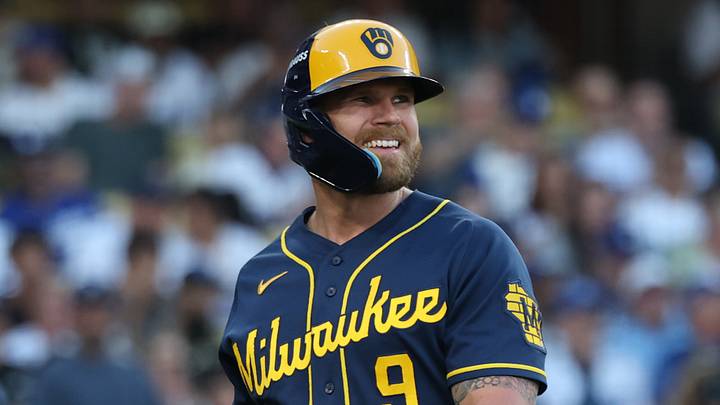
The Milwaukee Brewers did it. Despite running into a Los Angeles Dodgers team loaded with future Hall of Famers that had won back-to-back World Series, had a payroll three times the size of Milwaukee's, and swept the Brewers in the 2025 NLCS, the Brew Crew returned the favor, sweeping L.A. to go to the World Series. They came back from an early 4-0 deficit in Game 4 to wrap up the Championship Series, making it even sweeter for the Brewers.
While MLB prepares to lock the sport out in December, hoping to add a salary cap into place, the Brewers just showed that spending money proves absolutely nothing. I mean, teams like the Mets and Blue Jays did so in a sense this season as well, but the Brewers actually taking down the Dodgers, especially in the fashion they did, shows that small-market teams can win if they're run well. Here's a look at how the Brewers were able to advance to the World Series despite operating on a shoestring budget.
The Brewers can develop talent better than most teams

The Dodgers are a team that can spend money on any free agent and not really feel a thing.15 players in their organization made eight figures in 2026, per Baseball Reference. Seven of them made over $25 million. Four of them made over $30 million. On the flip side, only four Brewers players made eight figures in 2026. One of them made over $25 million (Christian Yelich). None of them made $30 million. The Dodgers are an organization that has and can develop talent, but they can just spend on a star free agent to fill a gap in their roster. The Brewers, on the other hand, cannot succeed without developing talent, and they do it as well as any organization in the sport. This is largely because they try to do this more than most teams, at least those in small markets.
The Brewers are in MLB's smallest market and rank 19th in payroll, but have one of the sport's biggest baseball ops and data teams.
— Front Office Sports (@FOS) October 16, 2026
They just swept the Dodgers and won their first-ever NL pennant. pic.twitter.com/5jRqdza8eI
Their baseball operations staff is, uh, quite large, with a ton of money poured into advanced analytics and research and development. It's safe to say that their investment in these areas has paid off, given the state of their roster.
Who, on this Brewers roster, was already a proven star? Christian Yelich was a good player with the Marlins, but he developed into an MVP with the Brewers (and remains a rock-solid DH option now, even as he's aged). William Contreras was a good hitter with the Braves, but he's now one of the best all-around catchers in the sport.
The Brewers get the most out of their guys, and that's really hard to do, especially when it's filled with as much youth as this team is. Seven of the nine regulars in the Brewers' lineup are younger than 30, and that isn't even including Jake Bauers, a player who wasn't a full-time starter until this season. Their best player, Jackson Chourio, is only 22 years old. All four of their starters in the NLCS are 27 and younger, with their two best (Jacob Misiorowski and Logan Henderson) being 24. Even most of Milwaukee's key relievers, not named Trevor Megill, are under 30.
The Brewers draft exceptionally well

To develop talent, you need to find it, and the Brewers have proven they can do that in the MLB Draft, where it's notoriously difficult to win big. Take a look at all of the drafted players on their roster.
Player | Round (Pick) | Year |
|---|---|---|
Cooper Pratt | 6 (182) | 2023 |
Jacob Misiorowski | 2 (63) | 2022 |
Sal Frelick | 1 (15) | 2021 |
Brice Turang | 1 (21) | 2021 |
Logan Henderson | 4 (116) | 2021 |
Garrett Mitchell | 1 (20) | 2020 |
Aaron Ashby | 4 (125) | 2018 |
Brandon Woodruff | 11 (326) | 2014 |
The Brewers consistently pick later in rounds and still find ways to draft future stars. Jacob Misiorowski was a late second-round pick, meaning that most MLB teams had a chance to draft him twice and didn't. Cooper Pratt, a rookie who came through with a ton of big hits in the NLCS and is already one of the best defensive shortstops in the league, was a sixth-round pick. The Brewers got Brice Turang (after 20 teams passed on him), Sal Frelick and Logan Henderson in the same draft. Henderson was a fourth-round pick, so teams had several chances to take him and just didn't.
Aaron Ashby, one of the best relievers in the sport, was a fourth-round pick. Brandon Woodruff, one of the best starters in the league when healthy, was picked after 325 other players back in 2014. It's hard enough to hit in the first round of the MLB Draft. The Brewers' ability to find talent in the draft is a gift that not many other teams have.
The Brewers don't miss when trading star talent

Something that the Brewers routinely do that upsets many MLB fans (myself included) is trade star players away as they approach free agency. This is incredibly frustrating because, to me, it feels like they're not trying to win now despite consistently getting to the playoffs. In reality, the Brewers are doing this because they know they can't pay star players their worth on the open market, so they trade them early to keep their window alive, and it's worked. It's worked largely because they've hit on these trades.
Corbin Burnes was traded for Joey Ortiz (starting third baseman) and DL Hall, who was dynamic in relief for Milwaukee in the NLCS. Josh Hader was traded for a package that included Robert Gasser (NLCS G3 starter) and Esteury Ruiz, who was part of another deal for William Contreras, one of their best players. Devin Williams was traded for Caleb Durbin, who was later flipped for Kyle Harrison, a key starter in the regular season. The Freddy Peralta trade hasn't aged quite as well yet, but there's reason to believe that at least one of Jett Williams or Brandon Sproat will develop into a quality big-leaguer.
Trading stars is only acceptable in a competitive window if you nail the returns, and the Brewers have simply done that. Given their success, don't be surprised if Contreras, a free agent after 2027, is traded this offseason.
The Brewers find exceptional value on the margins

Finding stars is tough, and paying them is virtually impossible for a small-market team, so a team like the Brewers needs to find value where no other team does. They've done that in the draft, and they've done that in other areas, too.
NLCS MVP Jake Bauers was signed to a minor league deal ahead of the 2025 season. Contreras wasn't even seen as the best player in his trade (Sean Murphy was). Andrew Vaughn was acquired after being DFA'd by the White Sox. David Hamilton was an afterthought in the aforementioned Caleb Durbin trade, and so was Shane Drohan. Abner Uribe signed for less than $100,000 as an international free agent. Trevor Megill was acquired from the Twins after they had DFA'd him. Even top prospect Jesus Made signed for less than $1 million as an international free agent. The list goes on and on.
The Brewers wouldn't have made it this far without identifying and developing players other teams had no interest in.
The Brewers don't go all-in on the blockbuster trade

The Brewers had a golden opportunity to go all-in on the 2026 campaign and trade for Tarik Skubal at the trade deadline. Given how loaded their farm system is, they could've traded for Skubal and not really felt a thing, even with the knowledge that he'd leave in the following offseason in free agency. Instead, the Dodgers got him and it felt like the Brewers had been eliminated right then. Instead, the Brewers made out like bandits.
This is nothing against Skubal, who didn't pitch poorly in his NLCS start and would've obviously made the Brewers better had they acquired him. Instead, it's everything about Logan Henderson, who the Tigers reportedly demanded in any Skubal package, and it's on the Brewers' philosophy of not going all-in.
It's easy to trade prospects for proven talent, but the Brewers are able to be successful year after year because they refrain from doing that. They have a loaded farm to dip into, and those young players consistently produce. Guys like Pratt and Luis Lara could've been traded, but the Brewers kept them around and are better off for it in 2026 and beyond.
 Add us as a preferred source on Google