
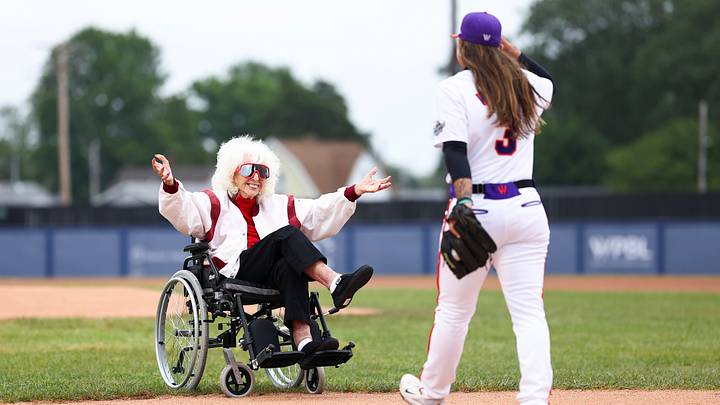
The Women’s Pro Baseball League opened its inaugural season on Aug. 1 with a ceremonial first pitch from women’s baseball icon Maybelle Blair to first overall draft pick Kelsie Whitmore.
Blair, immediately recognizable for her sort of helmet-esque, snow white hair and sunglasses that take up most of her face, turns 100 years old in January. She is one of the few still living players from the All-American Girls Professional Baseball League of 1943 to 1954, a lifelong advocate for women’s baseball, a member of the WPBL advisory board, and now the WPBL’s league-wide mascot.
Baseball’s most romantic moments are usually the ones that you can’t manufacture, but sometimes an opportunity presents itself that’s too good to pass up. Within the arc of Blair’s eephus to Whitmore were nearly 80 years between the AAGPBL’s last game and the WPBL’s first. You couldn’t draw it up any better.
How the WPBL got its start

Whitmore, a two-way player, is one of the heads on the Mount Rushmore of this new venture in women’s sports, alongside infielder Ashton Lansdell, catcher Denae Benites, and outfielder Mo’ne Davis, the first girl to throw a shutout in Little League World Series history.
Whitmore, Lansdell, Benites, and Davis were all selected within the first 10 picks of the Nov. 20 draft. They also happen to be the league’s most telegenic players.
Each logged time with the TikTok-friendly Savannah Bananas before the WPBL’s first season got underway. They filmed sketches and lip-syncs and did trick plays in the Bananas’ trademark (infamous, perhaps, depending on your persuasion), neo-barnstorming fashion that’s garnered them 11.8 million followers on TikTok, 4.4 on Instagram, and is viral enough to sell out Yankee Stadium and spark insufferable “back in my day” discourse online.
In its first season, the WPBL has similarly relied heavily on social media and their spiritual Founding Mothers to get the word out. The league has over 157,700 followers on TikTok, 256,000 on Instagram. Whitmore, Lansdell, and Benites have their own independent, heavily curated social media presences as young, queer dreamboats who post unabashed thirst traps for an audience that doesn’t always (rarely, even) feels welcome in Major League Baseball.
It's hard to imagine the Savannah Bananas without @KelsieWhitmore, but we can't wait to see the women of Banana Ball put on a show in the WPBL and for Team USA 💛 pic.twitter.com/bKG19oRJEy
— Banana Ball (@BananaBall_) July 9, 2026
Certain videos will get thousands of likes and even more views across social media platforms. The WPBL’s first merch drop sold out within the first day after a viral moment on Twitter.
These women — not just the four mentioned, but all of these women — are charismatic, talented, and are being afforded their first opportunity to play professional baseball. Not softball, not Banana Ball (all due respect to the Savannah Bananas). Baseball. The same sport that Babe Ruth and Willie Mays and Jackie Robinson and Shohei Ohtani played.
Questions remain about WPBL's present and its future
But what is this league, outside of the confines of a 9x16 TikTok? Where do they play? Who are they, outside of their four most notable players? Why is their season so short? How do they pay their players? What does their future look like? Is there a future at all?
How many teams are in WPBL?
Let’s get some basics out of the way. The WPBL is made up of four teams: the San Francisco Firebells, the Los Angeles Queens, the New York Heights, and the Boston Hunters. They’re currently getting toward the end of their first regular season, which lasted just about five weeks. Their postseason kicks off on Sept. 9 and involves two best-of-three semi-final series, with all four teams in the mix, then a best-of-five championship series. Games have been played exclusively at Robin Roberts Stadium in Springfield, IL, named after the Hall of Fame pitcher born in the city. They’re broadcast on the streaming-only platform ESPN+.
The rest … well, it’s a little more complicated.
The actual structure of the league off the field is unclear. Someone drafted or signed Whitmore, Lansdell, Benites, Davis, and the other 100+ women spread across four rosters, but who? There are no Andrew Friedmans, Brian Cashmans, David Stearnes, or Dave Dombrowskis here. There is no vast bureaucratic scouting and development network or draft day warrooms.
Those things might just have to come in time, but where did those anonymous someones even get the money they need to pay these players? Horace Mann, Dick’s Sporting Goods, and New Era are all listed as public sponsors, but beyond that, as far as we know, there is no magnanimous billionaire funding these efforts, like Mark Walter and the Professional Women’s Hockey League. There’s no established league behind them either, like the NBA and the WNBA.
How much to WPBL players get paid?
According to Front Office Sports, the WPBL’s teams “operate under a $95,000 salary cap, from which players will be paid an undisclosed amount on a per-game basis. The league will also cover living expenses for players’ six-week stay in Springfield, and give them a cut of sponsorship money.”
Women in professional sports are always (always, always) paid less than their male counterparts, especially at the start. The four teams’ rosters carry up to 30 players. Though they’re paid on a game-by-game basis, the even split between all 30 is easy math: each player is making an average of $3,167 for six weeks of rigorous physical activity and the hope that this might continue. They’re foregoing other paid activities, maybe more lucrative ones, to play in the league.
MLB has yet to embrace WPBL, which is a problem
MLB not only has yet to pledge any amount of financial support to the WPBL, they’ve barely acknowledged its existence. Crossovers have been limited to, for example, tryouts and the draft being held at Nationals Park in Washington DC.
Rob Manfred and MLB are undoubtedly waiting out the WPBL’s first season before making an investment, if they do at all. From the perspective of MLB, the billion-dollar industry, this only makes sense. From my perspective, as a baseball fan, as a woman, it’s unacceptable.

As someone with either the fortune or misfortune (again, depending on your persuasion) of being intimately familiar with the ins and outs of Major League Baseball, comparison has been impossible to avoid. I’ve seen the WPBL’s lack of structure (at least public structure), its limited resources, the tiny stadium they occupy and the fans who struggle to fill the seats, and I’ve wondered if this league can actually survive. It’s different, to say the least, from what took MLB 100 years to establish — and what they still have not perfected.
Those comparisons make it impossible to see how the WPBL survives without some kind of intervention. They’re subsisting on the generosity of three major sponsors, the presence of a few thousand fans who make the pilgrimage out to Illinois, and the revenue from a few thousands of TikTok views. The realist in me thinks it won’t last beyond this season. The dreamer in me says otherwise.
When I see women play sports, any sport, the dreamer is impossible to ignore. I love baseball, but more than that I love women. I love to watch them excel and succeed. The women of the WPBL have proven they can do that. Whether or not they can continue to do it might be up to Major League Baseball.
What risk is there for MLB’s billion-dollar empire, really? What amount of money could they pledge to support the league that they couldn’t just shrug away if it fails?
How many women and young girls could they bring to the game as a whole if all they did was acknowledge the league exists? What happened to “if you build it, they will come”?
Women's leagues are difficult to establish and even harder to maintain. The comments on any single one of the WPBL’s posts will tell you there’s an army of naysayers who are praying on its downfall.
Kelsie Whitmore, Ashton Lansdell, Denae Benites, Mo’ne Davis, and the women of the WPBL, present and future, deserve better than that. Maybelle Blair deserves better than that.
Right now, the WPBL is built on what figures to be a less than $1 million budget, a strong social media presence, and a lot of talent. In a perfect world, it would be enough to keep it going in perpetuity. In the world we live in, they need a helping hand. The fact that MLB hasn’t offered it isn’t exactly surprising, but it is deeply disappointing. There’s greatness here, if only MLB would recognize it.
 Add us as a preferred source on Google