
Key Points
Bullet point summary by AI
- The San Diego Padres suffered an embarrassing 12-7 loss to the Los Angeles Dodgers, dropping them back to .500 for the first time since April.
- The offense ranks 28th in wRC+ since May and the rotation remains thin behind Michael King, with Randy Vásquez struggling badly.
- With three games out of a playoff spot and several stars underperforming long-term contracts, President AJ Preller faces mounting pressure to reconsider his approach at the trade deadline.
The San Diego Padres had been in a tailspin for a while. On Thursday night against the Los Angeles Dodgers, though, the plane may have crashed and burned for good, as an early 6-0 lead became an embarrassing 12-7 loss that dropped the Padres back to .500 for the first time since the first week of April. The offense showed signs of life for two innings before reverting back to the same group that ranks 28th in wRC+ since the start of May. The starting rotation remains woefully thin behind Michael King, as Randy Vásquez gave up four runs on seven hits over three innings of work — raising his ERA over his last seven starts to a miserable 7.98.
San Diego's hot start to the season now seems like nothing more than a small sample size fluke. The Padres are 24-32 since the start of May, with a run differential that suggests that mark should be even worse. They're now three games out of a playoff spot, and as Thursday night attests, the gap between them and their rivals up I-5 is only getting wider.
AJ Preller will always look for ways to add talent ahead of the trade deadline, but at this point, is it even worth it? Despite hollowing out the farm system to build one of the more expensive teams in the league, the Padres are mired in mediocrity, with several big-name stars drastically underperforming contracts that San Diego will have a difficult time getting out from under. Neither this current core nor the man who built it are worth defending anymore.
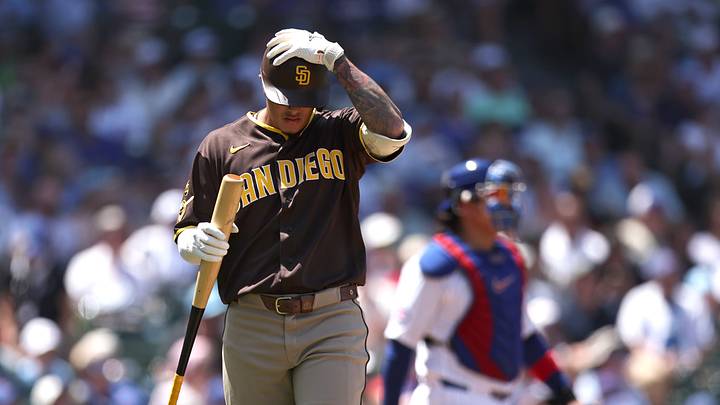
3B Manny Machado
The decline is officially here. This is no longer just a slow start, and it's well past time to appeal to the back of Machado's baseball card. The 33-year-old is still hitting below the Mendoza Line in early July, with career-worst numbers pretty much across the board — most alarmingly his K rate, chase rate and whiff rate.
The massive 11-year extension Preller handed out ahead of the 2023 season looks even more insane in hindsight than it did at the time. Machado is under contract through 2033, at which point he'll be nearing his 41st birthday. His defense at third base has yet to fall off a cliff, but it's only a matter of time as he pushes into his mid-30s. And when that happens, we're looking at one of the very worst regulars in the sport, making too much money to be benched or traded. You can hope for a rebound if you like, but Machado hasn't posted an OPS of .800 or better since 2022; this will only get worse.
OF Jackson Merrill

There was reason to believe in a bounce-back season for Merrill, who saw his sophomore campaign derailed by injury. So far in year three, though, things have only gotten worse, with his strikeout rate spiking and his power completely evaporating. It's been an alarming fall for a player whose preternatural hit tool seemed to be his calling card as a rookie just 24 months ago.
Of course, given the 10-year deal they signed him to after that first season, San Diego isn't getting out of the Merrill business any time soon. And unlike Machado, time is on his side; he's still just 23 years old, and it wouldn't be surprising at all if he eventually figures it out. Players who are that good that quickly in the Majors don't just fall off the face of the Earth. With his rookie year even further in the rearview mirror, though, Merrill as a future cornerstone can no longer be the default assumption, and it's up to him to prove that he can be the Padres' center fielder of the future. Because right now, the outlook seems grim.
INF Jake Cronenworth

Cronenworth silenced the doubters with a resurgent 2025 season in which he hit .246/.367/.377 and posted 2.5 bWAR while playing all over the infield. Unfortunately, that feels like a bit of a dead-cat bounce in hindsight: The former fan favorite is hitting a dismal .164 with a scarcely believable .236 slugging percentage, making lots of contact but doing shockingly little damage with it.
Has there been some bad luck involved there? Sure. But at this point, Cronenworth is 32; his offensive profile doesn't have much of anything to fall back on — he's not even getting on base anymore to help counteract the lack of pop — and his defensive versatility isn't nearly as valuable as it used to be. Which would be fine enough as a fifth infielder, were it not for the fact that he's locked up through the 2030 season at more than $12 million per year. That's meaningful money for a team in San Diego's financial situation, especially given how little value Cronenworth provides at this stage of his career.
RHP Randy Vásquez

It's not Vásquez's fault, really. He didn't ask to be part of the return for Juan Soto, nor was he the one who failed to address the Padres' starting rotation to the point that he's now the de facto No. 2 starter. Really, this is who he's always been, a swingman who was pitching way above his level during his hot start to this season.
Now, that start has come crumbling down, and San Diego is left with essentially zero reliable arms behind King. Vásquez gave some reason for hope that he'd be able to stick as a big-league starter, but in reality, he's the same guy who struggled to stick in the Padres rotation in previous seasons. He doesn't miss bats, and while being a fly-ball pitcher in Petco Park helps, the stuff isn't good enough to get away with forever. San Diego can't afford to pencil him into its future plans.
President AJ Preller

Of course, that was true even when the team made the choice to acquire him as part of the Soto return following the 2023 season. But that's just one of the many, many mistakes Preller has made in trying to get this core over the hump over the last few years, a bill that is now coming due all at once.
You do have to admire Preller for his aggression and creativity, and he does have a keen eye for identifying talent. He does not have a keen eye for building a sustainably competitive organization, though; if he did, the Padres wouldn't find themselves in the miss they're in right now. So many of his bets have backfired, from his forays into free agency for guys like Xander Bogaerts to homegrown extrensions for Merrill and Cronenworth. The proof is in the pudding, and the reality is that San Diego has very little financial flexibility or prospect capital moving forward with which to build a real contender.
Preller is loath to ever blow it up, but if San Diego is below .500 by the time the deadline rolls around, how can he justify buying yet again? A full reset is needed here, and things are going to get worse before they get better.
 Add us as a preferred source on Google