
The 2027 NBA Draft has more of a free-for-all vibe than the 2026 class, which featured four outlier-dominant freshmen who controlled the cycle from start to finish. Kansas' Tyran Stokes has made a strong early claim for No. 1 pick rights, but there's so much unsettled about this class — made even more uncertain by the NBA's new lottery rules, which increase the odds of a contender drafting for immediate need at the top of the board.
There's also the NIL of it all; more and more underclassmen are passing on perfectly viable NBA Draft routes in favor of another season in college and more cash in the bank. As college basketball moves toward a five-year eligibility window, that will only shrink the pool even further. There's so much we don't yet know about which players will actually declare next summer, but for now, let's focus on five freshmen making outsized statements in the early going:
For more NBA Draft coverage all season long from Chris Kline, subscribe to The Whiteboard — FanSided's NBA email newsletter.
Miles Sadler, West Virginia

Small guards are so often dismissed as obsolete, but there's nuance to that conversation. Yes, there is more value than ever in strength, size and defensive versatility across the positional spectrum. Then again, teams still need primary ball-handlers who can put the ball on a string, penetrate and create advantages from scratch. If there's a smaller guard who can set the table, fill it up and defend even remotely well, there's still a path to professional success.
Miles Sadler will probably never achieve full-blown stardom in the NBA; listed at 6-foot even and 170 pounds, he will face a steep adjustment against professional physicality. That said, he's too smart and skilled offensively to ignore. Sadler pairs great downhill burst with a knack for mixing speeds and manipulating the defense with his handle. He's 12-of-15 (80 percent) at the rim through two games. He's averaging 7.5 assists (62.2 AST%) to 2.5 turnovers (14.8 TO%), with active hands leading to a couple steals per game, too.
Miles Sadler is MUST WATCH ball.
— Ryan Hammer🔨 (@ryanhammer09) November 10, 2026
Perfect balance of *that boy nice* & *analytical darling*
20.5 ppg, 7.5 apg through 2 games.
Converting at 76% in the paint.
3x AST/TO ratio.
SUPER fast & twitchy, smart, aggressive, tight handle. Reminds me a lot of UNM Donovan Dent pic.twitter.com/VSYMHZxtAg
It's still early and West Virginia has yet to face top-shelf competition, so it's worth taking Sadler's early explosion with a grain of salt. That said, he's quite possibly the most well-rounded and prolific offensive freshman guard in the country right now. If he continues on this path, NBA teams will be forced to reckon with their own biases and consider Sadler as a one-and-done candidate. He ranked No. 25 on FanSided's preseason big board.
Obinna Ekezie Jr., Louisville

Obinna Ekezie Jr. played nine minutes in Louisville's season opener against Chattanooga. That number increased to 25 against Morehead State over the weekend, mostly because the Cardinals were coasting through a blowout. Ekezie will have trouble nailing down a huge role this season behind senior Flory Bidunga, the crown jewel of Louisville's portal class. And yet, even on the outskirts of the rotation, Ekezie looks like a guy who could force his way into NBA Draft conversations.
It's much too early for grand statements, but Ekezie has made a strong first impression with four blocks in 34 total minutes; he also has 25 points and 13 rebounds in that span, shooting 4-of-4 at the rim and 4-of-7 from 3-point range.
At 7-foot-2 and 240 pounds, Ekezie is a springy rim-runner and lob threat who can double as a floor-spacer at the five spot. He still has a ways to go in terms of developing his footwork and his passing instincts, but the core traits are highly compelling. The NBA is always hungry for legitimate inside-out scorers in the frontcourt, especially when they can rebound and protect the rim as effectively as Ekezie. If he's not a first-round pick in 2027, peg him as a potential top-10 pick in 2028.
Luigi Suigo, Villanova

Luigi Suigo was viewed as a potential first-round pick this past summer after a strong season with Mega Basket in Serbia. He instead opted for the NIL paycheck and a chance to improve his stock at Villanova, with the early returns suggesting that was a smart decision. It can't be overstated how little a three-game sample means in the long run. It's also worth pointing out that Suigo was quiet in Nova's season opener against Notre Dame, a power conference opponent. His subsequent spike in production came against Holy Cross and La Salle, two mid-major programs who can't hope to combat Suigo's 7-foot-3, 289-pound frame.
All that said, Suigo has a chance to quickly ramp up excitement in NBA Draft circles, as he possesses a few outlier traits in a draft class without many true standouts. His size is the primary selling point, obviously. Suigo is a mountain of a man, and he uses his length to frequently impact and redirect shots at the rim. He has also made a dent on the offensive glass for the Wildcats, producing easy second-chance points in the process.
Suigo excites with flashes of shooting touch; he's 1-of-4 from deep on the young season, but he attempted almost 1.9 per game in Serbia a year ago. He was a 76.2 percent free throw shooter, which is generally a favorable touch indicator. Best of all, he has 10 assists (with only two turnovers) in his last two appearances. Suigo displays vision and savvy working the short roll; he can also set up shop at the elbow and let offensive plays unfold around him. He has a chance to really pack the stat sheet and lure NBA scouts in with his varied skill set.
Quentin Coleman, Illinois

Probably unfairly, Quentin Coleman will be compared extensively to his predecessor in the Illinois backcourt: Keaton Wagler. A relative unknown upon his arrival in Champaign, Wagler quickly climbed the ladder to become a top-five pick. Coleman was not a McDonald's All-American, but he still arrived at Illinois as the No. 14 overall recruit in his class, per 247 Sports. He a five-star high schooler with a wide range of D-I offers. So it's a different situation from the rip.
That said, there are some undeniable similarities, both in terms of skill set and aesthetics. Illinois has a type, after all. The Illini, better than any other program, seek out high-feel players who are adaptable in nature. Coleman does not need to dominate the ball to render a positive impact. He's a productive spot-up shooter; after a slow start to the campaign, he drilled 5-of-6 attempts from 3-point range in Illinois' recent loss at Texas Tech. Like Wagler, Coleman is not necessarily a visionary passer, but he makes the right reads and stifles turnovers.
Coleman also needs to add strength and become a more physical presence. Even so, he's pretty fearless. He skies for rebounds, battles at the point of attack on defense, and embraces contact on drives, even if it's a losing battle. Wagler has a similarly fearless mentality, which has yielded positive results in the NBA so far.
The point here is not to say Coleman is Wagler 2.0, however. Coleman is a quicker and more explosive downhill athlete. He can slip through the cracks and play above the rim once he picks up a head of steam. Conversely, while Coleman is a very good shooter, he's not on Wagler's level in that department. All this is to say, Coleman is stepping into a great environment at Illinois, with a proven track record of development in his role. There's a nonzero chance he goes from "potential top-10 pick" to a contender for No. 1 overall.
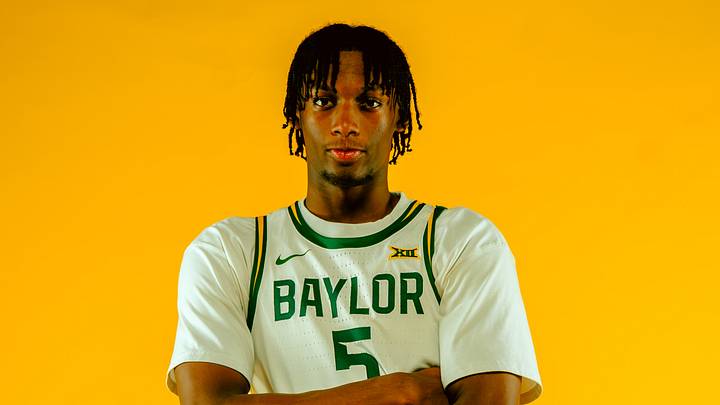
Dylan Mingo, Baylor

Dylan Mingo committed to North Carolina before the Michael Malone hire. When that situation flipped, Mingo flipped his commitment to Baylor, where he joined his older brother Kayden Mingo, who transferred to Waco after a strong freshman season at Penn State. So far, the Mingo brothers are quite fun. Kayden is the clear 1A (for now), but Dylan has practically exceeded his brother's production in fewer minutes. And folks, Dylan is doing some insane stuff for a "guard."
The knocks on Dylan Mingo coming into Baylor were twofold: durability and shooting. Mingo has troubling injury history and his 3-point shooting has never been more than theoretical. It's too early to judge durability, but he's 0-for-2 from deep in 66 minutes — that is going to stick out like a sore thumb on the scouting report.
Even without a remotely functional jumper, however, Mingo has found ways to get to the rim and to the free throw line. He's 12-of-13 (92.3 percent) on rim finishes; he's only shooting 47.4 percent on free throws, which is less than ideal, but he's drawing 7.9 fouls per 40 minutes. Mingo is a big, twitchy guard who can explode headlong down the lane or slow down and put his defender in a blender.
More impressive than anything Mingo is doing offensively, however, is his impact on the defensive end. He's up to 13 steals (10.4 STL%) in a three-game stretch, with a real presence on the back line (3.9 BLK%), too. Mingo just flies around. He's rebounding better than a lot of 7-footers, which can flow directly into transition offense, where Mingo's at his best. The intangibles are off the charts. The jumper is going to be a conversation topic all year, but that's fixable. The stuff that isn't fixable, Mingo already has figured out.
 Add us as a preferred source on Google