
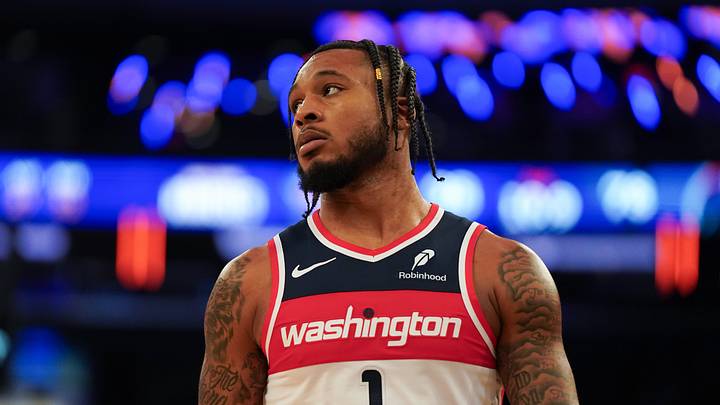
NBA careers seldom play out in linear fashion. We like to ascribe very linear narratives — the early developmental years, the sophomore or junior leap, the late-20s prime, then the eventual back-end decline. Yet, so often players take a more serpentine path. Sometimes a player gets overlooked and left for dead career-wise, only to be rediscovered or reinvented in a new place, long after folks have written them off.
Let's take a look at a handful of NBA reclamation projects who could author surprising new chapters in 2026-27.
Cam Whitmore
The Cleveland Cavaliers swapped Tre Mann for Cam Whitmore this summer in what essentially amounts to a salary dump. Cleveland promptly waived Whitmore, allowing the 22-year-old forward to seek employment elsewhere. The No. 20 overall pick in the 2023 NBA Draft, Whitmore spent two years on the rotational fringe in Houston before landing in D.C. last season, where he averaged 9.2 points, 2.8 rebounds and 0.7 assists in 16.9 minutes.
Whitmore was viewed as a potential top-five pick in 2023 but hidden personality concerns led him to tumble much further than expected. The Rockets have never lacked for frontcourt depth, so Whitmore's opportunities were limited. Still, it's hard to write off such a young player with Whitmore's myriad tools. He's a nuclear athlete, listed 6-foot-6, 230 pounds with a 6-foot-9 wingspan and effortless bounce.
The Nuggets are among the teams connected to Whitmore in free agency. Whitmore was not a winning player last season in Washington, although who was? The Wizards were 8.9 points per 100 possessions worse with him on the floor. It's not hard to figure out why. Whitmore is an inefficient, low-volume shooter with a negative assist-to-turnover ratio. It's hard to carve out a niche in the NBA if you can't space the floor or render quick, smart decisions with the basketball.
Still, it's hard to look at Whitmore, one of the toolsiest players in the world, and not see the vision. He converted on 70 percent of his attempts at the rim. His first step is electric and he's a powerful finisher, able to embrace and elevate through contact. He creates events on defense, too, with elevated steal (1.7 STL%) and block (0.9 BLK%) numbers for a wing. He's also a solid offensive rebounder.
Put him in the right situation (Nikola Jokić helps all his teammates, for what it's worth), and there's reason to believe Whitmore can produce as an off-ball cutter and straight-line driver while refocusing his efforts primarily on the defensive end. If Whitmore unlocks his full potential as a defender, the rest will fall into place. It will require sacrifice and acceptance, and a simple desire to prolong his career. But there's absolutely a world in which Whitmore can help an NBA team this season and beyond.
Devin Carter

Devin Carter was the No. 13 overall pick to Sacramento in 2024. Just two years later, he's signing an Exhibit 10 contract with the Boston Celtics, hoping to compete for a roster spot in training camp. That's quite the fall for a recent lottery, but the 24-year-old makes for a fascinating development project in Beantown. The Celtics locate and develop talent better than most teams, and Carter should have plenty of gas left in the tank.
Sacramento is where careers go to die, so it's hard to hold Carter solely responsible for flaming out there. He wound up in Atlanta at the trade deadline last season, but was buried in a deep Hawks frontcourt. Carter won't be front of the line for mintues in Boston, but he's worth keeping in the building. Stylsitically, Carter aligns with what Boston likes to do. He's a combo guard who built his reputation on stout, anticipatory defense at Providence. He started 12 games last season in Sacramento before the Hawks salary dump, too, averaging 8.9 points, 3.3 rebounds and 2.7 assists in 18.4 minutes. It not like he hasn't seen the floor.
Injuries were a major part of Carter's early-career undoing. He needs to prove not only that he can play, but that he can stay on the floor. In Boston, however, he has the chance to become a kind of second unit mirror to Derrick White. Carter's hands are everywhere on defense (2.1 STL%) and he's an elite positional rebounder. He can absolutely help a team win. The Kings were, statistically, better with him on the floor. It feels mildly insane that he does not have a guaranteed contract, but it's a huge financial win for the Celtics, who have revived many disregarded careers. Ron Harper Jr. just inked a multi-year contract extension after bouncing around on two-way contracts and non-guaranteed deals early in his career.
Carter's primary hurdles come on the offensive end; he's a career 26.3 percent 3-point shooter in the NBA. That obviously needs to improve. If Carter can become even a league average spot-up threat, however, he has solid feel and a high defensive floor. There's no reason to believe he can't become a rotation-caliber piece for the Celtics sooner than later.
Mario Hezonja

Mario Hezonja, the 31-year-old forward from Croatia, was the Magic's No. 5 overall draft pick in 2015. Despite occasional flashes of point forward brilliance, Hezonja never really caught on in the NBA. He has spent the last six years overseas, mostly with Spanish superpower Real Madrid. Now he's back, having averaged 17.5 points, 4.9 rebounds and 1.9 assists on .465/.366/.902 splits in Euroleague competition last season.
He inked a one-year minimum contract with the Cavs in the immediate aftermath of LeBron James' decision to join the 76ers. A poor man's alternative, but nonetheless an exciting opportunity for Hezonja to reinvent himself in the NBA. An opportunity to prove that he not only belongs, but that can put past missteps behind him.
The most apt descrption of Hezonja last time we saw him stateside was probably "overconfident." He knows he's stepping into a prove-it situation. He will need to earn his minutes, most likely on the defensive end. Cleveland's subsequent sign-and-trade for Peyton Watson pushes Hezonja down the depth chart, but he still addresses a need for size and physicality on the wing. Basket News reporter Donatas Urbonas notes "improved overall feedback on [Hezonja's] off-the-court maturity," so beyond basketball improvements, it seems like Hezonja is a more amiable locker room personality this time around.
If Hezonja can step in and defend multiple positions at a high level, there's little stopping him from carving out a significant role with the Cavs second unit. A career 31.9 percent 3-point shooter in the NBA, Hezonja also made marked strides in that department overseas. The Cavs aren't going to ask him to be creative and generate offense. He needs to complement to high-usage guards in Donovan Mitchell and James Harden, while not mucking up the paint for rim-running bigs Evan Mobley and Jarrett Allen.
Of this summer's Euroleague imports, Hezonja feels like the most probable impact player on a legitimate contender. The proof is in the pudding, of course, so he needs to show up and produce. But expect a very different version of the 6-foot-8 forward Orlando once considered a pillar of its rebound.
Cody Williams

The Jazz unceremoniously dealt Cody Williams to the Minnesota Timberwolves this offseason in a swap of "bad" contracts. The former No. 10 pick, just two years into his NBA career, is fighting to keep a roster spot. Williams was always more a project than his older brother Jalen, who quickly blossomed into a two-way star for Oklahoma City.
An impressive freshman season at Colorado, in which the younger Williams shot 73.6 percent at the rim and converted 41.7 percent of his 3s, hid some troubling red flags. He didn't really create events on defense and his role was incredibly streamlined. His turnover rate (20.5 percent) was almost double his assist rate (10.4). Predictably, Williams' thin frame has made it difficult to handle pressure and create advantages as a ball-handler.
He still needs to mature physically and round out an unrefined skill set. Williams is shooting 21.4 percent on 3s so far in the NBA. His success in college was such a small smaple, on low volume, that it was never really trustworthy.
He joins a contending Wolves team, however, that finds itself in desperate need of functional wing depth. The Jonathan Kuminga signing addresses that to an extent, but the Wolves' lack of rotation-caliber pieces beyond Jaden McDaniels and Anthony Edwards remains a concern. Never has depth been more paramount to success in the NBA. You need multiple bodies who can defend and fit within a scheme.
There's reason to believe Williams can still carve out a professional niche. He made strides physically last season and put a couple eye-popping performances on tape, including a 34-7-7 performance in late March. Over his last 15 games of the season, Williams averaged 17.5 points, 4.1 rebounds and 4.5 assists and 1.1 steals in 34.2 minutes. Utah basically let him run wild in an effort to tank. Williams will need to bottle that success in a more contained environment with the Wolves, but he's a solid finisher. He can handle a couple different matchups on defense. The turnovers are a problem, but Williams keeps his head up and throws some compelling passes.
This is how so many of these "reclamation" stories go. A player bombs with the team that drafts him, then finds a more fruitful role and opportunity with his second team. The Wolves could really use an optimized version of Williams — a Williams who can at least threaten from the 3-point line while slashing, passing and finding ways to connect the dots offensively. An up-tempo offense helmed by LaMelo Ball certainly can't hurt, as Williams looks most comfortable in the open floor.
Ben Simmons

Ben Simmons took last season off to get healthy and finance a championship-winning fishing team. Now he's back in the NBA, signing a non-guaranteed minimum contract with the Sacramento Kings. It's hard to imagine a more humbling circumstance for a former No. 1 overall pick than signing a non-guaranteed minimum contract with the worst organization in basketball, but that's where Simmons finds himself.
The hope is that this is a useful shift in perspective for Simmons, who clearly needs to reinvent himself and rebuild from the ground floor. He's no longer the perennial All-NBA and All-Defense candidate of yore. We can't know the specifics of his downfall — how much was mental hurdles and how much was a crippling back injury — but Simmons had clearly lost more than a step last time we saw him, along with any and all confidence attacking the basket.
It's unreasonable to expect a full rebirth for Simmons in Sacramento. There should be ample opportunity to stand out with the Kings, but Simmons' days as a triple-double machine are, in all likelihood, behind him. He now must learn to exist harmoniously as a role player. That means leaning into parts of his skill set that were grossly underutilized in his prime.
No, Simmons won't come into the season bombing 3s. But he really does not need to. Instead, Simmons ought to ditch the point guard persona and lean into life as a forward. He needs to set screens, roll hard to the rim, get up to lobs, and view himself through the prism of a connector, rather than a primary geneator.
The Kings' paper-thin backcourt may force Simmons to bring the ball up on occasion, but he can still move the ball quickly and flow into other actions. Imagine Simmons as a DHO partner and short-roll passer next to Darius Acuff. Imagine him playing the Domantas Sabonis role with the second unit, probing on the block and making quick-hitting decisions in the middle of the floor. That needs to be the vision.
There's no denying Simmons' talent, only his buy-in and his approach. Chiefly, the Kings could really use a lockdown defender on the wing. If Simmons can approach even 75 percent of the defender he was at his peak in Philadelphia, any offensive transformation becomes gravy.
Simmons is no spring chicken, but at 30 years old, there is plenty of time for a second act. It starts in camp, where he will need to prove himself in an environment where any proof whatsoever ought to be roundly celebrated.
 Add us as a preferred source on Google