
Key Points
Bullet point summary by AI
- Each NBA franchise has a standout draft pick that defined its legacy, often far from the spotlight of top selections.
- These picks range from late-round steals to mid-draft gems that transformed teams and shaped the league's history.
- The full list reveals how franchises built dynasties, turned around franchises, and created lasting franchises from unexpected choices.
The NBA Draft gets really spicy when teams find stars where nobody expects them. The great GMs know where to make picks all across the board. The San Antonio Spurs built a dynasty on the backs of Tim Duncan and a bunch of later picks. There are gems everywhere, and even though the perception is that no great player is going to go after the lottery, that’s just not the case.
So, with that said, let’s take a look at every team’s best draft pick of all time. One note to level set: This list is not looking at the best player drafted by said team, but the best draft pick, meaning the best value at that draft position. For example, the Chicago Bulls took Michael Jordan at third overall, but they also took Jimmy Butler at 30th overall. That 30th-overall pick holds a lot of weight. (Also, the pick only counts if you’ve played at least one game for the franchise, so the Hawks don’t get credit for Luka Doncic. And lastly, no No. 1 overall picks. That’s not good drafting; that’s just lottery luck.)
Atlanta Hawks, Pete Maravich, 1970 NBA Draft
- Honorable mention: John Collins
John Collins was seriously considered here. Getting an All-Star player and solid number two at 19 overall is impressive stuff by the recent regime in Atlanta, but we have to go with Pete Maravich in 1970. Of course, Maravich is most known as a Jazz great, but he had four really good years in Atlanta, and grabbing a Hall of Famer here at third overall is tidy work.
Maravich was an incredible college player, coming out of LSU with the NCAA Division I all-time leading scorer title. Maravich was scoring 44 points per game in college. Those are video game numbers. And yet, he didn’t go first overall. It was a stacked draft. The first four players taken went into the Hall of Fame, but the Hawks still got one of the greatest scoring players in the history of basketball.
Other options here are few and far between. Dominique Wilkins and Trae Young were both drafted by other teams and traded to the Hawks. The only other Hall of Famer drafted by Atlanta was Arvydas Sabonis, but that draft pick was voided because they took him when he wasn’t of age to be drafted. The Hawks' draft history is fairly messy, but they hit Maravich right on the head.

Boston Celtics, Larry Bird, 1978 NBA Draft
- Honorable mention: Paul Pierce, Paul Westphal
The Boston Celtics are one of the great franchises in the history of the NBA, and they have the draft picks to back it up. They’ve drafted 14 Hall of Famers, and that doesn’t even include Bill Russell. They got Paul Pierce and Paul Westphal at 10th overall in their respective draft years, but there’s no other option than Larry Legend. The choice to take Larry Bird might look like a risk. The Celtics used their sixth-overall pick on a guy they couldn’t sign for over a year, and he had the option to rejoin the next year’s draft if they couldn’t sign him, but the Celtics stood pat and got one of the best players in the history of the NBA.
Larry Bird brought the Celtics to three championships, winning Finals MVP at two of them. He was All-NBA first team for nine seasons in a row. He’s also one of the greatest three-point shooters of all time at a time when that wasn’t a main focus of the game. He was ahead of his time while also being dominant in his era.
Some of the guys who went ahead of Bird in ‘78 include Purvis Short and Rick Robey. With the Celtics on the board, they could have opted for Ron Brewer, Reggie Theus, or Freeman Williams. We think the Celtics made the right pick. Bird brought the Celtics back to relevance, and the ensuing draft picks and acquisitions helped build a dynasty around him.
Brooklyn Nets, Bernard King, 1977 NBA Draft
- Honorable mention: Brook Lopez, Buck Williams, Cliff Robinson
Sometimes, first is the best. Bernard King was the New Jersey Nets’ first draft pick after joining the NBA in 1976. They actually had the worst record in the NBA in 1976-77 after selling Julius Erving to the Philadelphia 76ers so they could afford the “invasion fee” to the New York Knicks, but they ended up drafting seventh.
That’s okay because they still ended up drafting the best possible player for their team. Bernard King was one of the best players in the late 1970s and 1980s. He took no time transitioning from the University of Tennessee to the NBA, putting up 24 points per game in his rookie season.
If the Nets had picked second overall, where they were originally supposed to, they would have ended up with Otis Birdsong. He was a decent player, but he was nothing like King. And while King’s career in New Jersey was relatively short-lived, he is still head and shoulders above anyone else the Nets have drafted.
Charlotte Hornets, Kemba Walker, 2011 NBA Draft
- Honorable mention: Baron Davis, Alonzo Mourning
Looking at the Charlotte Hornets draft history, they should be one of the best franchises in the league! You mean to tell me they selected both Kobe Bryant 13th overall and Shai Gilgeous Alexander 11th overall in their draft years? They got these superstars so late in their drafts, took a chance, and were rewarded with two multiple-time MVPs? What’s that? They traded them immediately? Oh no…
Okay, let’s not spend too much time on that. Let’s talk about Kemba Walker, a player who actually played a minute or two for the Hornets. The Hornets (then the Bobcats) selected Walker with the ninth-overall pick in the 2011 NBA Draft. He came out of college a star after helping UConn win a National Title. Unfortunately, he couldn’t bring those winning ways to Charlotte, but he was still one of the great players in this franchise’s history.
Walker is the franchise leader in points with more than 12,000 in his Hornets career. Nobody else has broken 10,000 in this team’s history. Walker was never a top-five player in the league, but he made four All-Star teams, and he was the franchise for about a decade in Charlotte.
Chicago Bulls, Michael Jordan, 1984 NBA Draft
- Honorable mention: Jimmy Butler, Joakim Noah, Toni Kukoč
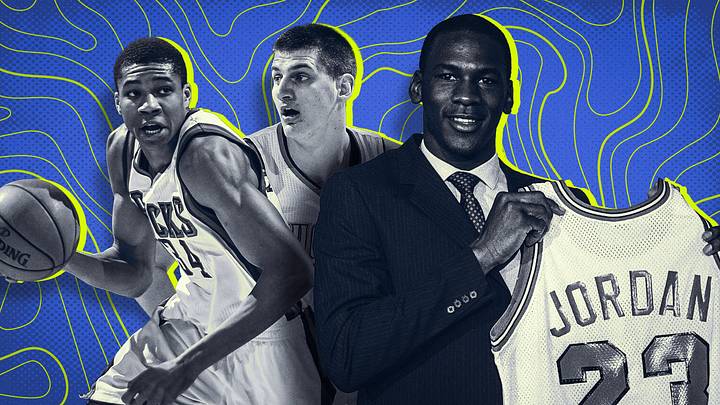
We know we mentioned Jimmy Butler earlier in this exercise, but there is no argument for another choice outside of Michael Jordan here. Having the greatest player in the history of the league fall to you at three in the draft is more than just luck. It’s the type of choice that will make you donate to charity to even out your karma. Jordan is the NBA. He’s still one of the most recognizable athletes in the world, close to 30 years since he won his last championship with Chicago. The Bulls are utterly feckless since he left, and they are still one of the most popular franchises in the league because of Jordan.
Nobody needs to hear the numbers. He’s the GOAT. He went 6-0 in the NBA Finals. The impact he had on the game is impossible to measure. The impact he had on the Bulls? It’s even greater. Having a team literally choose Sam Bowie over him is insane. Hakeem Olajuwon is arguable at least, but Jordan is the pick in any draft.
We hate to give the Bulls credit for watching this talent fall to them, but they still had to pull the trigger. Jordan could have continued to fall, with Sam Perkins and Charles Barkley right there, but the Bulls made the right move selecting number 23. Now, that number is etched into the franchise, the league, and the sport forever.
Cleveland Cavaliers, Carlos Boozer, 2002 NBA Draft
- Honorable mention: Bill Laimbeer
The Cleveland Cavaliers have drafted more than 260 players in their history. They have drafted zero Hall of Famers. They haven’t fallen into a Hall of Famer, ended up on the right end of history with one guy, or get lucky by having someone fall into their lap. Well, except that one Ohio native who was selected first overall.
In truth, the Cavaliers will likely have multiple Hall of Famers in the next 10ish years. LeBron James is the obvious choice. The NBA’s leading scorer is one of the best players of all time, but he was selected first overall, so we’re not giving the Cavs credit for making the obvious choice. Kyrie Irving is another choice, but he also went first overall.
Our choice came down to Carlos Boozer and Bill Laimbeer. Both had decent NBA careers, including multiple All-Star Games. Both were chosen in later rounds. We gave the slight edge to Boozer because he played in a more recent era. Boozer is one of the great bag fumbles. Letting him sign with the Utah Jazz in 2004, the Cavs let a legit number two for LeBron James leave over money. He went on to be a two-time All-Star and a really sound player for much of the rest of his career.
Dallas Mavericks, Jalen Brunson, 2018 NBA Draft
- Honorable mention: Josh Howard, Jason Kidd, Jamal Mashburn
First, let’s address all of the elephants in the room. Luka Dončić would have been here at this pick, but he was technically chosen by the Atlanta Hawks. Dirk Nowitzki should be this pick, but he was technically chosen by the Milwaukee Bucks. So many of the Mavericks greats, even the ones that started their career in Dallas, technically weren’t drafted by the Mavericks franchise.
Is this recency bias to pick Jalen Brunson, the 2026 Finals MVP for the New York Knicks? Maybe, but there are only a few second-round picks in the history of the league who have had the impact that Brunson has had on any franchise. He’s taken the laughing stock of the NBA and turned it into a champion. Brunson was insane for most of the playoffs, and he is now one of the league’s biggest stars.
There is obviously a ton of value here. Unfortunately, the Mavericks didn’t see it. They let Brunson walk in free agency to the Knicks for free. Brunson was getting better each year with the Mavs, and it’s not like he didn’t have a great pedigree in college. He was on those stacked Villanova teams in the mid-2010s. Yet, here we are, celebrating a championship in New York while Dallas wonders what could have been.

Denver Nuggets, Nikola Jokič, 2014 NBA Draft
- Honorable mention: Jamal Murray, LaPhonso Ellis, Dikembe Mutumbo
There is no more obvious pick on this list than that of the Denver Nuggets. The 41st-overall pick in the 2014 NBA Draft is now arguably the best player in the league. He led the Nuggets to a championship basically single-handedly, and he’s dominated the league with his size and shooting ability. He is a floor spacer like no other, and he’s truly a generational superstar.
So, why did Jokic fall to the second round in the first place? We get that he was playing in Serbia, but players from obscure areas of the world get drafted high every year. What was different about a talent as clear as Jokic? Heck, the Nuggets themselves took Jusuf Nurkić in the first round in 2014.
The consensus on draft night was he wasn’t very athletic after he was drafted, but a “nice stash.” Seriously, multiple draft grades pieces called Jokic a “stash” player. What’s interesting is that the 2014 draft was probably the last draft as hyped as this current draft, and the best player to come out of that one took 40 misses to get to Jokic.
Detroit Pistons, Dennis Rodman, 1986 NBA Draft
- Honorable mention: Joe Dumars, Isiah Thomas
The Detroit Pistons selected three Hall of Famers in the 1980s, and two of them came after the lottery. Joe Dumars was selected 18th overall in 1985, and Dennis Rodman was selected 27th in 1986. We’re going with Rodman just because of his impact on the game and the thought process behind the selection.
Rodman is one of the most intriguing stories of NBA prospect status in history. He was a full foot shorter when he entered college, and basketball wasn’t even on his mind. When he woke up one day standing at 6’8, basketball seemed like a natural route. But he was 19 years old at this point, so he got a late start. This is why he wasn’t a priority for most teams in the draft.
The Detroit Pistons took Rodman with the third pick in the second round. It seemed like a good enough play on his athleticism alone. He ended up being possibly the greatest rebounder in league history. Despite his reputation, he had an endless work ethic and dominated the boards at both ends of the court. He helped the Pistons win two championships before winning three more in Chicago.
Golden State Warriors, Steph Curry, 2009 NBA Draft
- Honorable mention: Klay Thompson, Draymond Green, Jason Richardson, Tim Hardaway, Chris Mullin
Another obvious one, Steph Curry not only changed the Golden State Warriors, but he changed the NBA entirely. He was the superstar of a dynasty and a leader of the three-point movement. Teams play a completely different style of game today because of Steph Curry. In the season before Curry joined the league, there were a total of around 53,000 three-point attempts in the regular season. Last year, there were 91,000 attempts from beyond the arc. That is 100% because of the impact of Curry’s existence in the NBA.
And remember the 2009 draft. The Minnesota Timberwolves took two point guards prior to Curry’s pick at seventh overall. Johnny Flynn and Ricky Rubio didn’t have the impact that Curry had, obviously. This is an all-time fumble by a franchise that severely needed a win.
As for Golden State, they are still gaining the dividends of this draft choice. With Curry on the roster, there’s always a reason to strive for more. They are expected to go all-in one more time in the 2026 offseason, and that’s because it is worth it to do so with Curry still playing at a relatively high level. Four championships later, and the Warriors are not satisfied because they don’t have to be with him on the roster.
Houston Rockets, Calvin Murphy, 1970 NBA Draft
- Honorable mention: Robert Horry, Sam Cassell
Calvin Murphy was a second-round pick in 1970. Now, he’s in the Naismith Basketball Hall of Fame. This one might surprise many, but this career was very good. Despite having as many Hall of Fame nominations as he does All-Star Game appearances, Murphy was a great player who played a key role in the first seasons of the Rockets in Houston.
Only Hakeem Olajuwon and James Harden had more win shares than Murphy did. He was more of a fan favorite after the Rockets moved from San Diego. He’s not a household name today, but he was a very underrated player in his era. The Rockets weren’t great, but they did have one magic run in 1981 when they made it to the NBA Finals. He scored 42 points in Game 7 of the Western Conference Semifinals to beat the San Antonio Spurs. They beat the Kansas City Royals in the WCF before losing to the Boston Celtics in the NBA Finals.
Murphy remains one of the best free-throw shooters in league history, setting NBA records at the time for most consecutive free throws made and for the highest free-throw percentage in a single season. At 5’9, he was one of the first short kings to show that anyone of any height can dominate the NBA in the right circumstances.
Indiana Pacers, Reggie Miller, 1987 NBA Draft
- Honorable mention: Paul George, RIk Smits, Danny Granger, Chuck Person
This one is a great battle between two of the best who have ever worn an Indiana Pacers uniform. Reggie Miller was selected 11th overall in the 1987 NBA Draft, and Paul George was selected 10th in 2010. They also technically drafted Kawhi Leonard in 2011, but they immediately traded him to the San Antonio Spurs (how do they keep getting away with this?).
We give the slight edge to Miller because of longevity. Miller embraced Pacers culture entirely, and he pushed them into the national spotlight. The five-time All-Star made the NBA’s 75th Anniversary Team, celebrating the best of the best in the history of the game. He wasn’t a statistically great player, but he was as clutch as they come. He is still considered iconic for the choking gesture he made at Spike Lee, which continued in history until the Knicks finally won the championship in 2026.
Miller finished his career with 25,000 points. He is still one of the great three-point shooters of any era. If he played today, many believe he would give Steph Curry a run for his money. Miller is still the most popular Pacers player and the best to wear the uniform as long as he did.

Los Angeles Clippers, DeAndre Jordan, 2008 NBA Draft
- Honorable mention: Eric Gordon, Chris Kaman, Lamar Odom
There are a few interesting players if you include the Buffalo Braves draft history into account, including Adrian Dantley, but we want to focus on the franchise since it was renamed the Clippers and moved to California. Since 1979, there have been zero Hall of Famers drafted by this franchise. There have only nine All-Stars drafted, and that’s despite this franchise being terrible for a large part of it.
They did do a good job drafting after the turn of the century, including getting Blake Griffin with the number-one overall pick in 2009. A year earlier, they made their best value pick of all time. DeAndre Jordan ruled the middle of the floor for the Clippers for a decade. He’s a one-time All-Star and won an NBA Championship with the Denver Nuggets in 2023.
Jordan made the All-NBA first team one time and was a third-team selection twice. Jordan was a defensive stud that allowed “Lob City” to thrive. This wasn’t one of the best players in the league, but his presence allowed some of the best players in the league to take another step towards greatness.
Los Angeles Lakers, Michael Cooper, 1978 NBA Draft
- Honorable mention: Andrew Bynum, Eddie Jones, Derek Fisher
The Los Angeles Lakers are one of the premier franchises in all of sports, but you might be surprised to know that they’ve only drafted seven Hall of Famers in their history. And most fo them came with the first or second-overall pick. Jerry West, Magic Johnson, Elgin Baylor, and James Worthy were all selected very early in the draft. We’re looking at which picks might make the most sense, and a few come up. Nick Van Exel was the Lakers’ star prior to the arrival of Shaq and Kobe, but the choice here has to be a champion of some kind.
Michael Cooper spent his entire career with the Los Angeles Lakers, and we can understand why. Who would leave a franchise when you’re playing such an underrated role on constant championship teams? (He did play one season in Italy at the end of his career, but we’ll ignore that). Cooper was taken in the third round of the 1978 NBA Draft. It’s a round that no longer exist in today’s NBA because it was deemed unnecessary.
The 1987 Defensive Player of the Year played on five championship teams for Los Angeles. He was on the NBA’s All-Defense team five times, and his number 21 has been retired by the Lakers. Only Magic Johnson and Kareem Abdul Jabbar were a part of five Lakers championship teams. Not bad for a guy who went 60th overall.
Memphis Grizzlies, Kyle Lowry, 2006 NBA Draft
- Honorable mention: Mike Conley, Shareef Abdur-Rahim
There are a lot of players who were technically drafted by the Vancouver and Memphis Grizzlies franchise. Steve Francis originally wore a Grizzlies hat at the draft, but he was traded to the Houston Rockets. Kevin Love was briefly part of this franchise before he was traded to the Timberwolves. The pick here has to be someone who actually played here, and that’s Kyle Lowry.
While he grew his star in other cities, it all started for Lowry in Memphis. He joined the Grizzlies in 2006 after he was drafted 24th overall. He was clearly a talent, but some in the organization felt the need to have him compete for playing time with Mike Conley Jr. rather than finding a way to play them together. Lowry was not going to be happy there, and they traded him to the Houston Rockets.
It took Lowry until 2010 to become a full-time starter in the league, but he was worth the wait. He became a six-time All-Star and won the NBA Championship with the Toronto Raptors. And now, 20 years since he was drafted by those Grizzlies, Lowry is still making an impact in the NBA, this time for his hometown Philadelphia 76ers.
Miami Heat, Bam Adebayo, 2017 NBA Draft
- Honorable mention: Dwyane Wade, Caron Butler, Glen Rice
Is Bam Adebayo better than Dwayne Wade? No, but is getting him 14th overall more impressive than getting Wade at fifth overall? We think so, and that’s why the man with the second-most points in an NBA game in league history is sitting as the best Miami Heat draft pick of all time.
Adebayo is trying to take the Miami Heat into their next era, and getting a player capable of that at 14 overall in today’s NBA is beyond impressive. Players like Frank Ntilikina and Dennis Smith Jr. were selected prior to Adebayo, both of whom are out of the league. The Heat are happy with their decision.
There is some projection with this pick. Adebayo seems to be getting better with age, and he should grow a little more in the next few years. If he can step his game up just a little bit, he still has a chance to become a Hall of Fame player. He already has three NBA All-Star Team selections under his belt, and he was on the All-NBA Defensive first or second team six times in his career. Adebayo is the future of the Heat, and at 28 years old at the time of this writing, he should remain in his prime for at least half a decade. Will he ever pass Wade? That’s a mighty mountain, but it’s possible. He’d need to at least get a championship under his belt.
Milwaukee Bucks, Giannis Antetokounmpo, 2013 NBA Draft
- Honorable mention: Vin Baker, Sidney Moncrief
We understand this might be a sore subject for Milwaukee Bucks fans right now, but there’s no doubt that Giannis Antetokounmpo is the best draft pick in the history of this franchise. They got one of the best players, and for a while, the best player, in the NBA at 15th overall in 2013. Some of the names selected before him include Anthony Bennett, Alex Len, and Ben McLemore. All of those franchises are absolutely kicking themselves that they didn’t pay more attention to Greek basketball that prior season.
Giannis is a sure-fire Hall of Famer already. Even if he retires today, he’s making it to Springfield. He already has two MVPs, 10 All-Star selections, seven All-NBA first teams, an NBA Defensive Player of the Year award, and a championship, which included Finals MVP in 2021. He brought the Bucks back to glory almost single-handedly. Heck, he even won an NBA Cup MVP.
Giannis is 31 years old, so he’s on the other side of that fateful age where players decline, but often, a player of this talent level doesn’t take their foot off the gas for a few more years, at the earliest. He’s still capable of averaging 30 points per game, and he’s about to pass Gary Payton and Larry Bird on the all-time scoring list. He even has a chance to make it into the top-five scorers of all time if he stays on this pace. Not bad for the 15th-overall pick.

Minnesota Timberwolves, Kevin Garnett, 1995 NBA Draft
- Honorable mention: Zach LaVine
The Minnesota Timberwolves had the fifth-overall pick in back-to-back years, 1995 and 1996. They chose back-to-back Hall of Famers. As was the way with the Timberwolves in these years, they traded one of them. They chose Kevin Garnett and Ray Allen in 1995 and 1996. And while they won a title together, they did that with the Boston Celtics. However, Garnett stayed in Minnesota, and he is truly their best player to ever grace Minnesota basketball (unless Anthony Edwards one day passes him).
Garnett is the all-time leader in points, rebounds, assists, steals, and blocks. He stuck by Minnesota in good times and bad. He truly tried to get this franchise to another level by himself most seasons. His numbers speak for themselves.
He retired as a 15-time All-Star and the 2004 MVP. He was one of the best players in the NBA pretty much his entire time with the Timberwolves. There are other decent picks, but nothing comes close to taking Garnett in 1995. Imagine if the Timberwolves instead chose Bryant “Big Country” Reeves?
New Orleans Pelicans, Chris Paul, 2005 NBA Draft
- Honorable mention: David West
For having such a short, unimpressive history, the New Orleans Pelicans actually has some really impressive draft picks. They took David West 18th overall in 2003, the franchise’s first draft pick. They took J.R. Smith with the 18th pick in 2004. Austin Rivers was a decent pick in 2012, and Buddy Hield had a decent career, but the choice here is Chris Paul.
Paul was drafted fourth overall in the 2005 NBA Draft. He was part of a point guard run that included Deron Williams and Raymond Felton. There’s a clear winner among those three. Paul not only had a great career, but he did show some of that greatness to New Orleans. Paul finished his rookie season leading all rookies in total points, assists, steals, and double-doubles, and became only the second rookie in NBA history to lead the league in total steals. Unfortunately, most of that came in Oklahoma City after the impacts of Hurricane Katrina.
In 2007-08, Paul led the Hornets to the top of the Western Conference, even holding the lead in the standings for parts of the season. He was a true star in New Orleans, one of the few in all of sports and definitely the biggest in basketball. His career continued in Los Angeles, Houston, and a few other cities. Paul will likely retire this offseason and join the Hall of Fame as soon as he’s eligible.
New York Knicks, Willis Reed, 1964 NBA Draft
- Honorable mention: Mark Jackson, Trevor Ariza, Mitchell Robinson
It’s Willis Reed or Walt Frazier for this pick, and it couldn’t be more obvious that it fell to those former teammates. The New York Knicks have been a laughing stock for most of their history since winning two championships in the 1970s, led by Reed and Frazier. That is, until 2026, when Jalen Brunson, Karl-Anthony Towns, OG Anunoby, Josh Hart, and Miles Bridges led them to a championship. The 2026 Knicks had zero players in their starting lineup who were actually drafted by them.
Meanwhile, the 70s Knicks were filled with homegrown players. For this specific pick, Reed is the choice. Reed won MVP in both Finals the Knicks won (1970 and 1973) while also winning NBA MVP for the Knicks in ‘70. All this talk of Brunson being the best Knick of all time can calm down. Reed still holds that title pretty firmly.
Despite his legacy, Reed had a relatively short career, retiring due to injuries after his 11th season. Just one year after winning Finals MVP, Reed was done with playing basketball. Of course, Reed’s most famous moment came in 1970 when he was trying to play through a torn thigh muscle. Reed’s existence in Game 7 of the 1973 Finals threw the Lakers off so much that they clearly lost their game plan, and the Knicks lifted the championship trophy once more.
Oklahoma City Thunder/Seattle Supersonics, Shawn Kemp, 1989 NBA Draft
- Honorable mention: Serge Ibaka, James Harden, Russell Westbrook, Nick Collison
It feels a little dirty choosing a Seattle Supersonics player in this slot because of how the franchise left that city, but the Shawn Kemp pick deserves recognition, as does Kemp himself. He was truly one of the great players in the league for a short period. Kemp was a six-time All-Star who made the All-NBA second-team three years in a row.
Kemp was drafted as the youngest player in the NBA, which likely impacted his draft stock. He was possibly the most athletic player in the draft that year, coming out of a year where he basically didn’t play basketball. Kemp took a minute to show what he could do on a basketball court, but he eventually became a star.
Kemp’s superstar era was short, but it was impactful. His biggest moment was on the biggest stage against the biggest star in league history. Kemp and Gary Payton combined to take on Michael Jordan’s best team. They faced the 72-win Bulls and stretched the series to six games. Kemp was so great, averaging just under 24 points per game and 10 rebounds, that he was only a few votes away from winning Finals MVP in the losing slot. Weight issues and other issues took him out of that superstar conversation, but for the first half of his career, Kemp was untouchable.
Orlando Magic, Nick Anderson, 1989 NBA Draft
- Honorable mention: Aaron Gordon, JJ Redick
This is where the rules do hurt. The Orlando Magic have selected some of the greats in the NBA Draft, but they were all taken first overall. Shaquille O’Neal, Dwight Howard, and Chris Webber are much higher on the all-time greats list than Nick Anderson, but let’s not take away from what Anderson was to the early years of this franchise.
The Magic’s first draft pick came at 11th overall in the 1989 NBA Draft. He spent the first 10 seasons of his career with the Magic. Since this was an expansion team, Anderson was trying to do a lot with not a lot. He comes out as underrated in the long run because he was trying to lift up a squad with a bad supporting cast. That is, until Shaq arrived.
We don’t love the pick, but the Magic’s history is not great. The least we could do is help by picking a fan favorite. Anderson was a star in a weird situation. However, we do want to point out that we expect Franz Wagner will likely take over this position in a few years.

Philadelphia 76ers, Maurice Cheeks, 1978 NBA Draft
- Honorable mention: Tyrese Maxey, Jrue Holiday, Andre Iguodala, Charles Barkley
The Philadelphia 76ers have a lot of really fun draft picks. Joel Embiid was an interesting risk in the 2014 NBA Draft with his injury, and he turned into a multiple-time MVP. Tyrese Maxey at 21st overall is one of the great draft picks of this era. Jrue Holiday at 17 and Andre Iguodala at 9 in their respective draft years found really impactful players later than they usually go. Of course, Charles Barkley was one of the all-time greats, and he went fifth. However, we’re going for a Hall of Famer that went in the second round.
Maurice Cheeks played 11 years with the Philadelphia 76ers, and he became one of the best on-ball defenders in the history of the league. In his rookie season, he had 37 steals in nine playoff games. That’s still the record for per-game steals average (4.1) in one playoff run.
Cheeks was a four-time All-Star, with his best season statistically coming in 1985-96. He had north of 15 points per game and nine assists per game. He played 39 minutes per night that season, and he upped his game in the playoffs, averaging 20 points, 7 assists, and 4.7 rebounds per game. In 1983, Cheeks helped the Sixers sweep the Los Angeles Lakers in the NBA Finals, winning their third championship.
Phoenix Suns, Steve Nash, 1996 NBA Draft
- Honorable mention: Devin Booker, Shawn Marion, Amare Stoudemire,
Another choice from the legendary 1996 NBA Draft, but this one comes at the end of the relevancy of the selections. Steve Nash has had a crazy career when you really think about it. He started off in Phoenix, playing two seasons with the Suns before moving on to the Mavericks. That trade got the Suns the draft pick to select Shawn Marion, another great player in Suns franchise history.
After six season with the Mavs, Nash went back to the Suns. There, he turned into one of the greatest players in the league. He won league MVP two times as the lead ball handler for the seven seconds or less offense. He found the right place to be as impactful as possible.
Nash had more than 11 assists per game five times, and was an All-Star eight times. He made the All-NBA first-time three times, and he led the league in assists five times. Nash started the change in value for quick-moving offenses in the league. He also changed the way we look at Canadians in the league. What a player to get at 15th overall.
Portland Trail Blazers, Clyde Drexler, 1983 NBA Draft
- Honorable mention: Damian Lillard, CJ McCollum
The Portland Trail Blazers have an interesting history at the draft. They have taken four Hall of Famers, including Bill Walton, who dragged his team to a championship. They also have a star in Damian Lillard sixth overall in 2012 and CJ McCollum 10th overall in 2013. However, there’s one choice here. It’s Clyde Drexler.
Drexler became one of the best players in that era. Getting a player as impactful as Drexler, especially for a franchise like the Trail Blazers, cannot be understated. Drexler was a superstar for the Blazers for more than 10 seasons. He finished his career as a 10-time All-Star and led Portland to the NBA Finals in 1990 and 1992, won an NBA championship with Houston in 1995, and earned a gold medal on the 1992 United States Olympic team better known as "The Dream Team".
This is another great resume, but Drexler also passed every eye test known to man. He was great across all segments of the game. It’s rare that a player who played the majority of his career with the Blazers would make the Hall of Fame, but here we are.
Sacramento Kings, Peja Stojakovic, 1996 NBA Draft
- Honorable mention: De'Aaron Fox, Jason Williams, Gerald Wallace, Otis Thorpe
Peja Stojakovic is hard to put here, but his career had a major impact on the Sacramento Kings directly. This is probably going to end up being Tyrese Halliburton, but we’re going to barely lean Stojakovic since his major contributions are with the Kings, and Halliburton is a sore subject in California’s capital.
Stojakovic spent more than seven seasons with the Kings, helping define the franchise's most successful era. Yet this isn't a case of someone putting up numbers simply because he spent a large portion of his prime in a small city. His value on a per-48-minute basis still tops every other Kings draft pick, proving his impact was as efficient as it was productive.
The Stojakovic pick is controversial to be on this list because it couldn’t be more Kings. Even when they made a great point, it comes when a better one is right there. If the Kings picked one pick higher, they would have Kobe Bryant. If they made the same pick as one pick lower, they would have Steve Nash. It’s a great 1-2-3 punch, but the Kings clearly got the worst of the three stars.
San Antonio Spurs, Tony Parker, 2001 NBA Draft
- Honorable mention: Manu Ginobili, George Hill
The San Antonio Spurs built the foundation for their dynasty around a number-one overall pick. With David Robinson out, the Spurs saw an opportunity in 1998-99 to tank and get Tim Duncan. With him in tow, the Spurs wanted to keep the winning going, so they had to get star players deep in drafts. They got Manu Ginobili with the 57th-overall pick and Tony Parker with the 28th-overall pick.
We’re going with Parker because of his resume. A six-time All-Star, Parker was the 2007 NBA Finals MVP. Three times, he was on the All-NBA second team, and he made the third team an additional time. Parker was legitimately a great player, and he got to add his skillset to a Spurs team that was trying to build past the foundation. If Duncan settled the land, Parker was the wood for the house. Without him, the structure would collapse.
Parker came to the NBA slightly undersized and with a French background that usually didn’t translate into better draft stock. We know why Parker fell to 28th overall, what we didn’t know was how great he would become. A four-time champion and a laundry list of awards from FIBA, it should be only a matter of time before Parker sneaks into the Hall of Fame.

Toronto Raptors, DeMar DeRozan, 2009 NBA Draft
- Honorable mention: Vince Carter, Chris Bosh, Tracy McGrady
The Toronto Raptors have a few great stars that have come through their ranks, and some were even drafted here. Tracy McGrady was a serious consideration for this pick, but his peak was just slightly too short to remain in consideration. Plus, DeMar DeRozan was chosen ninth, and McGrady was taken with the fourth-overall pick.
Surprisingly to some, DeRozan is already one of the greatest scorers in the history of the league. He finished last season with more than 26,000 points, good for 18th all-time. Next season, he should pass Hakeem Olajuwon and a few others to move into the top 15. This is all coming from a ninth-overall pick.
There was an insane amount of talent in the 2009 NBA Draft. Blake Griffin, Steph Curry, James Harden, and Jrue Holiday were all selected in that draft. DeRozan was often overlooked. The Raptors could have gotten stuck with someone like Brandon Jennings or Gerald Henderson, but they got a player who meant a ton to the franchise. Then, the Raptors traded him for Kawhi Leonard. He brought a title to Toronto, which felt a little cheer since DeRozan couldn’t be a part of it.
Utah Jazz, Karl Malone, 1985 NBA Draft
- Honorable mention: John Stockton
The Utah Jazz put together their best team and a yearly contender with draft picks that have a terrible hit rate. They got Karl Malone with the 13th-overall pick and John Stockton with the 16th-overall pick one year early. Both picks could be used in this list, but we’re going with Malone because he had the overall better career.
Malone’s final win shares for his career was 234.6. That’s good for fourth all-time. Only Wilt Chamberlain, Kareem Abdul-Jabbar, and LeBron James have more win shares than Malone. Of course, there are some moments he’d like to forget, and he didn’t end up winning a championship, but he’s still by far a superstar player who was way batter than the 13th-overall pick.
Looke at the rest of the ‘85 draft. Malone was by far the best player in the draft. Patrick Ewing went first, and Hall of Famers Chris Mullin, Arvydas Sabonis, and Joe Dumars all went to the Hall of Fame from this draft, but Malone at 13 is insane value. The Jazz could have ended up with someone like Alfredrick Hughes, Terry Catledge, and Blair Rasmussen. Instead, they picked a franchise-defining superstar.
Washington Wizards, Rasheed Wallace, 1995 NBA Draft
- Honorable mention: Manute Bol, Rip Hamilton
There are some interesting draft picks from the Washington Wizards and Washington Bullets perspective. Ironically, multiple of those players ended up on the championship Detorit Pistons team from 2004. On top of Rasheed Wallace, the Wizards/Bullets also drafted Richard Hamilton. But Wallace is far and away the better player. Wallace is the only player in this franchise who wasn’t drafted first or second to finish his career with over 100 win shares.
After one successful season with the Bullets, Wallace was traded to the Portland Trail Blazers for Rod Strickland (among other pieces both ways). Wallace’s career took off in Portland as he became one of the most feared players in the league.
Coming out of UNC, Wallace was considered a big man who could score and rebound and play incredible defense. He ended up becoming one of the best agitators in the league while also using that fear to score buckets. Winning the 2004 championship with the Pistons was a proof of concept for his play style.
More NBA news and analysis:
 Add us as a preferred source on Google