
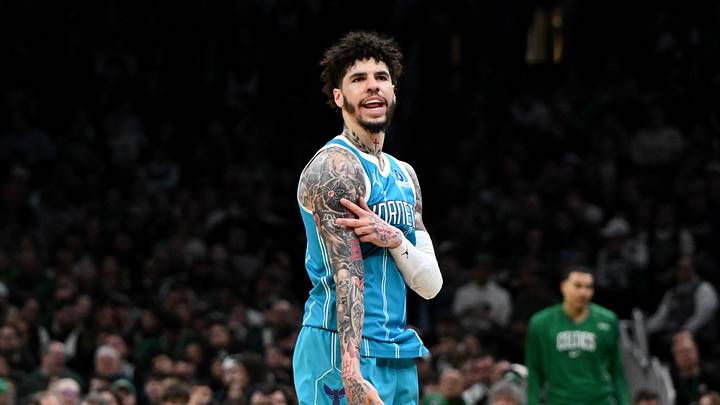
Key Points
Bullet point summary by AI
- A major NBA franchise made a blockbuster move this week, sacrificing key assets for a star player to build around its young cornerstone.
- The trade instantly creates one of the league's most explosive backcourts while raising urgent questions about frontcourt depth and long-term roster construction.
- How the team addresses its size concerns this offseason will determine whether this aggressive gamble pays off in the rugged Western Conference.
Just when we thought it was safe to exhale for a moment, a turbulent NBA offseason dropped yet another bombshell on us. On Thursday morning, ESPN's Shams Charania broke the news that the Minnesota Timberwolves had acquired LaMelo Ball from the Charlotte Hornets in exchange for [takes deep breath] Naz Reid, an unprotected 2033 first-round pick, first-round pick swaps in 2028, 2029 and 2030 and second-round picks in 2029, 2032 and 2033. Whispers of a potential Ball deal began to swirl late Wednesday night, but no one expected it to come together this quickly — much less to this team, and for this sort of haul.
But the Wolves were clearly feeling the heat to build a winner around Anthony Edwards as soon as possible. Their second-round loss to the San Antonio Spurs left the sense that the previous core had plateaued, and the decision to essentially salary-dump Julius Randle to Brooklyn ahead of the NBA Draft signaled that something big had better be coming next — lest Edwards start wondering whether the grass would be greener somewhere else.
One thing's for sure, Edwards can't say Tim Connelly isn't trying. Minnesota burned a nifty big man and almost all of its future draft capital for LaMelo, a singular player who drove a historically awesome offense in Charlotte this past season. But such a drastic move immediately begs the question: Is it enough to make the Wolves true title contenders, especially in the ever-rugged Western Conference? To attempt to answer that question, let's take a look at how this new-look depth chart shakes out.
Minnesota Timberwolves projected 2026-27 starting lineup and depth chart after LaMelo Ball trade
STARTER | POSITION | BENCH |
|---|---|---|
LaMelo Ball | PG | Mike Conley |
Anthony Edwards | SG | Ayo Dosunmu |
Jaden McDaniels | SF | Terrence Shannon Jr. |
Kyle Anderson | PF | |
Rudy Gobert | C | Joan Beringer |
It's not hard to see the vision with this starting five. Ball and Edwards immediately become one of — if not the — most dynamic backcourts in the league, one that should have no trouble gelling together and absolutely wrecking shop on the offensive end. Gobert and McDaniels, meanwhile, will provide the sort of defensive architecture that Ball never got to benefit from in Charlotte, while also feasting on Ball's elite passing both in transition and in the pick-and-roll.
Of course, if recent NBA history has taught us anything, it's that a great starting five is no longer sufficient to win 16 playoff games. And that's where the questions begin for the Wolves, because right now it's unclear how they're going to piece together the rest of their rotation given how much draft equity and money is now out the door.
The newly re-signed Ayo Dosunmu now slots in as a microwave scorer off the bench, a role for which he's far better suited. Terrence Shannon Jr. showed real juice on the wing during these playoffs. But beyond Gobert, what do the Wolves have in the frontcourt? Is second-round pick Trey Kaufman-Renn ready to soak up minutes at the 4? Is 2025 first-round pick Joan Beringer ready to serve as Gobert's backup after rarely seeing the floor as a rookie?
Size is a real question mark, and size is what Minnesota is going to need to outlast the likes of San Antonio (which beefed up in a major way around Victor Wembanyama in the draft, adding both Tarris Reed Jr. and Jayden Quaintance) and Oklahoma City (which now has a third seven-footer in Michigan's Aday Mara). No matter how much the Wolves can score — and trust, they will score a whole lot — it's fair to wonder about their strength on the interior and general attrition over the course of a marathon season.
Then again, maybe this was a swing they had to take, trusting that they could solve the resultant problems as they go. Another frustrating playoff loss put them on the clock with Edwards, and you don't always get to choose which stars are available to acquire on your timeline. Ball is an offensive wizard, and you can't blame Minnesota for swinging for the fences given what they have at stake over the next couple of years.
More NBA news and analysis:
 Add us as a preferred source on Google