
NBA history can teach fans so much; it can also remind fans that there were certain seasons when the best of the best weren't always the best. This is particularly true when evaluating past MVP winners.
Now let's be clear: every MVP-level player is not a scrub, but some MVP winners' seasons just don't stand out in the same way others' do. Hindsight is 20/20, so when looking back at some of these players, it would be fair to say that maybe there were some better options, while others won the award due to the lack of productions by other stars in terms of stats or wins.
Yet again, it must be emphasized that any players listed below are not bad players and have had very good seasons in their careers. However, looking back at these players, they weren't the best players of the modern era of the NBA, and to be clear, we are counting the modern era as the period when the 3-point line was introduced to the league during the 1979-80 season.

5. Dirk Nowitzki, 2007
Starting at number five, there's one-time MVP Dirk Nowitzki. The legendary power forward for the Dallas Mavericks was a force in the 2000s as one of the best power forwards in the NBA. During his MVP season, he averaged 24.6 points, 8.9 rebounds, and 3.4 assists. While those are very good numbers, they're not world-shattering by themselves.
There are two main reasons why he won MVP that season: the first being that his team had a 67-15 record, which was the best record in the NBA. He was also the first 7-footer to join the 50-40-90 club, which means he shot at least 50 percent from the field, 40 percent from the 3-point line and 90 percent from the free-throw line. Both feats deserve praise, no doubt; however, Dirk choked in the playoffs, being bounced out in the first round by the eighth-seeded Golden State Warriors.
On top of that, the other top-three finalists were Steve Nash of the Phoenix Suns — who was percentage points from rejoining the same club Dirk was in that season — and Kobe Bryant, who led the league in scoring but only had the Los Angeles Lakers two games above .500. The stronger argument would be made for Bryant, as Nash had won the previous two MVPs without winning an NBA title, but Bryant's team record was a real hindrance to him in this MVP race.
In the end, the narrative of being the best player on the best team after losing in the NBA Finals the year before, plus being the first 7-footer to join the 50-40-90 club, was the reason why Dirk won this MVP. While there could be an argument for a few other players, winning plus joining elite statistical company is more than enough to boost his resume past his slightly underwhelming stats.
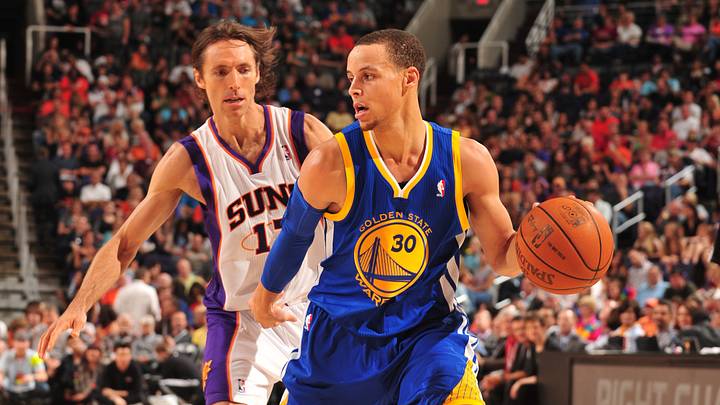
4. Stephen Curry, 2015

It was the beginning of the Golden State Warriors dynasty in the 2010s when Stephen Curry won his first MVP. Prior to winning MVP in the 2014-15 season, Curry's Warriors team hadn't gotten out of the second round, and he had only received one All-Star and All-NBA nomination the year before.
His numbers were solid; he averaged 23.8 points, 4.3 rebounds, 7.7 assists, and 2.0 steals. On the surface, those aren't sure-fire MVP numbers; what was more impressive, though, was his shooting. He led the league in 3-pointers attempted and made at 44.3 percent and led the NBA in free-throw percentage at 91.4 percent.
Like with Dirk before him, the narrative played a big part in winning the award. After hiring Steve Kerr as head coach, the Warriors increased their win total by 16 from the previous season. They were the number one team in the NBA that season with 67 wins, and after winning the MVP, Curry and the Warriors won the NBA title, which solidified the narrative behind his award.
Curry was also top-six in scoring this season, and the other two finalists for the award were James Harden and LeBron James. However, neither was able to establish a truly dominant stat line that could supplant Curry's narrative that season.

3. Derrick Rose, 2011
This one might be the most controversial on this list, and rightfully so. Derrick Rose was on his way to a Hall-of-Fame career before multiple injuries that stole his prime. The signature run for this point guard was the 2010-11 season, when he became the youngest player in NBA history to win MVP at 22-years-old. However, the stats aren't the main reason why Rose won MVP.
Let's start with the narrative against the player who had the stats to win the award. LeBron James left the Cleveland Cavaliers in one of the most infamous decisions to go play for the Miami Heat. He averaged 26.7 points, 7.5 rebounds, and 7.0 assists per game, versus 25.0 points, 4.1 rebounds, and 7.7 assists per game for Rose. On top of that, both teams were top in the Eastern Conference that year: Rose and the Chicago Bulls were first in the East, and LeBron and the Heat were second.
This isn't to say that Rose didn't have an MVP-caliber season; however, the narrative was working against LeBron this season and working for Rose, who was one of the most athletic point guards in the league at the time.
With that in mind, having Rose win MVP that season was easy enough to explain; however, there's a real argument that could have been made that LeBron James should have won MVP that year.
2. Steve Nash, 2005

Steven Nash was the conductor of one of the flashiest offenses of the 2000s. The "Seven Seconds or Less" offense run by the Phoenix Suns was innovative for its place in NBA history. It helped Nash win two MVPs back-to-back, but let's focus on the 2005 MVP.
In the 2004-05 season, Nash averaged 15.5 points, 3.3 rebounds, a league-leading 11.5 assists, and 1.0 steal per game, while shooting 50.2 percent from the field, 43.1 percent from downtown, and 88.7 percent from the foul line. The scoring isn't that impressive, obviously leading the NBA in assists, and nearly shooting 50-40-90 is beyond impressive.
The Suns were also the best regular-season team in the NBA that year, with 62 wins. Being the point guard for an innovative offseason, shooting at very high efficiency, and leading the best team in the regular season while also leading the NBA in assists is MVP-worthy.
However, being the best player on the best team doesn't make a player the best player in the league. The argument for Shaquille O'Neal or Dirk could have been made in that season, as both players finished in the top-three in MVP that year. However, narrative won out in this season for Nash, and the argument is there for him to win the award.

1. Karl Malone, 1999
When Michael Jordan left the NBA after his final title in the 1998 season, there was a big void left as to who the best player in the NBA was. Enter Karl Malone, who had already won an MVP award in the 1996-97 season. It's fair to ask why a two-time MVP winner makes number one on this list.
Let's first take a look at Malone as a whole, who was 35-years-old during his second MVP season. He averaged 23.8 points, 9.4 rebounds, 4.1 assists, and 1.3 steals. To put this into perspective, his scoring average that season was the 13th-highest of his career, which, in perspective, isn't that good at all for his personal achievements. His rebounding average of 9.4 was the 14th-highest of his career, which is even worse than his scoring average. In terms of just numbers, this was one of Malone's worst seasons while he was still the primary option on offense.
This was also the lockout season, in which the NBA only played 50 games, so this season was also out of the ordinary as well. It should also be noted that Malone's Utah Jazz weren't even head and shoulders above the best team in the NBA or even in the Western Conference, as they tied with the San Antonio Spurs, the eventual NBA champions that season, with the best regular-season record of 37-13
What helped Malone was that he was third in points per game that season, only trailing Iverson and Shaq that year. Both players did have winning records, but what is more damning is that Tim Duncan, young star of the Spurs who won it all and had the same regular season, along with being third in the award voting. Duncan had comparable numbers, as he averaged 21.7 points, 11.4 rebounds, 2.4 assists, and 2.5 blocks. It should also be noted that Alonzo Mourning was second in MVP voting that season.
Yet again, this isn't to say that none of these players didn't deserve to win MVP; they did. It's just that their cases for MVP relied more on narrative than on statistical outputs in some cases.
 Add us as a preferred source on Google