
The NBA MVP award has fallen into a predictable cycle of late. Giannis won twice. Then Jokić won twice. Then Embiid broke up the Jokić run, but the latter earned his third MVP award a year later. Then Shai Gilgeous-Alexander won twice, with Jokić finishing a close second both years.
Jokić isn't going anywhere. Nor is SGA. Embiid and Giannis are probably past their MVP primes, while the next generation — perhaps the next two-time winner — is coming up in the world, with a chance to break out this season. We should not discount the possibility of MVP No. 3 for Gilgeous-Alexander or No. 4 for Jokić, but these first-timers could shake up the race.
Honorable mentions: Kawhi Leonard, Scottie Barnes, Jalen Brunson, Cooper Flagg
Donovan Mitchell | Cleveland Cavaliers

We should talk about the Cleveland Cavaliers more. Not necessarily as a championship favorite — it is, unfortunately, very hard to trust James Harden in the playoffs — but definitely as a regular season buzzsaw. The Cavs addressed their biggest need this summer, landing Peyton Watson at a bargain price via sign-and-trade. He adds critical size, shooting and defense on the wing.
Donovan Mitchell finished tied for seventh in MVP voting last season, averaging 27.9 points, 4.5 rebounds and 5.7 assists on 61.3 percent true shooting. Cleveland couldn't put him in a much better position to succeed. Harden has really mastered the drive-and-kick, still able to draw two defenders and locate Mitchell with sonar precision. Mitchell is among the most explosive and powerful slashers in the NBA. He's deadly both off the catch and creating from scratch, having worked hard to add deception and gear shifts as a ball-handler.
Mitchell is not the most natural facilitator; you can argue that he does not really elevate teammates, a job that falls to Harden. But Mitchell is very much the engine behind a Cleveland team that's primed to compete for a top-four seed, maybe even the No. 1 seed. He creates advantages on a whim and has precious few holes in his scoring repertoire, able to blend his brute strength and speed with finesse floaters or deep movement 3s.
Anthony Edwards | Minnesota Timberwolves

The Minnesota Timberwolves are going to ball out this season. It's fair to quibble with their paper-thin frontcourt, but LaMelo Ball supercharges the offense in new and exciting ways, while any Rudy Gobert team is basically a top-10 defense by default. Anthony Edwards, of course, will remain center stage, coming off of his best individual campaign to date: 28.8 points, 5.0 rebounds and 3.7 assists on 61.7 percent true shooting.
Edwards isn't without his warts, but it's hard to deny the overwhelming star-power that emanates off the TV screen. He's is immensely likable and entertaining, which can absolutely play a factor in MVP voting. More importantly, he could reach new heights this year with LaMelo as his running mate. Kon Knueppel almost won Rookie of the Year as LaMelo's co-star; Edwards has never played with an orchestrator of this caliber.
The manner in which Ball warps and manipulates the defense, not to mention his ability to push the tempo, should profoundly benefit Edwards. He's already a dominant transition scorer; without Julius Randle mucking up the middle, Edwards should find more open driving lanes off setups from Ball.
Minnesota has a chance to emerge unambiguously as the primary challenger to OKC and San Antonio in the West. If that's so, and if Edwards posts career-high numbers on career-best efficiency, why wouldn't he garner MVP votes?
Cade Cunningham | Detroit Pistons

Cade Cunningham was one of four NBA players who received first-place MVP votes last season. The Detroit Pistons won 60 games and looked the part of a contender the whole time, with Cunningham very much front and center. Detroit's subsequent postseason flameout took some of the luster off, however, and Jalen Duren's never-ending free agency sure has not helped the vibes.
Let's assume, for now, that Detroit and Duren can come to an uneasy truce. The Pistons are more or less running back a 60-win team with marginal upgrades; John Collins is better than Tobias Harris, while first-round pick Ebuka Okorie adds much-needed shot creation in the second unit. All of this should mean the Pistons are still really good, led by elite defense and Cunningham's load-bearing offensive creation.
It's hard to overstate Cunningham's involvement in Detroit's offense. The Pistons were able to weather the storm when he was hurt last year, and Cunningham isn't the prettiest or most efficient high-volume scorer out there. But he's weaved into the fabric of just about everything Detroit does; he's a brilliant passer and a bullish, bully-ball slasher who has an innate sense of how to manipulate the defense, whether it's with his handle or his eyes.
He's a rock-solid defender, too, which helps. Very much the prototypical "jumbo point guard," Cunningham is built to be successful — and valuable — in the modern era.
Jayson Tatum | Boston Celtics

Jayson Tatum came back from a torn Achilles in record time and contributed on the back end of the Boston Celtics' incredible regular season. He didn't look quite himself in the playoffs and ultimately missed Boston's brutal Game 7 loss to Philadelphia, but he now gets a full summer to get his legs back under him. The Celtics are officially his team, now more than ever, after the Jaylen Brown trade.
Much has been said about the manner of Brown's departure and Boston's suspect return, but Joe Mazzulla has pretty much solved the regular season formula. The Celtics are going to spam 3s and play connected defense and win a bunch of games. Paul George needs to prove he can stay on the floor, but he's a very strong two-way complement to Tatum on the wing. Boston improved its frontcourt depth. The Celtics aren't going anywhere.
Last time we saw him at full strength, Tatum was more or less a top-five player. The Celtics might crash and burn again in the playoffs, but that doesn't mean anything in the MVP race. This is a regular season award and Tatum, barring another injury setback, figures to produce at an extremely high level for one of the better teams in a loaded Eastern Conference.
Victor Wembanyama | San Antonio Spurs

Victor Wembanyama finished third in MVP voting in his third NBA season, which isn't a half-bad arc. The San Antonio Spurs also went to the NBA Finals, toppling Oklahoma City's dynasty before it could really become a dynasty, and in the process threatening to become a dynasty in their own right. The Spurs did not win in the Finals, of course, so there's work to be done. But San Antonio is going to be right back in the mix next season and for many years to come.
Wemby won Defensive Player of the Year, an award he would've won the year prior, too, if not for a season-ending blood clot. The Spurs may never again play Wemby more than 30 minutes per game, as there are inherent injury concerns tied to his string-bean, 7-foot-4 frame. But does that even matter? We've never seen a defender who changes the geometry of the floor quite like Wembanyama. Teams straight up cannot score on the interior when he's on the floor. That sets such a high baseline for the Spurs.
The next step for Wembanyama is improving his efficiency and decision-making on offense. He's a preternaturally gifted scorer, with deep 3-point range and comically coordinated handles for such a massive human being. His ability to navigate pressure and create his own looks defies all conventional knowledge about this beloved sport.
While Wemby is never going to follow Shaq's advice and become an interior bruiser, he probably can stand to cut a few of the more challenging step-back jumpers out of his diet and spend more time rolling, catching lobs or looking to facilitate. Still, last season's 62.6 percent true shooting was a career high, trending in the right direction. He averaged 25.0 points, 11.5 rebounds, 3.1 assists and 3.1 blocks in only 29.2 minutes. You could argue, quite convincingly, that he is the favorite to win MVP this season and for the next half-decade.
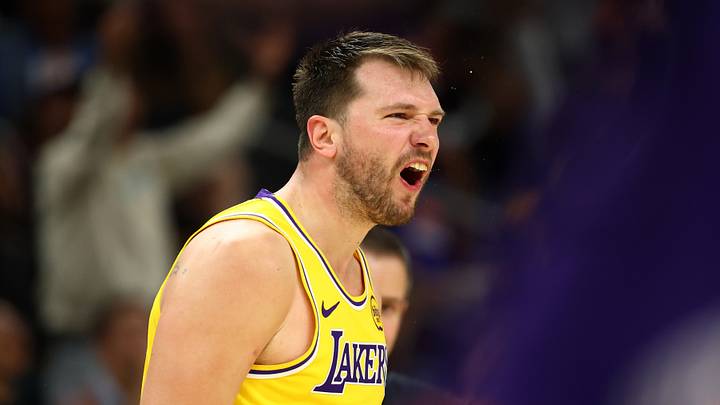
Luka Doncic | Los Angeles Lakers

Is Luka Dončić going to miss his window to win MVP? He ran up against Jokić and SGA; now Wemby is coming for the crown, giving Dončić zero margin for error. He averaged 33.5 points, 7.7 rebounds and 8.3 assists on 61.6 percent true shooting last season and finished a distant fourth in MVP voting, which speaks to the wealth of talent on display in the league.
That said, this could be the year for Dončić. Wemby is not guaranteed to reach 65 games; Jokić has won thrice and thus has to clear a higher bar to win MVP, while Gilgeous-Alexander would need to topple decades of NBA precedent to win a third straight. The Los Angeles Lakers, meanwhile, are now officially Dončić's team, without LeBron James' shadow looming over the organization. Los Angeles made a concerted effort to build a team around Dončić's skill set, with a rim-running, shot-blocking center in Walker Kessler, plus some skilled off-ball scorers in Quentin Grimes, Sandro Mamukelashvili and Collin Sexton.
The Lakers are going to put the ball in Dončić's hands and let him cook. It wouldn't be the least bit shocking if he's leading the NBA in usage and pushing 35 points per game on an L.A. team that, if healthy, should win plenty of games. The Lakers' depth and perimeter defense could prove problematic in the playoffs, but this team is built to thrive in a regular season environment, so long as Dončić can stay healthy. That really is the determining factor, as Dončić's extreme workload has clearly taken its toll in recent years.
If Wemby is not the favorite, then Dončić is. That's not to discount the past winners, but (recent) NBA history tells us its probably time for a new winner.
 Add us as a preferred source on Google