
The NBA offseason is mostly wrapped up, although a few noteworthy free agent stragglers remain. Jonathan Kuminga and DeMar DeRozan still need to find a home. In the meantime, we can look back at the last few months of chaos — all the shocking trades and questionable signings — and attempt to determine the five biggest mistakes.
That is admittedly a tall task, as the NBA is unpredictable in nature. We can't really know which decisions will age poorly this early in the process. There is a lot of time left to pass, and basketball left to be played, before we can draw definitive conclusions. That said, let's do our best to project forward.
Nuggets practically gave Peyton Watson away

It's not hard to understand some folks' trepidation around signing Peyton Watson, who basically has half a good season under his belt, to a four-year, $88 million contract. The Cavs also gave up Max Strus and a 2031 first-round pick to get it done. But Cleveland needed an athlete, someone who can guard on the wing, to compensate for their leaky backcourt defense.
Denver's side of this deal is inexplicable. If they didn't want to sign Watson for $22 million AAV, fine. He was a restricted free agent and there were no real remaining cap space teams around the league. Strong-arming Watson into taking the qualifying offer or signing a shorter-term deal could have its negative side effects (more on that later), but Denver held all the leverage. The only way for Watson to leave was via sign-and-trade, and the Nuggets opted for tax savings over trading him for an actual, useful player.
That 2031 Cavs pick could prove valuable down the road, but the Nuggets are trying to capitalize on a shrinking window with Nikola Jokić. This team continues to slowly bleed away talent and get incrementally worse each season. Watson was the only real player development win of the last few years in Denver, aside from Christian Braun, who was immediately overpaid. Denver gave him away for nothing. It's worth noting that Denver could also use defense and athleticism on the wing, and Watson was a 52 percent marksman on corner 3s last season. He benefitted from Jokić, and vice versa. Oh well.
Cavaliers are out of their mind with James Harden's extension

Credit to James Harden's agents, who secured a three-year, $97 million contract for the veteran point guard, with a player option and a trade kicker. All summer, the reports said Harden was both flexible and patient, willing to wait out the storm (i.e. the LeBron and Peyton Watson pursuits) and help Cleveland maximize its offseason. And to his credit, Harden was patient and the Cavs were able to maneuver their way to a major signing (Watson), re-sign Harden (for a lot), and somehow remain below the first apron. Cleveland was in the second apron only recently.
That is good business for the front office, but Harden is days away from his 37th birthday and coming off of a miserable postseason run, even if Cleveland made it to the conference finals. Harden is so much better than he gets credit for these days, but the postseason woes are too persistent throughout his career to ignore. Moreover, the odds of Harden providing north of $30 million in value in his age-39 season are close to zero.
Harden has become remarkably durable and consistent as a regular-season engine in recent years. He's always on the floor. He has embraced his post-MVP form, willing to focus on setting the table for teammates and taking more spot-up 3s. But he's also a horrendous team defender who has lost more than a step, no longer able to pressure the rim as fruitfully as he did in his prime.
Cleveland's backcourt arrangement was put under tremendous stress in the conference finals. The combined defensive shortcomings of Harden and Mitchell are problematic, to say the least. For Cleveland to tie up so much money, for forfeit so much flexibility, to hand Harden this contract — even as a reward for his patience and malleablity — is such a clear-as-day misstep.
Lakers put far too many eggs in the Walker Kessler basket

Walker Kessler couldn't ask for a better running mate to carry him through the prime of his career than Luka Dončić. He's not the same uber-bouncy lob threat that Derrick Lively is, but he will benefit similarly from spoon-fed dunks and layups at the rim. He can set screens to free up L.A.'s guards, while his rim protection is a massive boon for a Lakers team that spent last season relying on Deandre Ayton in that capacity.
The four-year, $129.5 million contract raised some eyebrows. While that's a lot for a center as limited in scope — at least offensively — as Walker, team-building is all about context, and pairing Walker and Dončić was understandably too appealing to pass up. The real issue was trading two unprotected future first-round picks and two unprotected first-round pick swaps to the Jazz.
Los Angeles has basically put all its eggs in the Walker Kessler basket. Between that deal and re-signing Austin Reaves to the max, the Lakers are fresh out of valuable picks to trade or money to spend on future free agents. There are normally creative ways around such limitations for the best front offices, but it's hard to trust Rob Pelinka and the Lakers to be smart with their resource allocation (four years, $60 million with a player option for Quentin Grimes was perhaps even more insane, to be honest).
There is not a single tradable first-round pick in the Lakers' cupboard through 2034. If this (very flawed) roster cannot break through in the West, it will be a while until Los Angeles can wiggle its way out of this corner.
Why exactly did the Wizards give Trae Young a max contract?

Washington signed Trae Young to a four-year, $212 million max extension. That effectively removed any leftover shine from the initial trade — a cheap pick-up that still seemed to favor the Hawks after CJ McCollum took two games off the Knicks in the playoffs, which is more than Victor Wembanyama can say.
Paying Young the max is one thing, but paying him the max in the current marketplace, when the CBA has squeezed high-spending teams and All-NBA players like Jalen Duren are struggling to get their worth on the open market, is even more stupefying. It's unclear which teams, if any, were even remotely interested in Young after an injury-plagued season. Who exactly were the Wizards bidding against? Your guess is as good as mine.
That's not to say Young can't or won't help the Wizards win a few more games this season. He's still a masterful passer with a penchant for manipulating defenders in the pick-and-roll. His shooting efficiency has tanked in recent years, but mere volume and reputation will still force defenders to stretch well past the 3-point line. If Young can stay on the floor and look a bit more like his old self, there's reason to believe he can help No. 1 overall pick A.J. Dybantsa carry the load. He's also a strong stylsitic fit next to Anthony Davis, if those two ever share the floor for an extended period of time.
It really does not help that the Eastern Conference is deeper than ever. Washington made the Young trade (and re-signed him) with the goal of accelerating their path to the postseason, but it's hard to see the Wizards finding the chemistry and stability necessary for such a leap in 2027.
Celtics are playing with fire after trading Jaylen Brown

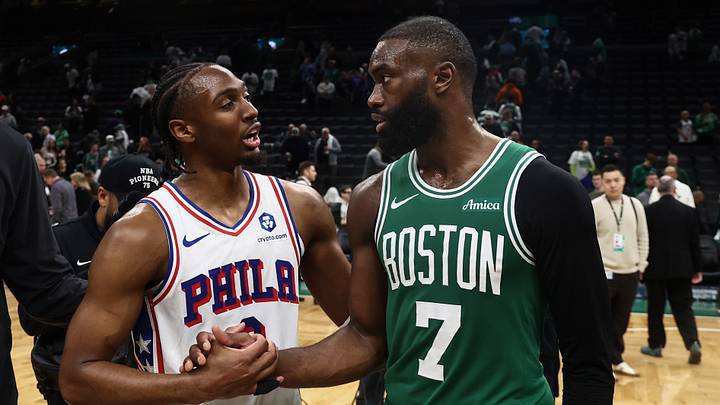
Boston's front office has probably earned the benefit of the doubt. Brad Stevens clearly knows what he's doing. But does their new ownership group? The Celtics basically used last summer to tear down the roster and expunge their cap sheet while Jayson Tatum was hurt. Jaylen Brown led Boston to 56 regular season wins and a 3-1 series lead over Philadelphia. The rest is history.
The Celtics clearly viewed the Brown trade, at least in part, as a salary dump. His supermax contract, worth $57.7 million this season and $65.6 million in 2028-29, is admittedly quite steep. Brown is a very talented but also extremely flawed star. The only problem with the trade from Boston's perspective: Paul George is only making marginally less, due $54.1 million this season. And while George was stellar in Philadelphia's stunning first-round comeback, he also sat 25 games midseason because of a suspension. Before that suspension, George's production and availability were sporadic at best.
He's not going to get a 25-game R&R period every season. At least not a healthy R&R period. George is 36 years old and has played 60-plus games just once in his last five seasons. While he's a better defender and spot-up shooter than Brown, the Celtics are replacing their most dependable offensive generator (besides a hopefully healthy Tatum) with someone who won't pressure the rim or effectively create from scratch in a playoff environment. Boston's offense got very stagnant late in that Sixers series, which was partially due to Brown's isos, but also partially because Brown was the only Celtic capable of consistent advantage creation.
The Celtics got a couple potentially valuable draft picks, but George is a less dependable star in the twilight of his career, and he does not really address what ailed Boston in the end. Brown's contract and play style carries its share of risk for the Sixers, but he's a durable one-man offensive ecosystem who can help them endure the inevitable Embiid-less stretches. He also helped the Sixers land LeBron James.
Boston trading Brown for George (and picks) was risky in a vacuum. Doing that trade with your arch divisional rival, who just knocked you out of the playoffs, and helping them gear up with LeBron, too — well, that's less than ideal. Philadelphia's organizational track record is far weaker than Boston's, so maybe there's some latent Celtics magic at work. But it does feel like Boston reopened a Sixers title window that had slammed shut.
 Add us as a preferred source on Google