
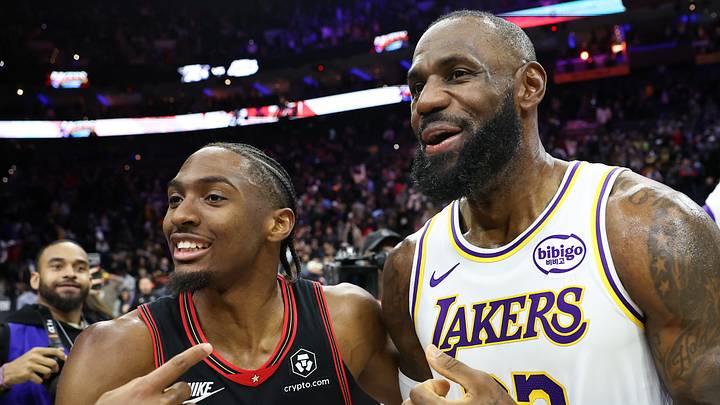
The Philadelphia 76ers' offseason was considered a resounding success as soon as new GM Mike Gansey flipped Paul George for Jaylen Brown. While that move wasn't without risk, it cranked open the Sixers' championship window ever so slightly. When LeBron James announced his intention to join the Sixers on a minimum contract, however, the offseason went from pleasantly surprising to downright unbelievable.
Yes, Philadelphia is coming for it all. And while there are plenty of unanswered questions as to the Sixers' ability to come together and maximize their excessive talent, there's no doubt that LeBron — even in his 24th NBA season, approaching his 42nd birthday — is a major boon. All four other starters in Philly should benefit from The King's arrival, but let's rank them based on who benefits the most.
4. Joel Embiid

I'll admit that when we did this exercise on The Sixer Sense Podcast, I placed Embiid third. Upon further reflection, however, let's bump the big fella down to No. 4. Again, every Sixers starter benefits from LeBron. There is no shortage of ways in which Embiid will have his load eased and game amplified by the greatest player of a generation.
LeBron allows the Sixers to stagger stars and better manage Embiid's minutes. To decrease his wear and tear offensively. Plus, LeBron immediately becomes the Sixers' best entry passer of the Embiid era by a country mile. Finally, someone who can deliver the basketball cleanly to Embiid in the post. What a gift.
LeBron can set Embiid upon on pick-and-pops, or feed him rolling to the rim, which is a new element of Embiid's skill set that this arrangement threatens to unlock.
That said, Embiid probably has to change his play style the most out of everybody by default. He's so used to being the heliocentric middle of Philadelphia's offense. There will still be plenty of opportunities for Embiid to hunt mismatches in the post and facilitate from the elbow. That said, the Sixers really need him to embrace the smaller things, like spacing out to the 3-point line, setting solid screens, and finishing at the rim. In fact, Embiid scaling down his usage is really a positive. It's all good, if everything clicks. But Embiid has the sharpest adjustment curve ahead of him.
3. VJ Edgecombe

Much has been made of VJ Edgecombe's diminished status in the Sixers' rotation after an eventful summer, with Draymond Green going so far as to say perhaps his agent should be upset (sour grapes much?). Yes, Edgecombe went from the second or third option a lot of nights to a clear No. 5 option in a loaded starting five. But it's worth remembering that Philly will play a lot of minutes without all five starters on the floor, during which Edgecombe can scale up. It's also worth remembering that, by default, Edgecombe will have the opponent's worst defender on him when the whole lineup is on the court.
Edgecombe still has room to grow as a shooter and finisher, but he's a sensational athlete who thrives in the open court. Really, the entire Sixers lineup (sans Embiid) is built to dominate in transition. LeBron slings an outlet pass as well as anyone in the league. Edgecombe is about as fast as Tyrese Maxey at full sprint. In the halfcourt, LeBron can spoon-feed open 3s, find him on backdoor cuts and lobs, or pinpoint Edgecombe in advantageous positions.
By virtue of how much attention opposing defenses will pay to Edgecombe's teammates, the second-year guard should get plenty of opportunities to feast on mismatches. If he improves as a shooter and ball-handler — and given his work ethic, there's every reason to believe he can — Edgecombe ought to walk into a ton of easy buckets. He is not going to be some afterthought every night.
Plus, this is a golden opportunity for Edgecombe to soak up knowledge from one of the game's greats. That is a less tangible benefit, but no less important for his development. There will come a time when the Sixers want Edgecombe to scale up and embrace stardom. Surely he can learn a few tips of the trade for his self-proclaimed GOAT.
2. Jaylen Brown

This new-look Sixers lineup will require an incredible amount of buy-in from Jaylen Brown, whose Celtics exit raised questions about just how willing he is to share the spotlight. That said, Brown has said all the right things since the trade. In his introductory press conference, he gave a quote that could come to define Philadelphia's season:
"I think at different points of my career, how I've handled pressure will probably look different. At this point now, I probably ignore a lot of it or just like kinda let it just be water under the bridge. My relationship with the media hasn't always been the best. That's part of the reason why I started streaming. I played in Boston for the last 10 years and the pressure is high there. It's title town, they expect to win every single year, and they're always looking for someone to blame. Some of those years, it was me. I've been through that. All I come with is my work ethic, my mentality, impact on winning and that's just my approach. Nothing else matter. How do we win games"
Brown has been through the media wringer all summer. The Celtics clearly wanted to reorganize their cap sheet and remove Brown's high-usage skill set from their rotation. Philadelphia will embrace everything Brown brings, even with his considerable faults. Brown is one of the most prolific and effective isolation scorers in the NBA. He applies constant pressure on the rim and is comfortable creating from scratch, which Philly will need late in games.
He has also dealt with turnover problems and efficiency concerns, largely a byproduct of the extremely high usage that he embraced last season as Boston's guiding light. Brown has never been the most natural facilitator. He can get bogged down in attacking unfavorable matchups and taking tough, contested mid-range jumpers.
The questions about Brown's willingness to sacrifice stem from comments he made after the season, calling it his favorite year in Boston, despite winning a championship two years prior with Jayson Tatum as an equal partner in the offense.
Brown delivered another gem in his presser, however, and one that's equally critical to making this ambitious experiment work: "It doesn’t have to be anybody’s team."
LeBron should help Brown ease his usage in the halfcourt. He's the best passer Brown has ever played with. He can find him on backdoor cuts, or hit him with a bullet pass in-stride, off of movement, so Brown does not need to break down the defense all on his own. Expect plenty of pick-and-rolls with Brown setting the screen and catching around the elbow. He is a great cutter and finisher when he wants to be.
If James can help optimize Brown's unique athleticism and scoring ability while helping to dampen those turnover numbers and remove him from less favorable situations, that will be a huge win. Brown needs to buy in, of course, but everything he has said to date suggests that he is willing and able to take a smaller share of the offensive pie.
1. Tyrese Maxey

One of the most common "concerns" circulated in the media after James made his decision was Philadelphia demoting Tyrese Maxey. Taking the team away from an ascending All-NBA talent, so to speak. That feels wildly out of line with who Maxey is as a player and a person. Not only is Maxey more than willing to share the spotlight and sacrifice where needed, but he has always — always — played his best basketball, well, away from the basketball.
Maxey's struggles in the Knicks series, for example, were because he was asked to do far too much. For all his immense talent, Maxey has never been an elite isolation scorer or self-creator. He's far more dangerous bombing spot-up 3s and using his electric speed to attack closeouts and pressure the rim against a tilted defense. It's why he played some of his most efficient, inspired basketball next to James Harden. And it's why LeBron's presence should massively aid his Klutch Sports understudy.
LeBron is going to hit Maxey on outlet passes and get him burning rubber in the open court. He's going to find Maxey behind the 3-point line, using his own gravity to create driving lanes that Maxey can exploit. There's a reason small, score-first guards like Kyrie Irving and Austin Reaves go so much out of their LeBron partnerships. That same principle applies to Maxey, who's arguably better than both of them at his current peak.
This new arrangement will also help keep Maxey's workload in check. Philadelphia has been playing with fire for years now, running Maxey into the ground because he's their lone durable, dependable star. He led the NBA with an absurd 38.0 minutes per game last season — after averaging 37.7 the year prior, and 37.5 the year before that.
Just helping Maxey take on a more manageable workload, where he's not asked to step on the court and carry a supermassive load every night, will help Philadelphia preserve and maximize its most ardent, shining beam of light.
Maxey was clearly the main reason LeBron was willing to sign in Philadelphia, and that partnership should yield major benefits in both directions.
 Add us as a preferred source on Google