
With the new year upon us and a couple months until the NBA trade deadline, the rumor mill is buzzing. Plenty of buzzy names are being tossed around, but in this era of heightened CBA penalties, it’s easy to theorize about a blockbuster trade than it is to actually completed one.
Not to worry, though. ‘Tis no longer the season for milk and cookies by the fireplace, but it is the season for absurd trade machine concoctions. My goal is to make those absurd concoctions somewhat reasonable and worthy of your contemplation.
Pelicans trade Zion Williamson to Suns

Zion Williamson continues to play well when he’s actually available. Unfortunately, the former No. 1 pick has already missed a spate of games this season and he has played more than 60 games in a season just twice in seven years. With the New Orleans Pelicans toiling at the bottom of the standings and no discernible path toward immediate contention, it’s time to find the exit ramp.
Of all the NBA buy-low candidates at the deadline, Zion is perhaps the most compelling — and the riskiest. He’s only 25, his contract is non-guaranteed moving forward, and again, he’s a good player. Zion’s blend of quickness and strength is unmatched; he can get to the rim at will, he’s a slick passer on the move, and he’s a genuine offensive engine at the peak of his powers.
If the Phoenix Suns, in the middle of an unexpectedly competitive season, want to spice things up a bit and give Devin Booker a legitimate running mate, Zion certainly fits the bill. It would be smart for Phoenix to sell high on Dillon Brooks, who is putting up empty stats while his defense suffers. Grayson Allen is enjoying a productive season, and he’s still a sniper from 3-point range, but his efficiency has slipped ever so slightly under a more burdensome workload.
This trade gives the Pelicans a couple useful role players — both on reasonable contracts, both of whom could be flipped at a later date — and what promises to be a first-round pick somewhere in the 10-to-20 range. That ought to appeal to New Orleans after shipping their own first-round pick, which could end up No. 1 overall, to Atlanta in the Derik Queen trade.
For Phoenix, it’s a chance to see if Zion can stay healthy. If he can, there’s a lot of upside between him and Booker. Williamson fits the Suns’ more youthful timeline and if he flames out spectacularly, so be it. The Suns can cut bait and free up the money, no problem. The Suns don’t really have much guard depth around Booker right now, save for the ever-inconsistent and presently unavailable Jalen Green. Zion is more or less a guard and a forward all at once, giving Phoenix another mechanism for running the offense, with a level of rim pressure and shot creation that should elevate role players and put Booker in more advantageous spots. It’s a fun concept, if everything breaks right.
Hornets trade LaMelo Ball to Timberwolves

With Mike Conley hitting a wall, the Minnesota Timberwolves could really use a facelift at point guard. This is still a very competitive team, but something feels a little off right now, and there’s a case for a major shake-up, if not wholesale changes. Anthony Edwards is still their guiding light, of course, but it’s fair to wonder if Julius Randle is the right No. 2 to get Minnesota where it wants to go.
Now, is LaMelo Ball that right No. 2? It’s fair to hesitate in your response. This trade is not without risk, as Ball has never really been in a winning situation since high school. The Charlotte Hornets’ lack of culture in recent years, compounded by Ball’s persistent injuries, has clouded his reputation. We have not seen him in a position to meaningfully contend, and it’s unclear if he would operate with the seriousness necessary to capitalize on such an opportunity.
The upside, however, is significant. Ball’s size, skill and feel at the point guard position is a rare blend. He’s one of the nuttiest passers in the sport — a true basketball poet, operating with an unbridled creativity that can manifest open shots for teammates out of thin air. He doesn’t need to pound the rock much to set the offense in motion. Letting him push the tempo a bit next to Ant, and perhaps toss a few lobs to Rudy Gobert, could free up Minnesota’s offense to take a real leap.
That said, Ball can also get lost in the sauce. There are bad turnovers aplenty, and he’s not really committed defensively, despite possessing the tools and instincts to be quite good on that end in theory. If the Wolves assess the risk and deem it too substantial, so be it. That is understandable. I’d like to see them give it a shot, though.
As for the Hornets, this is an opportunity to shift focus and reset. Julius Randle might actually help them win a few too many games in the short term, but if he does, Charlotte can float him in trade talks next summer. Mike Conley is an excellent locker room figure as the Hornets attempt this cultural overhaul. Rob Dillingham is a fun upside bet in the backcourt in lieu of Ball.
Most importantly, this clears the way for Kon Knueppel and Brandon Miller to take center stage as Charlotte’s primary building blocks for the future. Randle is a means to an end, and a potential short-term buoy, but Dillingham, the potential financial flexibility, and any draft assets Charlotte might be able to squeeze out of Minnesota, are the real focal points here. That, and finally turning the page on the cursed LaMelo Ball era, even if the curse wasn’t really his fault.
Lakers trade Austin Reaves to Bulls in 3-team deal

Hell, why not? Let’s get weird. The Brooklyn Nets want to cash in on Michael Porter Jr.’s resurgent season. The Los Angeles Lakers could use a bit more size, and it’s unclear if the Luka Dončić-Austin Reaves pairing can actually work long term. The Chicago Bulls are stuck in no-man’s land and could use some sort of foundational change, even if it leaves them in a similar state of perpetual Play-In contention.
This trade addresses all three issues. Chicago swaps out Josh Giddey, in the middle of a career year, for Austin Reaves and Rui Hachimura — an upgrade at point guard and an immediate contributor on the wing. L.A. gets its size influx with Porter, who can come in and bomb 3s off of Dončič setups, while ideally hammering the glass and maintaining the defensive effort he has showcased in Brooklyn. The Nets get to watch Josh Giddey cook for a while and then, like Porter, flip him for assets down the line. Chicago's first-round pick, a potential lottery selection, is a nice sweetener.
Brooklyn already received a nice bit of draft capital along with Porter in the Cam Johnson trade. Giddey does not really fit Brooklyn's current roster, and yet, he's the exact player archetype this front office apparently loves. Giddey was the most common pre-draft comp for Egor Dëmin. There's a bit of overlap in pairing them, but Brooklyn has committed to this multiple ball-handlers setup, and Giddey is much further along than Dëmin. He can feed the Cam Thomases of the world and give the Nets' tall, multifaceted lineups a different kind of juice. Dëmin, honestly, is at his best when he's just shooting 3s right now. He can learn a lot from Giddey, and perhaps benefit on the court in the interim.
Chicago gets better. Whether or not selling their first-round pick at this juncture is smart is up for debate, but we know how this front office operates, and tanking for a high draft pick is not really a consideration. Reaves will need a new contract soon, but Chicago can happily foot the bill. Reaves has proven himself quite adept as a No. 1 option when Dončić misses time. He’s not much of a downgrade from Giddey in terms of playmaking, but he’s a huge upgrade in terms of scoring. Reaves’ rim pressure, foul-drawing, and three-level dynamism would infuse this Bulls offense with a bit more life. Billy Donovan is a great coach to maximize Reaves’ offensive skill set and mitigate his defensive shortcomings.
As for the Lakers, it’s fair to wonder if Porter is a better asset than Reaves. In fact, he probably is not. But as this team attempts to recenter around Dončić, Porter is absolutely a better fit. He’s not known for his defensive prowess, but the Nets are a better team defensively with Porter on the floor this season. Offensively, the former lottery pick has looked right at home as the No. 1 option. It’s fair to wonder if Porter is amenable to shifting back into a more complementary role at this point in his career — he made sure everyone knew he was glad to get out of Denver and chuck more shots in Brooklyn — but he’d embrace the L.A. spotlight (good luck with that, Lakers fans) and he’d benefit a ton, in theory, from Dončić’s singular gravity and playmaking skills.
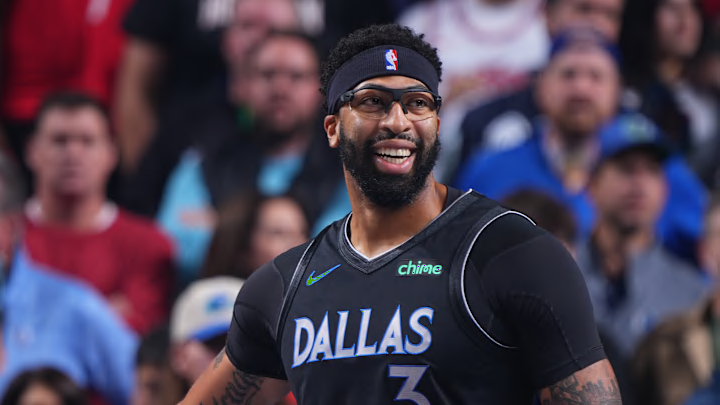
Mavericks trade Anthony Davis to Hawks

The Atlanta Hawks are probably the team most overtly connected to the Dallas Mavericks in Anthony Davis trade rumors. Trae Young is probably not a part of this deal, but the idea that Atlanta can’t win with Young on the floor feels a little bit overblown, even if his struggles have been pronounced this year. That’s not to say Atlanta shouldn’t explore trades — it’s time — but finding a different trade partner, or keeping Young through the end of the season, is not a dealbreaker.
Despite all the negative hubbub around Dallas’ trade for Davis, he remains an incredibly impactful, positive player when he’s healthy. The health issue is a major factor, of course, especially for this Hawks team, but Davis can help Atlanta take the next step after a disappointing start to the season.
On paper, this Hawks team has all the hallmarks of a contender — the multifaceted, big playmaking wing in Jalen Johnson, the elite defensive apparatus in Porzingis (when available), Nickeil Alexander-Walker and Dyson Daniels. The star point guard. Davis improves the defense and is probably a better stylistic fit for Young than Porzingis is, assuming Atlanta keeps its point guard through the deadline.
Davis is still under contract for three more years, which is potentially a gift and potentially a curse. The downside risk is enormous, there’s no way around it, but if Davis can stabilize as a steadfast second star who cleans up on easy looks at the rim and dominates the paint defensively, Atlanta will come away from this deal satisfied.
The toll of trading for AD at this point shouldn’t be too steep. It’s a pure cash dump and reset for the Mavs. Zaccharie Risacher is a better player than he’s made out to be, but he’s not your typical No. 1 pick in terms of upside. The Mavs can develop him with essentially seven more years of team control, hoping that his shooting and off-ball instincts pair effectively with Cooper Flagg and Kyrie Irving. Dallas also gets an solid bench guard in Luke Kennard, who’d help a lot in his role, and an expiring big man to fill Davis’ shoes in Porzingis — an awkward but necessary reunion. Porzingis is still quite effective barring injuries, and his blend of shot-blocking, shooting and post scoring can help the Mavs win games until his presumed departure next summer.
The Mavs get out from under AD’s contract and finally move past the Nico Harrison baggage. Atlanta gets a still-effective two-way anchor in the post as it attempts to thread the needle between a bright future and a roster built to compete right now, while the East is a wide-open playing field.
 Add us as a preferred source on Google