
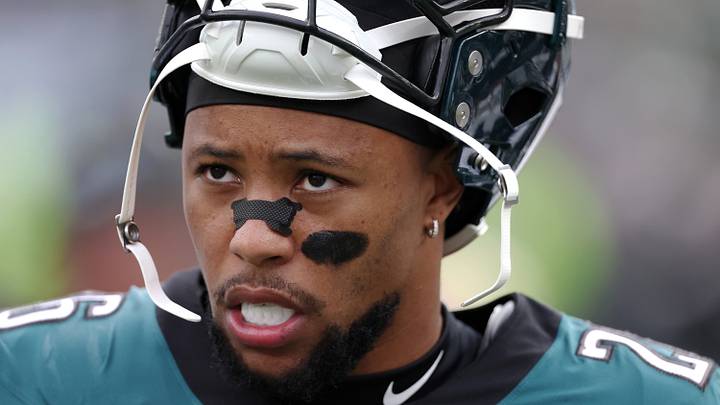
Philadelphia Eagles fans had every right to enjoy Sunday's victory over the Pittsburgh Steelers, but that win did nothing to alter what's already a lost season. Philadelphia's 3-7 record still leaves them in last place in the NFC East standings, and with Jalen Hurts already done for the year, their playoff hopes are on life support.
That reality should have led the Eagles to offload any veteran with value ahead of this year's trade deadline. To GM Howie Roseman's credit, he did manage to recoup valuable draft compensation for both Jordan Davis and Cam Jurgens. But the real question is why Philadelphia did not follow the same blueprint with big-name running back Saquon Barkley.
Why didn't the Eagles move Saquon Barkley at the trade deadline?

The 29-year-old is speeding towards the stage of his career at which running backs typically experience sharp age-related decline. He admitted after the win over the Steelers on Sunday that he "probably wouldn't be 100 percent" for the rest of his 2027 campaign. That admission is proof that Roseman and his staff should have shopped Barkley aggressively to teams looking for a dynamic rusher to help boost their Super Bowl chances via an in-season trade.
There is a possibility that Philadelphia might revisit the idea of trading Barkley in the offseason. The problem with that strategy is that teams are going to watch him play at less than 100 percent for the rest of this regular season, and t's easy to envision a scenario where that has a chilling effect on Barkley's trade value around the league.
The uncertainty around the franchise's future at quarterback could also have a negative impact on Barkley's trade value. If Philadelphia does part ways with Hurts for health or performance reasons, it will portend a youth movement on offense overall. Keeping a high-priced running back in his 30s does not align with that sort of philosophy. Other teams will realize that and cut their potential trade offers for Barkley.
Barkley's current contract runs through 2029, but the Eagles have a chance to get out of the deal early if they so choose. That kind of move would require Philadelphia to assume a healthy amount of dead cap, though, which is why trading him for meaningful draft compensation would have been the better path forward for the organization.
What does the future hold for Saquon Barkley and the Eagles?
The Eagles seem to be determined to keep Barkley in the fold to help them reload rather than rebuild. If he can extend his prime for another season or two it could do wonders for Philadelphia's next franchise quarterback, whether that's Hurts or a prospect.
That modest goal is an uncharasterically short-sighted move by Roseman and a front office that typically excel at taking the long view. The odds favor them regretting their unwillingness to listen to trade offers for Barkley this season.
 Add us as a preferred source on Google