
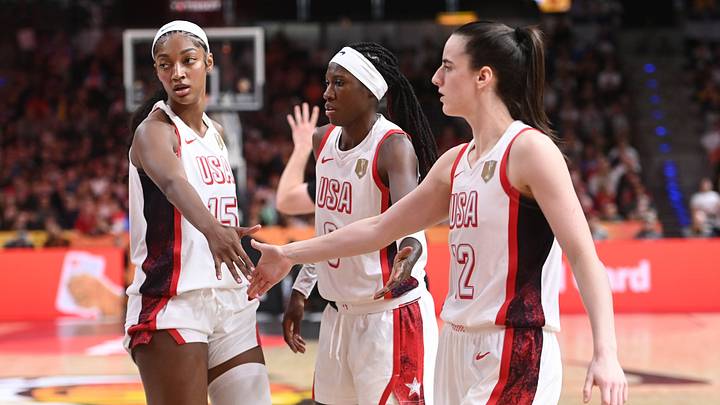
We just watched Team USA secure their first victory of the 2026 FIBA World Cup, a dominant 94-61 win over China. While the stars looked comfortable and in tune on the court, WNBA fans at home may have noticed some key differences from what we're used to.
With each international tournament come some adjustments needed for players who are used to competing in the WNBA. None of the tweaks to the rulebook are groundbreaking, but they definitely make a difference in some situations. Here are the six biggest contrasts between FIBA and WNBA play.
1. Five vs. six fouls
In a normal WNBA game, a player is allowed six fouls before fouling out, putting them on the bench for the rest of the game. In FIBA play, players are allowed only five fouls. This shouldn't affect many of the Team USA players, all of whom played with five fouls in the college ranks. However, four Team USA players — Kiki Iriafen, Caitlin Clark, Aliyah Boston and Angel Reese — are averaging over 3.0 fouls per game this WNBA season. It's definitely something to watch in closer games.

2. Defensive 3-second rule
While both leagues enforce the offensive 3-second violation, things are different when it comes to defense. The WNBA, like the NBA, enforces a defensive 3-second rule, meaning a defender can't camp out, in the paint. The defender must be actively guarding someone within three seconds. FIBA has forgone this rule entirely, giving players, specifically bigs, the opportunity to stay close to the basket in order to close on the lane or block a shot.
3. Rim protection
Speaking of bigs protecting the paint — while the WNBA has a rule against rim protection, FIBA does not. In the WNBA, the rules do not allow players to touch the ball if it's in or above the rim. In international play, none of that is off-limits. Once the ball hits the rim, a player can swat at it, tip it in the hoop, bounce it off the backboard or anything else. On a recent episode of her podcast Game Recognize Game, Team USA forward Breanna Stewart called this rule "so crazy," stating: "Like you can literally like hit it off the rim. That's nuts."

4. Jump balls
This one is pretty simple: In the WNBA, during held balls or tie-ups, play will stop and the referees will call a jump ball. They then toss the ball up and the players essentially fight for possession as they would on the tipoff that begins each game. In FIBA play, though, there are only jump balls at the beginining of the first quarter and overtime periods. If there is a held ball or tie-up, they use the possession arrow to determine whose ball it is, much like the old college system.
5. A smaller court (and a closer 3-point line)
Now let's step away from the rules and focus on the more apparent differences. The court used in FIBA play is slightly smaller than in the WNBA. A normal WNBA court is 94 feet by 50 feet. The FIBA courts are just under 92 feet by just over 49 feet.
Something that might impact some shooters a little more is the difference in the 3-point line — another very slight disparity, though. In the WNBA, the line is 22 feet and 1.75 inches from the basket. In FIBA play, the line is a bit closer, 20 feet and 8 inches away from the basket.
6. Different ball
You've likely noticed World Cup balls don't look like the ones we WNBA fans are used to. While both balls are the standard size-6 ball with a circumference of 28.5 inches, the WNBA uses an 8-panel Wilson ball, while FIBA uses a 12-panel Molten ball. This causes a difference in grip and overall feel for players.
While these differences don't impact some players too much, others say they're completely game-changing. Diana Taurasi, a Team USA legend with a wealth of international experience including six Olympic Gold Medals, gave her thoughts back in 2024. Per Desert Wave Co, DT stated: "I mean, playing international basketball is like a different sport. The ball's different, the lines are different, the buzzer's different, the refs are different."
 Add us as a preferred source on Google