
College football fans are being asked to swallow a lot right now. Despite vocal and vehement opposition, the list of things that fans don’t want and that are being forced upon them continues to grow.
A bigger Playoff that threatens to cheapen the entire event. The elimination of conference championship games to accommodate that larger Playoff field, along with a bowl season that keeps dwindling and becoming less relevant. A regular season that was once the best in all of sports, but whose consequences keep getting softened.
Fans apparently have little say in what college football becomes. But they should at least be able to trust how its games are officiated — and after the wildest weekend in recent memory saw several downright glaring mistakes, that trust is at an all-time low.
College football's officiating safety net has failed on multiple occasions this season

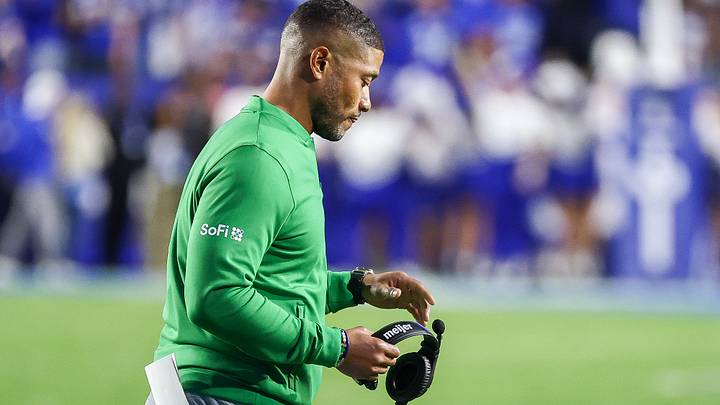
We’ve seen examples all season of failed officiating, but Week 7 brought several high-profile cases that merit special attention. Exhibit A: At the end of a barnburner between Notre Dame and BYU, the officials — both on the field and in the replay booth — declared the game over after missing that there was still a second remaining on the clock when CJ Carr's final pass attempt fell incomplete in the end zone.
The Big 12 acknowledged that time remained when the final pass hit the ground and that the replay crew incorrectly cleared the play. Notre Dame should have received another snap. The conference has promised a review of its end-of-game process.
But that “review of process” statement is something fans have heard before, and not just from the Big 12. The problem is, the process didn’t fail; the officials did.
The officials had a mechanism in place that was specifically intended to catch this. That mechanism still failed at the moment it mattered most. An acknowledgment after the fact cannot restore the lost opportunity for any team. There’s no way of knowing whether Notre Dame would have won the game, but the Irish deserved the chance the rules provided, and they were denied that opportunity despite clear evidence that was completely overlooked.
Earlier this season, the end-of-game clock was again the culprit in poor officiating. Only in the case of Michigan vs. Western Michigan, instead of ignoring a second left on the clock, the officials opted to give Michigan an extra second that wasn’t deserved under protocol. The NCAA oversight committee concluded that proper replay protocol would have produced a different outcome, and that Western Michigan should have been the victor, yet there’s no mechanism for overturning the final score.
Beyond these major issues, the list of “oops, we got it wrong” instances has been dizzying this season:
- The Big Ten admitted officiating errors in Oregon-UCLA
- The Big Ten also recognized errors in the Northwestern-Maryland game
- The SEC admitted an onside kick officiating error in Texas-Tennessee
It feels as if every week fans are forced to deal with a “what if” because of officiating errors that aren’t judgment calls, but rather incorrect applications of the rules.
Replay was supposed to make obvious errors less frequent
The use of instant replay and reviews from the booth was supposed to reduce the chances that an obvious error would slip through the cracks. Fans now endure stoppages, long delays and explanations, yet consequential mistakes still escape correction. Replay was supposed to be the safety net; too often, it feels like another hole in the floor.
We can begin with what it cannot fix. While Notre Dame and BYU were going down to the wire, it looked like Florida State was about to take Miami to a third overtime after a dramatic, fourth-down Hail Mary touchdown. But that touchdown was wiped away due to a highly controversial holding call — one that no replay review system can retroactively correct, despite having endless camera angles to do so.
This was the holding call that negated the Hail Mary for Florida State… pic.twitter.com/BRIfV15tTV
— Tony Clements (@TonyCMKE) October 18, 2026
Then there are the mistakes the booth can address. That’s where “clear and obvious” starts doing an awful lot of heavy lifting: There should be a high standard for overturning a call, but when an explanation rests on uncertainty that the available video appears to resolve, fans deserve something more substantial than another recitation of the standard. Otherwise, “clear and obvious” begins to sound like the reason for having replay and the excuse for accomplishing nothing with it.
And who is making sure the review process itself works consistently? Who answers when the safety net fails? A procedure is only useful if people follow it, someone checks their work and mistakes lead to changes that extend beyond the crew that made them.
College football cannot keep interrupting games in the name of getting calls right, and then shrug when the review becomes part of what went wrong. More cameras and longer delays cannot supply the leadership the sport keeps doing without.
Before college football can fix its officiating, somebody has to own the problem
College football is one of the most lucrative sports in the world, generating billions of dollars every year, yet there’s no single person who has authority and takes responsibility for how the sport is run. Conference leaders answer for their pieces of college football, but they're by definition in competition with one another. The sport needs someone responsible for the whole: setting expectations, requiring explanations and making sure corrections carry across conference lines.
College football has powerful conference commissioners, television partners and playoff executives. Their fragmented authority leaves nobody visibly responsible for delivering a consistent national officiating standard.
Right now, every fan base says their conference has the worst officials in the country. The sad truth is, they’re all probably right in saying so. An admission from a conference office that a crew made a mistake does nothing but exacerbate the problem.
Who requires corrective action? Who tracks whether it works? Who answers when the same failure happens again? Who owns the recurring problem? Who must show that it is getting better? Right now, those answers are largely unknown.
Fans should expect the same application of the rules whether their team is playing in Athens, Ann Arbor or Provo. A catch should be a catch. The standard for overturning a call should travel as reliably as the equipment trucks. Nobody should need to know which conference supplied the crew to understand how a game will be officiated.
That requires someone with the authority to make consistency a requirement and answer when it breaks down. Conference commissioners have their own memberships to serve and interests to protect. Who is responsible for making sure a mistake identified by one conference becomes a lesson for every crew in the country?
The concrete fixes are obvious, but will anyone make it happen?
There’s simply no denying that there’s a problem when it comes to officiating, and the solutions are just as obvious.
What could help?
- An independent national officiating authority: Common training, evaluation, replay procedures and assignment standards across FBS.
- Public explanations of major errors: Identify the applicable rule, what went wrong and what will change beyond an “internal review”.
- Consequences tied to performance: Retraining, reassignment or removal for repeated serious failures, with a published accountability policy.
- Investment in the workforce: Better recruitment, compensation, training and retention. The players, coaches and executives are all being paid like professionals; it’s time to give officials that same respect.
- A focused replay audit: Determine why correctable errors survive before expanding the list of things officials can review.
Investment is happening in practically every other facet of the sport, yet these seemingly simple steps to correct a core element of the sport continually seem to be pushed aside. We're not asking for perfection, just improvement and a reason to trust.
As with anything, perfection is impossible. An occasional human mistake is understandable, but recurring failure that the sport’s leadership cannot convincingly explain or correct is unacceptable.
Fans can tolerate losing. What erodes their loyalty and investment is wondering whether the rules were applied competently and whether anyone with authority cares enough to improve them. If the people running college football insist on changing its postseason, traditions and stakes, the least they owe everyone watching and supporting the sport is a credible system for deciding what happens on the field.
 Add us as a preferred source on Google