
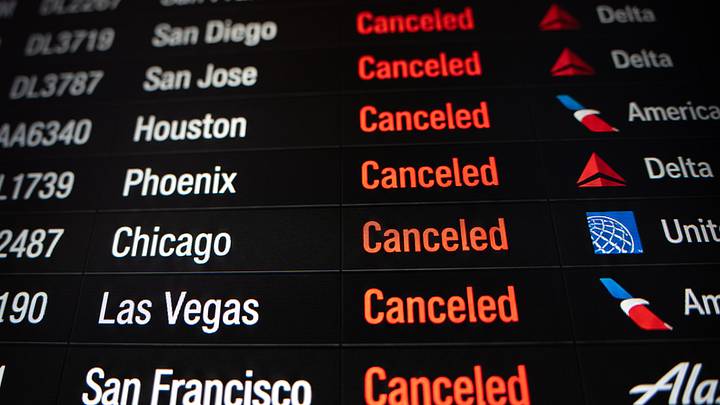
Nine of Saturday's college football games had their start times changed due to teams' flights being unable to reach their destinations Friday night. That came after the Federal Aviation Administration issued a nationwide ground stop for the first time since 2023 over what officials said were aging technology failures.
Several college football kickoff times have been adjusted for Saturday due to FAA flight restrictions.
— ESPN College Football (@ESPNCFB) November 14, 2026
Here's a look at the updated schedule. All times Eastern. pic.twitter.com/QsYxfWdv8k
In two of those, the visiting team had to travel across multiple time zones to face a conference opponent. In the Big 12, Arizona State was forced to fly the morning of its contest with UCF in Orlando, Fla., and in the Big Ten, Washington was delayed getting to East Lansing, Mich., to face Michigan State.
Even with pushed kickoff times, routines were disrupted, putting the traveling squads at a serious disadvantage. Perhaps that could have been prevented if teams didn't have to travel more than 1,000 miles one way to play a team in its own conference. Then programs like Arizona State and Washington could've just hopped on a bus when flights were cancelled and still arrived with enough time to prepare. But that's nonsense. What are we even thinking here?
What if we had small regional conferences that didn’t require everyone flying across the country each week? 🤔 https://t.co/OaZWhTDsRT
— RedditCFB (@RedditCFB) November 13, 2026



Ground stop reopened conference realingment wounds
The massive headache created by this ground stop is exposing the ridiculousness of the new college football landscape fans are only just starting to get used to. We're in Year 3 of the Power Four era after the Pac-12 experienced a mass exodus that saw four Pacific Coast teams (USC, UCLA, Washington and Oregon) join the Midwest-based Big Ten. The first of those moves ultimately triggered four Mountain Time Zone teams (Arizona State, Arizona, Colorado and Utah) to join the already ballooning Big 12, which had just added BYU and Eastern teams Cincinnati and UCF the year prior.
Of course, the most asinine departures were Stanford and California joining the Atlantic Coast Conference with Dallas-based SMU. These were only the latest chapters in the realignment saga that also featured Texas and Oklahoma joining old Big 12 neighbors Missouri and Texas A&M in the Southeastern Conference.
There's only one college football program that is justified in traveling hundreds of miles one way (or making opponents come that far to them) and that's Hawaii, because it's on an island in the middle of the Pacific Ocean. Otherwise, these cross-country conference matchups are creating more problems than they solved (translation: more money for television). If this was the goal, then the Airplane Conference was shot down roughly 80 years ago for nothing.
Conferences adjusted accordingly to the disruptive ground stop, but if the bulk of traveling teams lose Saturday, then there could be an argument for teams to travel less. With the advent of the 24-team College Football Playoff in 2027, conference title games are disappearing. That raises the key question: Are conferences that require absurd travel even necessary anymore?
 Add us as a preferred source on Google