
Key Points
Bullet point summary by AI
- Shinnecock Hills Golf Club has hosted the U.S. Open in three different centuries, most recently in 2026.
- Only six players in U.S. Open history have finished under par at Shinnecock, a course known for its difficulty and wind.
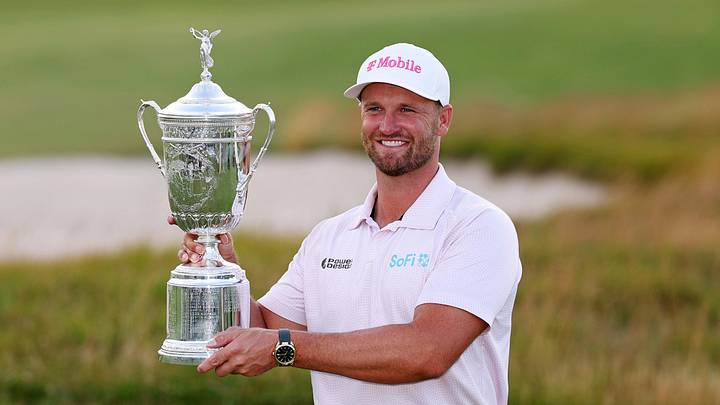
- Wyndham Clark won the 2026 U.S. Open at Shinnecock by one stroke, becoming the first wire-to-wire winner since 2014.
Of every course that's ever hosted the U.S. Open since golf's second-oldest major was first contested in 1895, only Shinnecock Hills Golf Club has hosted America's national championship in three different centuries.
Established in 1891, Shinnecock became one of the five founding clubs of the USGA in 1894 and served as the host of the second-ever U.S. Open in 1896. It took a while for the tourney to return — nine decades, to be exact — but the famed Long Island venue has become a semi-regular part of the rotation, hosting in 1986, 1995, 2004, 2018 and, of course, the 2026 edition.
Red numbers have been a rarity at this historic track over the years, as only six players overall have finished under par in the six editions. Let's have a look back at every U.S. Open winner at Shinnecock Hills.
James Foulis won the 1896 U.S. Open at Shinnecock by three shots
As mentioned above, Shinnecock hosted the second-ever playing of the U.S. Open in 1896, and that particular edition still holds a record that will never be broken, as the course played to just 4,423 yards back then — making it the shortest in tourney history.
This edition was also historic in that John Shippen, who was an assistant professional at Shinnecock and is believed to be the first American-born professional golfer, became the first Black player to tee it up at the U.S. Open, ultimately finishing in a tie for fifth. Shippen made five more appearances in the event, the last coming in 1913, and no Black player appeared in the tourney again until Ted Rhodes at Riviera in 1948. Native American Oscar Bunn was also included in the 35-man field at Shinnecock, and while many of the European players threatened to boycott the event, the USGA didn't budge.
In the end, only 28 of the 35 players in the field finished the tournament, which was just 36 holes at that time, and it was Scotland's James Foulis, who'd finished in a tie for third in the inaugural edition a year earlier, who walked away with the title, shooting rounds of 78 and 74 to defeat defending champion Horace Rawlins by three strokes. Scores weren't taken relative to par at that time, so his 152 is considered the official winning score.
To give you an overall idea of what scoring was like then, Foulis' 74 stood as a U.S. Open record until 1903.
Raymond Floyd became the oldest U.S. Open champion (at the time) at Shinnecock in 1986

ln April 1986, Jack Nicklaus had become the oldest Masters champion in history at age 46, capturing his18th and what turned out to be final major championship victory of his illustrious career.
Two months later, when the U.S. Open returned to Shinnecock after a 90-year absence, the Golden Bear made a run over the weekend in an attempt to get major No. 19, shooting impressive rounds of 67 and 68 — but he ultimately fell a few shots short and tied for eighth.
Weather played a big part in the early rounds, as a Nor'easter blew across Shinnecock, and things got so bad on the opening day that nearly a third of the field shot in the 80s, with the average score being 75.3. Bob Tway led the pack after that opening round, but Greg Norman took a three-shot lead after 36 holes and held a one-shot advantage heading into the final round.
In the end, though, it was Raymond Floyd who walked away with the title, shooting a final-round 66 to make himself the only player in red figures for the week, finishing at 1-under to take a two-shot victory over Chip Beck and Lanny Wadkins. And with the win, the four-time major champion became the oldest U.S. Open winner of all time at 43 years and 284 days. (Hale Irwin would break the record in 1990 at Medinah at 45 years and 15 days old.)
Fun fact about that 1986 season as a whole: Norman led all four major championships after 54 holes but only won one of them, that being The Open Championship.
Corey Pavin took down Greg Norman at the 1995 U.S. Open, which was the tourney debut for Tiger Woods

One of the big storylines heading into the 1995 U.S. Open was the tournament debut of a 19-year-old phenom by the name of Tiger Woods, who'd won the first of three straight U.S. Amateur titles the year before to get himself into the field at Shinnecock.
Tiger opened with a respectable 4-over round of 74 on Thursday, but during Friday's second round, he strained a ligament in his left wrist while hitting a shot out of the unforgiving rough on the third hole. Woods tried to fight through it, but after hitting his tee shot on the sixth, he couldn't take the pain and withdrew.
As for those who did finish, Norman once again put himself in a position to win a U.S. Open, shooting 68-67 over the first two days to take a two-shot lead into the weekend. And while he lost his solo lead with a third-round 74, he was still tied at the top at even par alongside Tom Lehman heading into the final 18 holes.
But seven players were within two of Norman and Lehman heading into that final round, one of whom was Corey Pavin, who started his Sunday at 2-over. Pavin had a dozen PGA Tour victories to his credit at that time and eight top-10 finishes in majors, but just couldn't break through with that big win ... until that week at Shinnecock.
"It's the shot of his life!"
— U.S. Open (@usopengolf) June 16, 2026
228 yards. 4-wood. 72nd hole. The shot that won Corey Pavin the 1995 U.S. Open at Shinnecock Hills.
We handed the club to some of the game's best and said... your turn. pic.twitter.com/fQoSFOsE3v
While others faded, Pavin rose to the challenge on Sunday with a final-round 68, capping his day with a 228-yard 4-wood on his approach into the 18th that landed five feet from the hole. Yes, he missed the ensuing birdie putt, but he tapped in for par to finish at even for the week, taking a two-shot victory over Norman, who closed with a 3-over 73.
Retief Goosen won a controversial U.S. Open at Shinnecock in 2004

The 2004 edition made a little history in the sense that, coming into 2026, it was the first time a U.S. Open contested at Shinnecock featured more than one player finished under par. Okay, so there were only two who did so, but it's still something, right?
One of those players was Phil Mickelson, who, two months earlier, had finally broken through to win his first major with a dramatic victory at The Masters. Lefty had twice finished as the runner-up at the U.S. Open (1999, 2002), and again put himself in position to win with rounds of 68 and 66 on Thursday and Friday to share the 36-hole lead with Shigeki Maruyama at 6-under before a third-round 73 knocked him down into a tie for second with Ernie Els at 3-under heading into the final round.
Mickelson stayed close to the top of the leaderboard for most of the day on Sunday, but a double-bogey at the par-3 17th, which featured a three-putt from five feet, ended his bid to become, at the time, just the sixth player to win the first two majors of the year. Phil, of course, would go on to finish second at the U.S Open three more times in 2006, 2009 and 2013.
The other player to break par was winner Retief Goosen, who captured his second U.S. Open title in four years. After an opening-round 70, the South African fired a 66 on Friday to get within two shots of the lead and followed that up with a third-round 69, making him just one of three players to finish under par on a challenging Saturday and giving him a two-shot lead on Mickelson and Els heading into the final 18.
Sunday was even more difficult, as not a single player scored in red figures, with the average score for the day being 78.7. Like Mickelson, Goosen fired a final-round 71 to win by two at 4-under.
This particular edition of the U.S. Open came with some controversy, as there was some miscommunication between the setup team at the USGA and the grounds crew at Shinnecock, which led to the course firming up something fierce on Sunday and play being temporarily suspended so water could be applied to several of the greens — most notably the seventh, which simply wouldn't hold a golf ball in certain areas.
There were calls of unfairness, as the final groups faced a bit of an easier course than did the rest of the field. As mentioned, the scoring average that Sunday was 78.7, but the average for those in the final five groups was 75.9.
Brooks Koepka won the 2018 U.S. Open at Shinnecock at 1-over

In case you haven't picked up on it yet, Shinnecock is ridiculously difficult, and the winds coming off the Atlantic Ocean and the Great Peconic Bay again affected how things played out on Long Island during the 2018 edition of the U.S. Open.
After the first round, only four players were in red figures, as Dustin Johnson, Russell Henley, Scott Piercy and Ian Poulter sat atop the leaderboard at 1-under. Following Friday's second round, only one remained, as Johnson shot a 67 to sit at 4-under, leading Piercy and Charley Hoffman by four. And after Saturday's third round, there were none, as DJ fired a 7-over round of 77 to fall to 3-over, where he shared the 54-hole lead with Daniel Berger, Tony Finau and defending champion Brooks Koepka.
With the winds finally dying down on Sunday and the USGA setting up some more favorable hole locations, scores were certainly a lot lower, falling from an average of 75.3 to 72.2, and Rickie Fowler certainly took advantage. After posting a whopping 14-over round of 84 in Round 3, he fired a 5-under round of 65 in Round 4. But he still didn't post the low round of the day.
No, that honor went to Tommy Fleetwood, who carded four birdies against a single bogey on the front to go out in 32 and then made four birdies on a bogey-free back nine to post a 7-under 63, matching the lowest round in U.S. Open history and vaulting him into second place at 2-over.
When all was said and done, though, it was Koepka who hoisted the trophy, as he became just the seventh player to win back-to-back U.S. Opens following a final-round 66 to finish at 1-over, joining Willie Anderson (1903, 1904, 1905), John McDermott (1911, 1912), Bobby Jones (1929, 1930), Ralph Guldahl (1937, 1938), Ben Hogan (1950, 1951) and Curtis Strange (1988, 1989).
Wyndham Clark hung on to win the 2026 U.S. Open at Shinnecock by a single stroke

The opening round of the 2026 U.S. Open, which rolled into Friday due to a two-hour delay caused by heavy morning fog on Thursday, saw a total of 16 players in red figures after 18 holes, with Wyndham Clark leading the way at 6-under.
That number dropped to 10 by the time the second round concluded on Friday evening, with Clark maintaining his lead after firing a 1-under 69 to move to 7-under for the week, giving him a four-stroke advantage over Matt Fitzpatrick, Tom Kim, Xander Schauffele and Sam Stevens.
Saturday proved to be the most difficult day, as only two players shot under par in Round 3, with Emiliano Grillo posting a 3-under 67 to get to even for the tournament, putting him into a tie for sixth, and world No. 1 Scottie Scheffler, who shot a 1-under 69 to get to 1-under for the week, worked into a tie for second alongside Kim, Stevens and Sahith Theegala. With an even-par round of 70, Clark extended his lead to six heading into the final round at 7-under.
Despite the big advantage on Sunday, Clark certainly didn't cruise to victory on Sunday, as three bogeys in his first seven holes made things much more interesting. While some thought Scheffler, who was paired with Clark in the final twosome, would make a charge, it ended up being his good friend, Sam Burns, who did so, making four birdies in his first eight holes to cut Clark's lead to one.
But that was as close as anyone got. Despite some struggles throughout the day, Clark made a big birdie on the par-5 16th to extend his lead to two. And while he bogeyed 17, a two-putt par on the 18th was enough to get the job done, as he finished at 4-under to claim his second U.S. Open title in four years and also became the first wire-to-winner since Martin Kaymer at Pinehurst No. 2 in 2014.
WIRE-TO-WIRE FOR WYNDHAM! 🏆 🏆 pic.twitter.com/k7kvzfXzTS
— U.S. Open (@usopengolf) June 21, 2026
At the end of the day, only two other players were in red figures, with Burns finishing one back at 3-under and Kim finishing at 1-under.
Shinnecock Hills is now set to host the U.S. Open for the seventh time in 2036.
 Add us as a preferred source on Google