
MLB history is full of unlikely connections. Some of the sport's greatest players spent years defining completely different franchises, only for their careers to intersect in places nobody remembers. Others were briefly teammates before either player became a household name.
For this list, both players must have spent overlapping time as major-league teammates during the regular season. Minor-league teammates, spring training appearances and coaching relationships don't count.
The list spans generations of baseball history, featuring unexpected teammate pairings from franchises across MLB.
30. Frank Thomas and Nick Swisher: Oakland Athletics (2006)
Frank Thomas is synonymous with the Chicago White Sox, while Nick Swisher is probably best remembered for his time with the New York Yankees. But before Swisher won a World Series in the Bronx, he spent a season sharing Oakland's lineup with one of the greatest right-handed hitters in baseball history.
Thomas arrived in Oakland in 2006 after 16 seasons with the White Sox, and the supposedly declining slugger immediately reminded everyone why he was called the Big Hurt. He crushed 39 home runs with 114 RBI and a .926 OPS in 137 games. Swisher, meanwhile, contributed 35 homers and 95 RBI in his second full season. Together, they helped the Athletics win 93 games and reach the ALCS.
Thomas would eventually return to Oakland briefly in 2008, but that 2006 campaign remains the fascinating intersection of two players whose legacies became tied to entirely different franchises. The Athletics effectively got one final vintage Thomas season, and Swisher had a front-row seat.
29. Tom Seaver and Roger Clemens: Boston Red Sox (1986)
Roger Clemens won the American League Cy Young Award and MVP in 1986, but he wasn't even the most accomplished pitcher in the Red Sox clubhouse. That distinction belonged to Tom Seaver.
Boston acquired the 41-year-old Seaver from the Chicago White Sox in June 1986, pairing the three-time Cy Young winner with the 23-year-old Clemens, who was beginning one of the most dominant seasons in modern pitching history.
Clemens finished 24-4 with a 2.48 ERA and 238 strikeouts. Seaver, meanwhile, went 5-7 with a 3.80 ERA in 16 starts for Boston during what turned out to be the final season of his career. The Red Sox reached the World Series that October, although a knee injury prevented Seaver from pitching in the postseason.
Two pitchers who combined for 665 career victories shared the same rotation, but only for a few months. And somehow, neither would ever win a World Series with Boston.

28. David Ortiz and Torii Hunter: Minnesota Twins (1997-2002)
Before David Ortiz became Big Papi, a Boston icon and one of the most feared postseason hitters in baseball history, he was a young first baseman and designated hitter trying to establish himself in Minnesota.
And yes, he shared a clubhouse with Torii Hunter. The two spent six seasons with the Twins, including the 2002 campaign that saw Minnesota win 94 games and reach the ALCS.
Hunter was already emerging as an elite center fielder, hitting .289 with 29 home runs, 94 RBI and 23 stolen bases that season. Ortiz wasn't exactly struggling, either. He hit .272 with 20 home runs, 75 RBI and an .839 OPS in 125 games.
Minnesota nevertheless released Ortiz after the season, and Boston signed him that offseason. The rest is painful history for Twins fans. Minnesota had a future three-time World Series champion and franchise legend sharing a lineup with one of its most beloved homegrown stars.
Perhaps the most unbelievable part isn't even that Ortiz and Hunter were teammates, but that Minnesota voluntarily broke them up.
27. Brian Giles and Eddie Murray: Cleveland Indians (1995-96)
Brian Giles is best remembered as one of the Pittsburgh Pirates' most productive hitters of the early 2000s. Eddie Murray, meanwhile, is synonymous with Baltimore Orioles baseball and his remarkable consistency as a switch-hitting slugger.
But before Giles became an All-Star in Pittsburgh, he spent the beginning of his career alongside Murray in Cleveland. The two overlapped in 1995 and 1996, when Murray was nearing retirement and Giles was attempting to establish himself in the majors.
Murray hit .323 with 21 home runs and 82 RBI for Cleveland in 1995. Giles received a September call-up and went an impressive 5-for-9 with his first major-league home run.
Giles returned in July 1996, briefly sharing the roster with Murray again before the veteran was traded back to Baltimore. Giles eventually finished that season hitting .355 in 51 games.
Murray retired with 504 home runs and 3,255 hits, while Giles eventually developed into one of baseball's most underrated offensive stars.

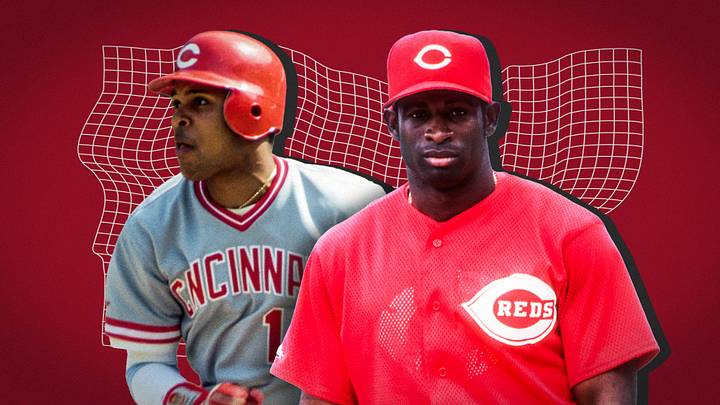
26. Deion Sanders and Barry Larkin: Cincinnati Reds (1994-95)
Deion Sanders is remembered as one of the greatest two-sport athletes in American history, but his baseball career included a stop that tends to get lost between his years with Atlanta and San Francisco.
Sanders played for the Cincinnati Reds in 1994 and 1995, meaning he briefly shared the field with future Hall of Fame shortstop Barry Larkin.
During his first stint with Cincinnati in 1994, Sanders hit .277 with 16 stolen bases across 46 games. Larkin was already firmly established as the face of the franchise, hitting .279 with nine home runs and 26 steals during the strike-shortened season.
25. Carl Yastrzemski and Wade Boggs: Boston Red Sox (1982-83)
Imagine being a rookie and sharing the lineup with the player who had practically defined your franchise for the previous two decades. That was Wade Boggs' introduction to the Boston Red Sox.
Boggs made his major-league debut in 1982, joining a Boston roster that still featured Carl Yastrzemski, who was approaching the end of his legendary 23-year career.
And Boggs immediately looked like a worthy successor. The rookie hit .349 across 104 games in 1982, while the 42-year-old Yastrzemski batted .275 with 16 home runs and 72 RBI. Their careers overlapped again in 1983, when Boggs won his first American League batting title with a .361 average. Yastrzemski retired after that season, finishing with 3,419 hits and 452 home runs.
Boston essentially went straight from one of the greatest left-handed hitters in franchise history to another, with almost no interruption.
24. Randy Johnson and Jeff Bagwell: Houston Astros (1998)
Randy Johnson in an Astros uniform already feels like something from an alternate baseball universe. Remembering that he shared a clubhouse with Jeff Bagwell makes it even stranger.
Houston acquired Johnson from Seattle at the 1998 trade deadline, adding one of baseball's most dominant pitchers to a team that already featured Bagwell and Craig Biggio.
In 11 regular-season starts with Houston, the Big Unit went an absurd 10-1 with a 1.28 ERA and 116 strikeouts in 84 1/3 innings. Bagwell, meanwhile, finished the season with 34 home runs and 111 RBI.
The Astros won a franchise-record 102 games that season, only to lose to San Diego in the NLDS. Johnson departed for Arizona in free agency, making his Houston tenure a spectacularly brief experiment.
23. Willie Randolph and Jeff Kent: New York Mets (1992)
Willie Randolph and Jeff Kent are so strongly associated with different teams that their brief connection in Queens is almost impossible to picture.
Randolph spent 13 seasons with the Yankees, becoming an essential part of their championship teams in the late 1970s. Kent eventually became an MVP-winning second baseman with the San Francisco Giants. But their careers intersected with the Mets in 1992.
Randolph was playing the final season of his 18-year career, batting .252 with a .352 on-base percentage in 90 games. Kent arrived from Toronto in the August trade that sent David Cone to the Blue Jays, hitting .239 with three home runs in 37 games for New York.
Two second basemen who combined for 4,671 career hits were teammates on a forgettable 72-90 Mets club. Baseball history can be wonderfully strange.

22. Gary Sheffield and Miguel Cabrera: Detroit Tigers (2008)
Miguel Cabrera's arrival in Detroit was supposed to transform the Tigers into an offensive powerhouse. What makes that period especially interesting is that one of his teammates was another former batting champion with more than 500 career home runs.
Gary Sheffield had joined Detroit in 2007, one season before the blockbuster trade that brought Cabrera from the Florida Marlins.
Their careers overlapped in 2008, with Sheffield entering his age-39 season and Cabrera just beginning what became a legendary tenure in Detroit.
Cabrera wasted little time establishing himself, batting .292 with 37 home runs and 127 RBI. Sheffield, battling through a much less productive season, managed 19 homers in 114 games. Sheffield departed after the season, while Cabrera eventually became a two-time MVP and Triple Crown winner.
Detroit essentially had two generations of right-handed hitting greatness sharing its lineup, but the results never came close to matching the star power.
21. Jim Thome and Manny Machado: Baltimore Orioles (2012)
Jim Thome was already one of baseball's most accomplished power hitters before Manny Machado had even played a major-league game.
Thome arrived in Baltimore during the 2012 season, and Machado made his debut that August at just 20 years old. The two eventually shared the active roster during Baltimore's unexpected postseason push.
By that point, Thome had surpassed 600 career home runs, while Machado was beginning a career that would quickly establish him as one of baseball's best third basemen. The veteran appeared in 28 games for Baltimore, hitting three homers with a .744 OPS. Machado played 51 games, batting .262 with seven home runs and 26 RBI.
The Orioles won 93 games that year and made their first postseason appearance since 1997. All the while, one of the greatest sluggers of the 1990s and 2000s was helping a future superstar begin his career.
20. Dennis Eckersley and Greg Maddux: Chicago Cubs (1986)
Two of the greatest pitchers in baseball history shared the same rotation in Chicago, but almost nobody associates them with the same era.
Dennis Eckersley was already an established veteran when a 20-year-old Greg Maddux made his major-league debut for the Cubs in September 1986.
Eckersley was still a starting pitcher, finishing the season 6-11 with a 4.57 ERA and 137 strikeouts across 201 innings. Maddux appeared in just six games, going 2-4 with a 5.52 ERA. The following season, Eckersley joined Oakland and began his transformation into one of baseball's greatest closers.
The two eventually combined for 745 career victories, eight Cy Young Awards and two Hall of Fame plaques.
19. Rickey Henderson and Paul Molitor: Toronto Blue Jays (1993)
Rickey Henderson and Paul Molitor were already established legends long before the Toronto Blue Jays brought them together in 1993.
Molitor joined Toronto before the season, while Henderson arrived from Oakland at the trade deadline. Their partnership was short, but it ended with a World Series championship.
Molitor delivered an outstanding regular season, batting .332 with 22 home runs and 111 RBI. Henderson struggled after arriving in Toronto, hitting just .215 in 44 regular-season games. That didn't stop the Blue Jays from winning their second consecutive championship.
Molitor was sensational in the World Series against Philadelphia, hitting .500 with two home runs and eight RBI to earn World Series MVP honors. Henderson contributed to the championship run despite falling short of his usual offensive standards.
The image of Henderson and Molitor celebrating together feels strange because both had already established their legacies elsewhere. Toronto briefly assembled two of baseball's greatest offensive catalysts, and unlike many of the combinations on this list, it actually ended with a ring.
18. Roberto Alomar and CC Sabathia: Cleveland Indians (2001)
Roberto Alomar and CC Sabathia seem like players from completely different chapters of Cleveland baseball history.
Alomar was the established superstar, a decorated second baseman whose championship years with Toronto were already behind him. Sabathia was the 20-year-old pitching prospect beginning a career that would eventually lead to a Cy Young Award and a World Series championship with the Yankees. But their paths crossed on Cleveland's 2001 roster, and both made significant contributions.
Alomar enjoyed one of the finest seasons of his career, batting .336 with 20 home runs, 100 RBI and 30 stolen bases. Sabathia went 17-5 with a 4.39 ERA across 180 1/3 innings, finishing second in American League Rookie of the Year voting. The Indians won 91 games and captured the AL Central title before falling to Seattle in the ALDS.
It was Alomar's final season in Cleveland and Sabathia's first, making their time as teammates a perfect example of two baseball generations colliding.

17. Ken Griffey Jr. and Jim Thome: Chicago White Sox (2008)
Ken Griffey Jr. and Jim Thome combined for more than 1,200 career home runs in their careers, and it's easy to forget that they briefly played together for the Chicago White Sox.
Griffey arrived from Cincinnati at the 2008 trade deadline, joining a Chicago lineup that already featured Thome, Jermaine Dye and Paul Konerko. At the time, Griffey had more than 600 career home runs and Thome more than 500, making them the first teammates in history to combine those particular milestones.
Thome remained productive, hitting 34 home runs with 90 RBI during the season. Griffey contributed just three homers in 41 games for Chicago, but his presence gave the White Sox a remarkable collection of established sluggers.
The team won 89 games, claimed the AL Central after a one-game tiebreaker against Minnesota and reached the postseason.
Griffey's White Sox stint is often forgotten because it lasted only a few months. But there's something delightful about two of the most recognizable left-handed power hitters of their generation briefly sharing the same lineup.
16. Barry Bonds and Tim Wakefield: Pittsburgh Pirates (1992)
Tim Wakefield is so closely associated with the Boston Red Sox that it's easy to forget he began his career alongside Barry Bonds in Pittsburgh.
Wakefield made his major-league debut on July 31, 1992, and pitched a complete-game victory against St. Louis. Bonds actually homered in that game, helping the rookie earn his first big-league win.
Wakefield went 8-1 with a 2.15 ERA in 13 starts that season. Bonds hit .311 with 34 home runs, 103 RBI and 39 stolen bases, winning his second National League MVP Award. The Pirates won 96 games and reached the NLCS, where Wakefield delivered two complete-game victories against Atlanta.
Pittsburgh had a future Red Sox legend and baseball's eventual all-time home-run leader on the same team. Even better, one helped the other win his MLB debut.
15. Harmon Killebrew and George Brett: Kansas City Royals (1975)
Harmon Killebrew is so closely associated with the Minnesota Twins that it's easy to forget he spent his final major-league season playing alongside a young George Brett in Kansas City.
Killebrew joined the Royals in 1975 at age 39, bringing 559 career home runs and more than two decades of big-league experience to a roster featuring a 22-year-old Brett.
Their performances couldn't have been more different. Killebrew struggled during his farewell campaign, batting just .199 with 14 home runs and 44 RBI in 106 games. Brett, meanwhile, was beginning his ascent toward superstardom, hitting .308 with 195 hits and 11 home runs.
Killebrew retired after the season with 573 career homers. Brett eventually collected 3,154 hits, won three batting titles and became the defining player in Royals history.
14. Pedro Martínez and Cliff Lee: Philadelphia Phillies (2009)
The 2009 Phillies had a rotation that sounds like somebody assembled it in a baseball video game.
Pedro Martínez and Cliff Lee were teammates during Philadelphia's attempt to repeat as World Series champions, joining Cole Hamels on a pitching staff loaded with recognizable names. Lee arrived from Cleveland at the trade deadline, while Martínez signed with Philadelphia after spending the beginning of the season as a free agent.
Martínez went 5-1 with a 3.63 ERA in nine regular-season starts. Lee was even more impressive during the postseason, going 4-0 with a 1.56 ERA in five starts. Their partnership helped Philadelphia reach the World Series, where the Yankees ultimately prevailed in six games.
The connection feels unusual because Martínez's legacy is centered on his dominance with Boston and Montreal, while Lee is closely associated with Cleveland and his later Phillies years. For one memorable postseason, however, two of the most talented pitchers of their respective generations were chasing the same championship in Philadelphia.
13. Billy Wagner and Craig Kimbrel: Atlanta Braves (2010)
Few organizations have managed a more seamless transition between elite closers than Atlanta did in 2010.
Billy Wagner, one of the greatest left-handed relievers in baseball history, spent his final season with the Braves. Craig Kimbrel, who would become one of the most dominant closers of the following decade, was just beginning his career.
Wagner recorded 37 saves with a 1.43 ERA and 104 strikeouts in 69 1/3 innings. Kimbrel, working primarily in a setup role during his rookie campaign, posted a microscopic 0.44 ERA with 40 strikeouts in only 20 2/3 innings.
Wagner retired after the season, and Kimbrel immediately took over as Atlanta's closer. He rewarded the Braves with 46 saves and the NL Rookie of the Year Award in 2011.
It's rare for one historically great closer to directly precede another, much less share a bullpen with him. But Atlanta essentially had its future ninth-inning superstar learning alongside the man he was about to replace.
12. Derek Jeter and José Canseco: New York Yankees (2000)
Derek Jeter and José Canseco might be the strangest combination of personalities to ever win a World Series together in Yankees uniforms.
Jeter represented the polished, championship-focused identity of New York's late-1990s dynasty. Canseco was one of baseball's most controversial stars, known for his prodigious power and later revelations about performance-enhancing drugs.
Their careers collided when the Yankees claimed Canseco off waivers from Tampa Bay in August 2000. Canseco appeared in 37 games for New York, hitting .243 with six home runs and 19 RBI. Jeter, meanwhile, batted .339 during the regular season before helping lead the Yankees to their third consecutive championship.
Canseco made just one plate appearance in the postseason, striking out as a pinch hitter in the World Series against the Mets. That means Canseco technically earned a championship ring alongside Jeter, Mariano Rivera and the rest of the Yankees dynasty.
Of all the unlikely contributors to New York's championship era, Canseco might be the one whose presence still feels the most out of place.
Jose Canseco was asked to describe Derek Jeter in one word...
— DraftKings Network (@DKNetwork) September 17, 2026
He didn't hesitate 😳
(🎥 @allthesmokeprod) pic.twitter.com/ci3p7vtjYB
11. Greg Maddux and Clayton Kershaw: Los Angeles Dodgers (2008)
Greg Maddux and Clayton Kershaw might be two of the greatest pitchers of their respective generations, but their careers overlapped at a point when one was preparing to retire and the other was barely beginning.
Kershaw made his major-league debut in May 2008 at just 20 years old. Maddux arrived from San Diego that August, rejoining the Dodgers for the final stretch of his Hall of Fame career.
Maddux made seven starts for Los Angeles, posting a 5.09 ERA before retiring after the season with 355 career victories. Kershaw, meanwhile, went 5-5 with a 4.26 ERA and 100 strikeouts in his rookie campaign.
Maddux had already won four Cy Young Awards before Kershaw ever appeared in the majors. Kershaw would eventually win three of his own.

10. Tony Gwynn and Rickey Henderson: San Diego Padres (1996-97)
Tony Gwynn and Rickey Henderson were two of the greatest offensive players of their generation, but they approached hitting in radically different ways.
Gwynn was a master of contact, capable of sending pitches into seemingly impossible locations. Henderson revolutionized the leadoff role with his combination of speed, patience and power.
Somehow, the two spent parts of two seasons as teammates in San Diego. Henderson joined the Padres in 1996, adding another veteran presence to a lineup anchored by Gwynn and Ken Caminiti.
Gwynn hit .353 that season, while Henderson helped provide the offensive spark at the top of the lineup. San Diego won 91 games and captured the NL West title. They were still teammates in 1997 before Henderson was traded to Anaheim.
Both eventually entered the Hall of Fame, with Gwynn collecting 3,141 career hits and Henderson finishing with 1,406 stolen bases, the most in MLB history.
9. Nolan Ryan and Rod Carew: California Angels (1979)
Nolan Ryan and Rod Carew have two of the most distinct statistical legacies in baseball history. The former is the all-time strikeout king with 5,714, while the latter won seven batting titles and finished his career with 3,053 hits.
Their careers overlapped with the California Angels in 1979, a season that also happened to be significant in franchise history.
Carew arrived from Minnesota before the season, joining an Angels roster that already featured Ryan, Don Baylor and Bobby Grich. Despite being 33 years old, Carew hit .318 with a .419 on-base percentage. Ryan made 34 starts and continued to serve as one of the most intimidating pitchers in the American League.
The Angels won 88 games and reached the postseason for the first time in franchise history, eventually falling to Baltimore in the ALCS.
Ryan departed for Houston after the season, making 1979 their only campaign together.

8. Willie Mays and Tom Seaver: New York Mets (1972-73)
Willie Mays and Tom Seaver belong to completely different chapters of New York baseball history.
Mays was the legendary Giants outfielder whose career began when the franchise still played in New York. Seaver became the defining ace of the expansion Mets, leading them to an improbable World Series championship in 1969.
Their careers finally intersected in 1972, when the Mets acquired Mays from San Francisco. By 1973, the 42-year-old Mays was nearing retirement, but Seaver was still very much in his prime.
Seaver went 19-10 with a 2.08 ERA and 251 strikeouts, winning his second Cy Young Award. Mays hit just .211 during his final season, but he remained an important veteran presence on a team that made another extraordinary postseason run.
The Mets won only 82 regular-season games but captured the National League pennant before losing to Oakland in seven World Series games.
Mays finished his career in the same city where it began, and one of his final teammates was the greatest pitcher in Mets history.
7. Randy Johnson and Max Scherzer: Arizona Diamondbacks (2008)
The Arizona Diamondbacks once had two of the greatest strikeout pitchers in baseball history sharing the same pitching staff.
Randy Johnson was approaching the end of his legendary career when Max Scherzer made his MLB debut in 2008.
Johnson, then 44 years old, had already won five Cy Young Awards and helped Arizona claim the 2001 World Series championship. Scherzer was a 23-year-old rookie who hadn't yet established himself as a major-league starter.
Johnson went 11-10 with a 3.91 ERA and 173 strikeouts across 184 innings. Scherzer appeared in 16 games, including seven starts, posting a 3.05 ERA with 66 strikeouts in 56 innings.
Johnson departed for San Francisco after the season, while Scherzer eventually developed into a three-time Cy Young winner. The Diamondbacks traded Scherzer to Detroit after the 2009 season, long before he reached his peak.

6. Pete Rose and Tim Raines: Montreal Expos (1984)
Pete Rose spent most of his career becoming a Cincinnati Reds legend, while Tim Raines established himself as one of the greatest players in Montreal Expos history. But for 95 games in 1984, the two actually shared a lineup.
Rose joined Montreal at age 42 and hit .259 with 72 hits before returning to Cincinnati. Raines, meanwhile, was in the middle of his prime, batting .309 with 75 stolen bases and 106 runs scored.
Their partnership also produced a fascinating piece of history. On April 13, Rose recorded his 4,000th career hit against Philadelphia, becoming just the second player ever to reach the milestone. Later that inning, he scored from second base on a single by Raines.
Two of baseball's greatest leadoff hitters actually shared the same lineup, and one helped the other celebrate a historic achievement.
5. Willie Mays and Duke Snider: San Francisco Giants (1964)
Willie Mays and Duke Snider spent years as rivals when their respective franchises called New York home, with Mays starring for the Giants and Snider becoming one of the Brooklyn Dodgers' greatest players. But the two Hall of Famers actually finished up as teammates.
Snider joined San Francisco in 1964, playing the final season of his 18-year career alongside his longtime rival. At age 37, he appeared in 91 games, batting just .210 with four home runs and 17 RBI. Mays, meanwhile, was still performing at an extraordinary level. He hit 47 home runs with 111 RBI that season, eventually finishing sixth in National League MVP voting.
Snider retired with 407 career home runs, while Mays eventually finished with 660. Strangely enough, two players who helped define one of baseball's greatest rivalries actually wore the same uniform before their careers were over.
4. Goose Gossage and Ken Griffey Jr.: Seattle Mariners (1994)
Goose Gossage and Ken Griffey Jr. sound like players from completely different generations of baseball history.
Gossage established himself as one of the game's most intimidating relievers during the 1970s and 1980s, becoming a Yankees legend and helping New York win the 1978 World Series. Griffey, meanwhile, was becoming the face of baseball's next generation. But the two actually shared a clubhouse in Seattle in 1994.
Gossage joined the Mariners at age 42 for the final season of his Hall of Fame career, making 36 relief appearances with a 4.18 ERA and one save. Griffey was spectacular that year, hitting .323 with 40 home runs and 90 RBI before the players' strike ended the season.
Gossage retired with 310 career saves, while Griffey eventually accumulated 630 home runs.
One of the greatest closers of the 1970s and one of the defining superstars of the 1990s actually wore the same uniform.
3. Nolan Ryan and Sammy Sosa: Texas Rangers (1989)
Sammy Sosa is remembered almost exclusively as a Chicago Cubs superstar, while Nolan Ryan's Texas Rangers years are an essential part of his legendary pitching career.
Few fans remember that Sosa actually began his major-league career with the Rangers in 1989, the same season Ryan arrived in Texas. The two were briefly teammates before Sosa was traded to the Chicago White Sox that July.
Sosa appeared in just 25 games for Texas, batting .238 with one home run and three RBI. Ryan, meanwhile, was still an elite pitcher at age 42, recording 301 strikeouts during the season.
That August, Ryan became the first pitcher in MLB history to reach 5,000 career strikeouts. Sosa eventually became one of only nine players to hit at least 600 career home runs, finishing with 609.
The Rangers had both players on the same roster when one was approaching the final years of his career and the other was barely beginning his. And Texas traded away Sosa before the baseball world had any idea what he would become.
2. Bobby Bonilla and Albert Pujols: St. Louis Cardinals (2001)
Bobby Bonilla is remembered for his years with the Pittsburgh Pirates and New York Mets, while Albert Pujols became one of the greatest players in Cardinals history. But the two were actually teammates during Pujols' rookie season in 2001.
In fact, Bonilla's injury helped create the opportunity for Pujols to make the Opening Day roster.
Bonilla had signed with St. Louis expecting to play third base, but an injury during spring training opened the door for a 21-year-old rookie who proceeded to take baseball by storm. Pujols hit .329 with 37 home runs and 130 RBI, winning National League Rookie of the Year. Bonilla, meanwhile, appeared in 93 games, batting .213 with five home runs and 21 RBI before retiring.
One of baseball's most recognizable stars of the 1990s helped clear the path for one of its greatest hitters of the next two decades.
1. Hank Aaron and Robin Yount: Milwaukee Brewers (1975-76)
Hank Aaron and Robin Yount playing together sounds like something that should be impossible.
Aaron began his major-league career in 1954 with the Milwaukee Braves, spending two decades establishing himself as one of baseball's greatest players. Yount didn't debut until 1974, when he was just 18 years old.
But Aaron returned to Milwaukee in 1975, joining the Brewers for the final two seasons of his legendary career. That put him on the same roster as a teenage Yount, who was beginning his own journey toward Cooperstown.
In 1975, the 41-year-old Aaron hit 12 home runs, while the 19-year-old Yount batted .267 with eight homers and 52 RBI.
Aaron retired after the 1976 season with 755 career home runs, then the all-time MLB record. Yount eventually spent his entire 20-year career with Milwaukee, collecting 3,142 hits and winning two American League MVP Awards.
Two of the greatest players ever associated with Milwaukee shared a clubhouse despite beginning their careers 20 years apart. Of all the improbable teammate combinations in baseball history, this might be the most extraordinary.
 Add us as a preferred source on Google