
Key Points
Bullet point summary by AI
- MLB's 2026 season shows a notable increase in players hitting .300 or better, reversing a multi-year decline.
- The surge in high-average hitters has boosted offensive excitement and could reshape award races and fan engagement.
- Whether this trend holds through the season will test its impact on Rob Manfred's efforts to revitalize the game's offensive appeal.
You need not have been alive or invested in the Mark McGwire-Sammy Sosa home run chase to know that Major League Baseball is at its most interesting when offense is up.
And, yes, we know all of the cliches about how people love home runs. But it’s hard to deny that a team rattling off clutch hits, whether it’s a pesky single or a thrilling bases-clearing triple off the wall, gets fans out of their seats and off the couch.
Even with a potential lockout looming, MLB commissioner Rob Manfred should be especially pleased with the 2026 season, including a trend that seemingly no one has noticed: batting averages are finally on the rise … well, somewhat.
The truth about Major League Baseball’s improved batting averages

Before going any further, we must note that the leaguewide offense itself isn’t necessarily up. As of June 12, the average MLB hitter owns a .242 batting average with a .715 OPS. Both are slightly down from the .245 and .719 we saw last year.
Teams are averaging 4.47 runs per game, right in line with last year’s 4.45.
The key difference, though, is the number of players hitting at least. 300. As of June 12, an impressive 16 players have at least a .300 average, with the Marlins’ Otto Lopez and the Giants’ Jung Hoo Lee leading the way at .344 and .338, respectively.
We’ve just thrown a lot of numbers your way, so be prepared for even more stats.
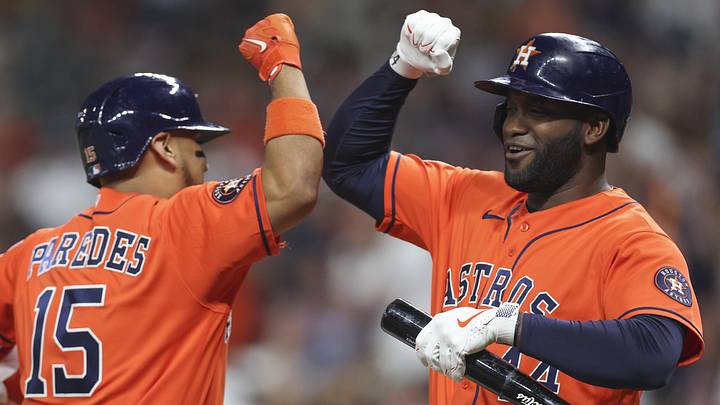
Rays designated hitter Yandy Díaz has an AL-high .331 average, well above the Astros’ Yordan Alvarez’s .316. Twelve of those 16 players are in the National League, with notable names including the Giants’ Luis Arraez (.327) and the Dodgers’ Shohei Ohtani (.305).
What makes this so important is that only seven qualified players hit at least .300 last year. Things were so bad that Phillies shortstop Trea Turner led the National League with a .304 average, the lowest average for a batting champion in NL history.
We haven’t had a season with double-digit players hitting at least .300 since 2022, when 11 players did so.
Why Major League Baseball’s batting average trend is so important

Obviously, batting average in 2026 isn’t as relevant as it was in 1986. I personally believe that, outside of WAR, the most important hitting stats are OPS, walk rate, and strikeout rate. Take a look at Baseball-Reference’s hitting statistics page, and you’ll quickly notice that many of the players with a high OPS have already accumulated at least 2.0 bWAR.
Considering that we’re nearly 70 games in, that puts a significant amount of those players on pace for at least 6.0 bWAR. Anyone who plays Immaculate Grid knows that 6.0 bWAR is the magic number for an elite season.
More hits mean more offense, and more runners on base mean more runs. Why wouldn’t Manfred be rooting for this recent surge of .300 hitters to continue?
The next question is whether any lesser-known players, like Lopez or the Rockies’ Troy Johnston, can turn their high averages into more recognition. Then again, Johnston plays for the Rockies and is worth 0.0 bWAR (but 0.6 fWAR), so he might be waiting just a little longer.
More MLB news and analysis
 Add us as a preferred source on Google