
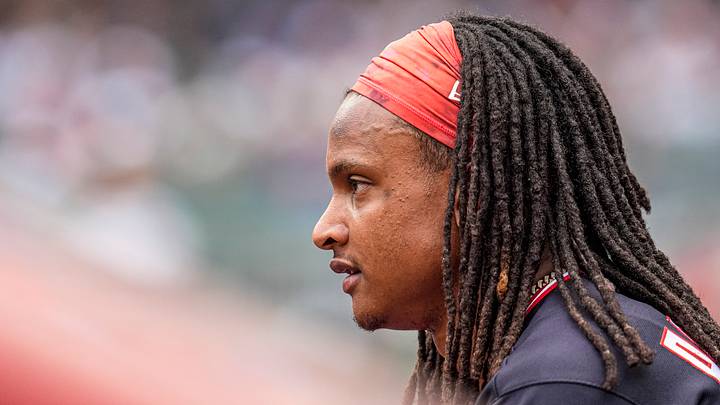
Despite constant speculation surrounding his future with the organization, All-Star shortstop CJ Abrams remained with the Washington Nationals past this year's trade deadline. The 25-year-old has enjoyed career-best production this season, up to 29 home runs and 24 stolen bases with an .887 OPS and 141 wRC+. Rarely does an ascending player of Abrams' caliber get dealt with two full years left before free agency, so it was hardly a surprising decision from the Nationals front office.
More surprising, however, is their decision to move Abrams to second base midseason — a move Abrams is "not thrilled" about, per his agent's comment to ESPN.
Why are the Nationals moving CJ Abrams to second base?

Abrams leads MLB with 19 errors, while his -17 OAA (outs above average) ranks in the league's bottom percentile. Simply put, this was a baseball decision. Abrams is super athletic, but he's far too careless and imprecise with his defensive technique. He's the worst defender at essentially the most important position on the field, aside from pitcher.
His offensive value more than makes up for it, of course, but the Nationals can limit the harm done by Abrams' poor defense — and put him in fewer challenging situations — by sliding him over to second base. Nasim Nuñez, who will effectively swap places with Abrams on the infield, is an elite defender (+5 OAA) by comparison.
And yet, ego is often wrapped up in a player's position. We need only think back to last season, when Rafael Devers effectively forced his way out of Boston because he was unhappy about Alex Bregman bumping him off of third base. Or look at Philadelphia, where Trea Turner is only still at shortstop because he's on a $330 million contract and he views himself as a shortstop.
Abrams views himself as a shortstop "short-term and long-term," per his agent Mike Sanders, who added: "I don't think we have a full evaluation yet of how good he can truly be there."
While Abrams is also committed to being "a team-first player," this creates an awkward friction in the clubhouse, especially since Abrams' name has already come up in trade rumors. Should Washington revisit those talks in the offseason, several MLB teams are probably more than happy to let Abrams figure it out at shortstop.
Boston Red Sox

The Red Sox are probably anxious to move on from Trevor Story at this point. We can't ignore top prospect Franklin Arias, who will probably start 2027 in the Majors, but Boston can come up with a creative alignment. Bumping Arias to second or third base to placate an extremely productive Abrams, at least for a couple years, is probably worthwhile.
Boston has tons of infield depth, with Nick Sogard and Anthony Siegler both exploding past expectations this season. That's more ammo to throw at Washington in trade talks, however. With Marcelo Mayer out the door, Kristian Campbell trending toward full-time outfielder status and Story about to lose his spot in the lineup, an infield quartet of Abrams, Arias, Curtis Mead and Willson Contreras in 2027 sure looks good on paper.
We know the Red Sox sniffed around Abrams, Zach Neto and other high-profile shortstops at the deadline. Expect them to revisit those conversations as soon as the season ends.
Atlanta Braves

Atlanta has received a whole bunch of nothing from Ha-Seong Kim this season and the Braves did nothing to address their shortstop woes at the trade deadline. Rookie Jim Jarvis isn't without promise, but his .576 OPS isn't getting the job done either. The Braves need a shortstop more than any contender in the Majors. Ozzie Albies' forthcoming free agency could open up another hole in the infield, too — and increase their need for a big bat, just generally.
The Nationals probably aren't keen on trading Abrams in the division, but as we saw with Adley Rutschman and the Red Sox at the deadline, sometimes the price is right. The Nats need to do what's best for business, and the Braves can offer an appealing collection of young arms to a Washington team in dire need of pitching depth. AJ Smith-Shawver, J.R. Ritchie, Cam Caminiti, Owen Murphy, Didier Fuentes — Washington can probably have its pick of the litter, so to speak.
Philadelphia Phillies

Bryson Stott has thrived since his impromptu move to third base after the deadline, but the expectation is that he'll move back to second base next season if Luis Arráez leaves in free agency. Alec Bohm is, in all likelihood, halfway out the door already, despite his recent hot streak. And yet, Turner remains entrenched at shortstop on a massive contract. So why is this even a conversation?
Well, because Turner (-5 OAA) is probably due for a position change himself. And unlike Abrams, he's well past his 30th birthday and probably won't rekindle the magic of 2025, which feels like a blip on the radar at this point. Abrams at least has room to improve. Bumping Turner to second base would allow Stott to remain at third, or the Phillies can move him to center field, where his elite speed has played well in the past.
Between Gage Wood, Andrew Painter and up-and-coming hitting prospects like first-round pick Tyler Spangler, the Phillies are equipped to at least put a competitive offer on the table, should they choose to. This could depend on how confident the organization is in Aidan Miller's health moving forward.
Milwaukee Brewers

The Brewers handed Cooper Pratt a contract extension before he even stepped on an MLB field. Pratt has performed well since his call-up, but the left side of the infield has been a sore spot for the Brewers all season. Milwaukee has a deep farm system and a chronic lack of thump in the middle of the order. Abrams does not really align with their organizational values, but a chance to get him working under their development staff — with two years of cheap arbitration left — could move the needle for a team hoping to topple the higher-spending Dodgers and Braves.
Top prospects Jesús Made and Luis Peña, both uber-talented shortstops, need at least a year or two more seasoning in the Minors. The Brewers are the only team on this list where an extension is completely off the table, but even as an extended "rental," the on-field value promises to be immense. It does not hurt that Milwaukee has such a strong succession plan in place already.
 Add us as a preferred source on Google