
Baseball is a unique sport in one's ability to numerically quantify so much of what happens on the field. That's not to say baseball isn't without its own quirks and subtleties, or that you don't need to watch the games to understand what's happening. But, there is value to be placed on the analytics. In MLB, far more than in the NBA or NFL or NHL, luck can be expressed in the metrics. We can know, broadly, which hitters are outperforming their "expected" production.
So, let's dive into xwOBA — or Expected Weighted On-base Average — to determine the luckiest hitters this season, according to the data.
What is xwOBA?
MLB defines wOBA as follows:
"wOBA is a version of on-base percentage that accounts for how a player reached base -- instead of simply considering whether a player reached base. The value for each method of reaching base is determined by how much that event is worth in relation to projected runs scored (example: a double is worth more than a single)... Unlike on-base percentage and OPS (OBP + SLG), wOBA assigns value to each method of reaching base, in terms of its impact on scoring runs."
Expected wOBA, or xwOBA, is essentially the expected outcomes based on factors such as exit velocity and launch angle. How hard a ball is hit, where a ball is hit, and so forth. To quote MLB's own definition once more:
"In the same way that each batted ball is assigned an expected batting average, every batted ball is given a single, double, triple and home run probability based on the results of comparable batted balls since Statcast was implemented Major League wide in 2015. For the majority of batted balls, this is achieved using only exit velocity and launch angle. As of 2019, "topped" or "weakly hit" balls also incorporate a batter's seasonal Sprint Speed."
MLB's luckiest hitters per xwOBA, ranked
Name | Team | wOBA | xwOBA | Difference |
|---|---|---|---|---|
1. Mickey Moniak | Rockies | .374 | .304 | +.070 |
2. Ceddanne Rafaela | Red Sox | .348 | .289 | +.059 |
3. Zack Gelof | A's | .348 | .289 | +.059 |
4. Keibert Ruiz | Nationals | .317 | .268 | +.049 |
5. Ernie Clement | Blue Jays | .315 | .269 | +.046 |
6. TJ Rumfield | Rockies | .364 | .319 | +.045 |
7. Jake McCarthy | Rockies | .352 | .308 | +.044 |
8. CJ Abrams | Nationals | .391 | .348 | +.043 |
9. Brooks Lee | Twins | .312 | .269 | +.043 |
10. Hunter Goodman | Rockies | .368 | .325 | +.043 |
11. Luis Arráez | Phillies | .347 | .305 | +.042 |
12. Wyatt Langford | Rangers | .347 | .306 | +.041 |
13. Liam Hicks | Rays | .351 | .312 | +.039 |
14. Ozzie Albies | Braves | .322 | .285 | +.037 |
15. Jake Mangum | Pirates | .322 | .285 | +.037 |
16. Chandler Simpson | Rays | .303 | .266 | +.037 |
17. Ty France | Padres | .368 | .331 | +.037 |
18. Chase Meidroth | White Sox | .327 | .292 | +.035 |
19. Pete Crow-Armstrong | Cubs | .400 | .366 | +.034 |
20. Cedric Mullins | Rays | .283 | .250 | +.033 |
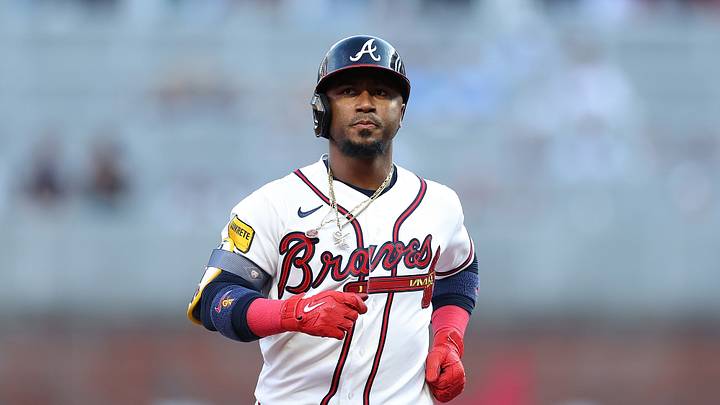
Ozzie Albies, Atlanta Braves

Ozzie Albies' return to form has played a major role in the Braves' ascent. He recently became a four-time All-Star, with a .768 OPS and 102 wRC+. This comes after Albies experienced major regression in each of the past two seasons, with a career-worst .671 OPS in 2025. Albies was a model of consistency for so long in Atlanta, and one could view this season as his comeback.
That said, the numbers paint a more deceptive portrait. Albies' xwOBA (.285) is even lower than it was a year ago (.299). His 28.4 percent hard-hit rate is also a regression, which puts him in MLB's seventh percentile. Albies is very good at making contact, but he does not draw walks and he does not much a ton of quality contact.
You will see a lot of comparable hitters on the list above. Luis Arráez, for example, has long produced "lucky" outcomes at the plate by simple virtue of putting the ball in play a lot. Even soft contact is going to squeeze through a gap or catch the defense sleeping on occasion. Albies' expected average (.235) sits far below his actual .261 average, however, so the numbers point to imminent regression. Since he's a free agent after the season, the Braves will need to think twice about paying Albies to stick around. His career is not on the upswing; that much is certain.
CJ Abrams, Washington Nationals

CJ Abrams has been unconscious at the plate for much of this season. He came out of the gate scorching hot, and then came out of the All-Star break on another heater. It's hard to deny the 25-year-old's productivity, up to 28 home runs and 21 stolen bases on the campaign, with a .920 OPS and 149 wRC+.
He certainly passes the eye test. Abrams is a stupendous athlete, with major speed to complement burgeoning power. To produce at this level still so early in his career, with more arbitration years left on his contract, made it impossible for the Nats to trade him, despite persistent buzz leading up to the Aug. 3 deadline.
Abrams' .348 xwOBA is still in the 75th percentile, per Baseball Savant. So it's important to emphasize that "lucky" does not mean "secretly bad." Abrams would still be enjoying a breakthrough season, even if he was producing in lockstep with the "expected" metrics. Speed is another valuable tool in the pursuit of luck. Abrams can beat out infield singles, stretch singles into doubles, and do a lot more damage on the average swing than a more plodding alternative.
Pete Crow-Armstrong, Chicago Cubs

Pete Crow-Armstrong put his stamp on the MVP race Wednesday afternoon, belting two home runs and a double in Chicago's rousing victory over Shohei Ohtani's Dodgers. He's up to 26 homers and 28 stolen bases on the season, with a .938 OPS and 156 wRC+ — plus league-best defensive metrics, to boot.
It is perhaps surprising to see PCA's name on a list like this. How can such a consistently dominant force be "lucky." Again, herein lies the important distinction between luck and skill. Yes, PCA has come into some batted-ball luck this season, but it by no means should suggest that he isn't a complete force of nature. His .366 xwOBA is in the 89th percentile.
Even more so than Abrams, PCA generates a ton of hard contact and burns rubber out of the box. He's one of the fastest and most aggressive base-runners in the sport. So many "doubles" according to conventional metrics are going to be triples for PCA. Same for singles becoming doubles, and so forth. So do not use this as an argument against Crow-Armstrong in the MVP race, as he's very much the deserving frontrunner with his MLB-best 7.8 fWAR, or wins above replacement. Yordan Álvarez, the AL MVP frontrunner, has 5.7 fWAR by comparison.
Colorado Rockies

You probably notice the oddly high concentration of Rockies on this list, with four in the top 10. Mickey Moniak by far has the highest discrepancy between actual production and "expected" production, while two-time All-Star Hunter Goodman also pops up. TJ Rumfield is an unexpected Rookie of the Year contender. Jake McCarthy has completely revitalized his career after falling out of favor in Arizona last season.
What's the deal here?
Well, it's hard to think of Coors Field and the natural hitting advantages that come from playing half your games at high elevation, in a ballpark that historically favors the longball. There are other more individualized explanations, too.
Rumfield's average exit velocity (83.9 MPH) ranks in the league's bottom percentile. He does not hit the ball very hard, but he consistently jacks up the launch angle, able to loft and pull homers down the first base line and occasionally over the shorter right field fence.
McCarthy has not suddenly developed added strength and power, but he has dramatically improved his launch angles, too. That is in addition to always hitting for average and doing damange with his top-of-scale speed, making his breakout far more than pure luck.
Goodman hits the ball hard, high and very far. He strikes out a bunch, which can lead to volatility, but he's able to crank up the exit velocity and take advantage of the thin air. He's up over 30 homers for the second straight season, on track to maybe break 40 this season. That does not happen through pure luck.
Moniak pretty much did the same thing in 2025 . He's probably the biggest beneficiary of the Coors Field factor, with a silly 1.002 OPS at home this season (compared to a .690 OPS on the road). His expected slugging percentage (.437), while not at all bad, is dramatically lower than his actual .571 slugging percentage. He is a fine hitter who becomes an awesome hitter at Coors, and is thus the luckiest hitter in baseball. His teammates on this list are a bit easier to believe in, however.
 Add us as a preferred source on Google