
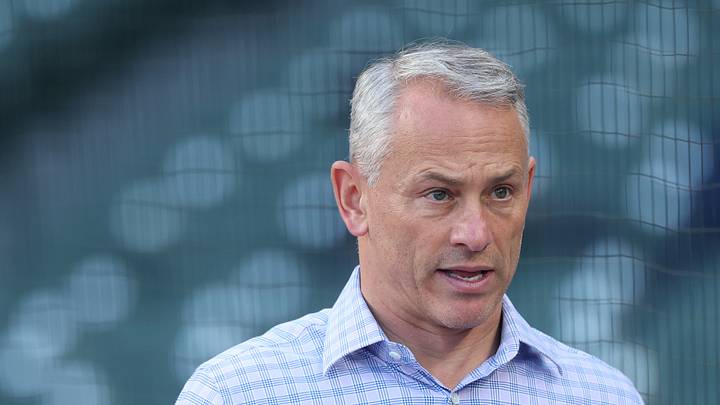
You can't call Jed Hoyer and the Chicago Cubs passive, not after they threw a pair of $120 million deals at lefty Trevor Rogers (over five years) and Japanese slugger Teruaki Sato (over six) before we even hit lunchtime on Tuesday. And in a vacuum, it's not hard to make an argument for either player: Rogers might well be the best pitcher not named Tarik Skubal on the market this winter, while Sato won't turn 28 until March and has massive power upside if he can make enough contact in the Majors. Given all that the Cubs are losing this offseason — from Seiya Suzuki to pretty much an entire starting rotation — they needed to get busy, and this certainly qualifies.
Zooming out, though, the picture is far from rosy. Even with Rogers and Sato on board, this shouldn't strike anybody as a championship-caliber roster. And now there's even more money committed for years to come, without a pipeline of young, cost-controlled talent to supplement it.
Cubs are still nowhere near a title after Trevor Rogers, Teruaki Sato deals

Start with the pitching staff, which is still a giant question mark even with the addition of Rogers. Who, to be clear, is a very good pitcher, probably much better than most people realize — he was much better than his 4.03 ERA suggests this past season, and he's got legitimate No. 2/3 upside. And yet, here's the current state of the Cubs' rotation:
- LHP Trevor Rogers
- LHP Justin Steele (out since April 2025 due to elbow surgery)
- RHP Ben Brown (will miss the start of 2027 due to neck surgery)
- RHP Cade Horton (wlil miss the start of 2027 due to elbow surgery)
- RHP Edward Cabrera (demoted from the rotation in 2026)
- LHP Braxton Garrett (has thrown 46.1 MLB innings since 2024)
- RHP Javier Assad
Is there a world in which Steele, Brown and Horton all return at some point in the first half and recapture their previous forms? Sure. But there's also a world in which they miss far more time, or show signs of rust. And beyond those three huge question marks, there's simply very little in the way of proven MLB production, especially given how badly Cabrera fared in his first season in Chicago in 2026. Oh, and we haven't even gotten to a bullpen that, while it punched above its weight last year, needs serious work in its own right this winter.
It's very, very hard to imagine this pitching staff as currently constituted being able to survive in October, if it can even get there in the first place. And while Sato should replace the departing Suzuki in a corner outfield spot, he comes with substantially more risk than his predecessor; even the best-case scenarios here feel more or less like a lateral move for a team that still needs to replace Ian Happ and find a sustainable solution at DH.
So you have a pitching staff full of holes paired with an offense that, while certainly good, doesn't project to be elite in the way it might need to be. It would be one thing if there was young talent coming through the pipeline, or if there was still loads of financial flexibility remaining. As it stands, though, the Cubs have burned up a good amount of their remaining resources.
Cubs can't spend enough money to hide growing roster deficiencies
Of course, these are the Cubs we're talking about; they should be among the biggest spenders in baseball on a yearly basis. In reality, though, we know that's not the case under Tom Ricketts' ownership, which has come with a fairly generous but still very real budget. That matters, because with Rogers and Sato now in tow, along with long-term deals for Pete Crow-Armstrong, Alex Bregman, Nico Hoerner and Dansby Swanson, Chicago has some $150 million in salary per year guaranteed through the end of the decade.
All of the above are still good-to-great players. They're also being paid market rate, with PCA's pre-arb extension the notable exception. It's simply not sustainable, given what we know about the Cubs' financial reality, to spend your way into a World Series roster; there are still needs all over the place, and now $50 million less in annual salary with which to fill them. Graduations, injuries and regression have left Chicago's farm system far worse off than it was just a couple of years ago, too, so there are no near-term solutions either via promotion or trade.
On the one hand, it's hard to blame Hoyer for getting aggressive in free agency given all the payroll his team just shed and how desperate the Cubs are to maximize this contention window. Neither Rogers nor Sato truly move the needle in a way that, say, Skubal would have, despite the fact that they both cost significant money. It feels like the worst of all possible worlds here, spending big and pulling from your future flexibility in service of a present that feels pretty underwhelming, and it serves as an indictment of the mistakes that have brought the team to this point.
 Add us as a preferred source on Google