
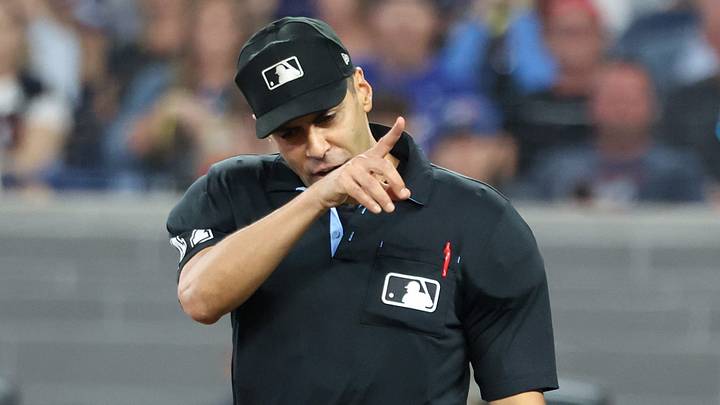
Whether you like it or not, MLB umpires can swing any given game, even a World Series contest. One blown call can impact more than you can believe, so while the ABS system is in place to combat umpire mistakes, it's not as if challenges are unlimited per team. There's still a need for quality umpiring.
With that, you'd think MLB would pick the best umpires the sport has to offer to be on the field for the World Series. A look at the data would give you mixed results on that front.
World Series umpire crew and home plate assignments

Here's a look at the World Series umpire assignments. Seven different umpires are scheduled to be behind home plate for the best-of-seven series.
Game | Home Plate Umpire | Previous World Series Appearances |
|---|---|---|
1 | Gabe Morales | 0 |
2 | Jim Wolf | 2 |
3 | Nic Lentz | 0 |
4 | James Hoye | 2 |
5 | Vic Carapazza | 1 |
6 | Dan Bellino | 1 |
7 | Tripp Gibson | 1 |
At first glance, this is a list that makes a lot of sense. The crew features a pair of umpires to never appear in a World Series, a pair of umpires with two World Series appearances, and three others who have umpires World Series games once. There's a nice mix of World Series rookies and veterans there. MLB fans care mostly about quality, though, and for most of these umpires, it just isn't great.
How often ABS challenges overturned the World Series umpires

Something the ABS system provides is the ability to overturn umpiring mistakes. In the past, a blown call just had to stand without issue. Now, players can hold umpires accountable. Some umpires performed better with this new system than others. Here's a look at how these seven umpires performed in the regular season out of the 75 to be challenged at least 100 times according to TaptoChallenge.
Umpire | ABS challenges | ABS overturns | Overturn % | Regular season rank |
|---|---|---|---|---|
Gabe Morales | 106 | 54 | 50.9% | 22nd |
Jim Wolf | 136 | 73 | 53.7% | 39th |
Nic Lentz | 149 | 72 | 48.3% | 9th |
James Hoye | 151 | 79 | 52.3% | 29th |
Vic Carapazza | 127 | 66 | 52% | 27th |
Dan Bellino | 142 | 85 | 59.9% | 64th |
Tripp Gibson | 121 | 61 | 50.4% | 18th |
The best of the bunch was Nic Lentz, who is the only World Series umpire who was overturned less than 50 percent of the time when opponents challenged his calls. On the flip side, Dan Bellino's calls were overturned roughly 60 percent of the time, which is hard to even fathom. Only 11 umpires were overturned at a higher rate among those challenged at least 100 times, which raises the question of why Bellino, who has appeared in a World Series before, earned the nod.
Which World Series umpires had the most accurate strike zones?

As important as ABS challenges are, those come few and far between, especially in the postseason. The Brewers and Rays will be cognizant of wasting challenges, especially early in ballgames. What's most important is that umpires have good control of the strike zone and don't miss too many calls. I understand that they're human and will make mistakes, but the World Series should have the best umpires the game has to offer featured. With that, let's see how these seven umpires rank compared to the 34 who have umpired games this postseason, again, using TapToChallenge as a source.
Umpire | Pitches called | Correct calls | Accuracy | Regular season rank |
|---|---|---|---|---|
Gabe Morales | 4,233 | 4,000 | 94.5% | 4th |
Jim Wolf | 4,261 | 3,976 | 93.3% | 47th |
Nic Lentz | 5,122 | 4,801 | 93.7% | 25th |
James Hoye | 4,737 | 4,437 | 93.7% | 29th |
Vic Carapazza | 4,957 | 4,648 | 93.8% | 23rd |
Dan Bellino | 4,754 | 4,430 | 93.2% | 50th |
Tripp Gibson | 4,717 | 4,445 | 94.2% | 13th |
There's some good news and some bad news here. Gabe Morales, the home plate umpire for Game 1 of the series, was one of the most accurate at calling balls and strikes in the regular season. There are also only two umpires who rank as below average among the 75 umpires, which is good. However, there're only two top-20 umpires in terms of accuracy calling this series, and one of them, Tripp Gibson, would only be behind the plate in a winner-take-all Game 7. That doesn't feel right.
How the Brewers and Rays stack up on ABS challenges

Another layer that makes this World Series interesting is that the Milwaukee Brewers and the Tampa Bay Rays were awfully similar when it came to challenging pitches in the regular season. Brewers hitters ranked 21st in MLB with a 46 percent success rate, according to Baseball Savant, while the Rays were 22nd with that same 46 percent success rate. As for the defense, the Rays were 15th with a 58 percent success rate, while Milwaukee was 19th at 56 percent.
The percentages were similar, but the team's strategies were different in the regular season. Rays hitters challenged 29 more times than the Brewers' hitters, but Milwaukee's fielders challenged 69 more times than the Rays'. In fact, the Brewers' fielders were the third-most aggressive team when it came to using challenges in the regular season, while their hitters ranked second-to-last. In other words, William Contreras, who attempted 49 more challenges than any other fielder (and had a solid 57 percent success rate), was trusted to tap his helmet whenever he felt like it.
The playoffs have been a different story, though. Rays hitters were far more aggressive than Milwaukee hitters during the regular season, but they have not challenged a single time in the playoffs. That might change in the playoffs, but it's clear they have a gameplan to only trust Liam Hicks with challenging, and for what it's worth, he's gone 8-for-12, which is a 67 percent success rate. Contreras has been as active as anyone when it comes to challenging in the playoffs, as evidenced by his league-leading 20 attempts behind the plate, but he's just 12-for-20 (60 percent).
It'll be interesting to see what trends stick in the Fall Classic. Will Contreras continue to challenge anything close? Will the Rays have their hitters challenge? One pitch might not seem like much in the moment, but usage of the ABS system could dictate who wins a given game, which, of course, could then swing the entire World Series.
 Add us as a preferred source on Google