
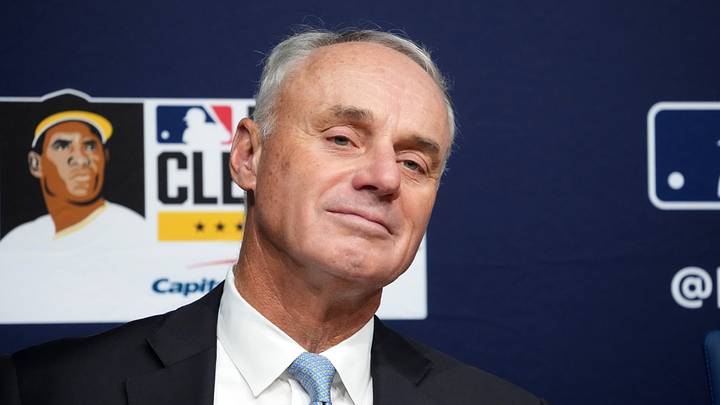
On Wednesday morning, ESPN's Jeff Passan reported that Rob Manfred and MLB owners "do not intend" to back off their demand for a salary cap in labor negotiations — buoyed in large part by by "surveys that show fans want one". Sure, it would help their precious franchise valuations skyrocket, but they really have the best interests of the game at heart! They're just trying to stand up for the ordinary Joe!
Except, just a few hours later, FOX Sports broke news that Game 1 of the NLCS between the Los Angeles Dodgers and Milwaukee Brewers had brought in more than 10.7 million viewers — the most for any LCS Game 1 since 2005, and the most for any LCS game period since 2010.
🚨 MOST-WATCHED LCS GAME 1 IN 21 YEARS 🚨
— FOX Sports PR (@FOXSportsPR) October 14, 2026
FOX knocks it out of the park with best viewership for any LCS Game 1 since 2005, and most-viewed LCS game overall since 2010.⚾️📺 pic.twitter.com/cIEZhvhNUK
All due respect to Milwaukee's fervent and long-suffering fan base, but it's hardly a big enough market to account for that growth all on its own. You only hit that sort of number if you're getting plenty of casual observers to tune in as well. You know, the casual observers that Manfred claims to be worried about losing if MLB moves forward with its current economic model.
Love them or hate them, everyone pays attention to the Dodgers
I have no doubt that fans in smaller markets like Pittsburgh and Cleveland — heck, even Milwaukee — wouldn't object to a salary cap. You can only watch your team be outspent by hundreds of millions of dollars for so many years before you start to wonder whether there's a better way of doing things.
But if that frustration has curdled into a rejection of the current product, it hasn't shown up the numbers. In fact, the truth appears to be quite the opposite: No matter what team you root for, these Dodgers make you feel something. And even if that something is hate, or rage, it keeps you glued to your screen.
This is hardly a phenomenon unique to baseball; you see it in, say, the NBA, where the Golden State Warriors drew big-time numbers for years mostly because everybody kept tuning in hoping they'd lose. And you saw it in last year's World Series, which also earned banner ratings. Sure, there were a disproportionate number of wild moments and dramatic endings, but that's what happens when you put a disproportionate number of great baseball players on one field. And all of it was heightened thanks to what felt like historic stakes, a dynasty rising and falling on every pitch.
MLB should think twice before putting an end to the era of superteams

That's the sort of thing that baseball claims to want, the sort of narrative that markets itself to even casual sports fans who might not otherwise care much at all about the Fall Classic. But it becomes much, much less likely in a salary cap system, where artificial financial constraints force annual player movement and it's nearly impossible for a team to hoard talent — much less keep it across multiple seasons.
There are probably some readers who are rejoicing at that idea, and again, I do get it. Zooming out, though, it's not as simple as saying that increased parity will lead to more interest from more corners of the sport. (Setting aside the fact that, as this year's playoffs prove, baseball does not seem to have much of a parity problem.) The NBA is going on eight different champions in a row now, and people can't stop wringing their hands about plateauing interest. Love it or hate it, leagues need big bads against which everybody else can position themselves.
Again, it's not like simply being rich allows you to assemble a consistently competitive team. What the Dodgers have done over the past few years is, of course, in part a story of money, but it's also a story of scouting and development — you know, the things we should be incentivizing. If a team does all of that right, why shouldn't they be this successful? And why would that be a bad thing for baseball, given all the interest this team clearly generates?
We all know that Manfred's really on about: lining the pockets of the owners who sign his own paychecks. But in trying to launder that mission through what's best for fans, he inadvertently made a great argument for keeping the current system in place, even if it needs a tweak or two.
 Add us as a preferred source on Google