
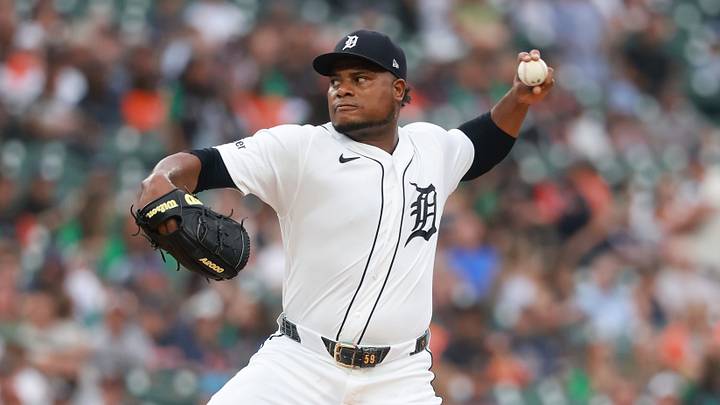
Losers of five in a row and eight of nine, their AL Wild Card hopes vanishing in front of their eyes, the Detroit Tigers entered a huge series with the top-seeded Tampa Bay Rays needing a stopper. A star with big-game experience who could live up to his salary, put the team on his back and right the ship. And as he's done all year long, lefty Framber Valdez proved that he was ... not the guy for the job.
Detroit was trailing before they even came to bat on Monday night, as Valdez gave up two runs (although just one earned) in a 28-pitch first. He'd finish his night with four runs (three earned) allowed on eight hits and two walks with zero strikeouts over six innings of work and his team trailing 4-1.
When the Tigers signed the lefty to a three-year, $115 million contract over the winter, this was exactly the sort of big game they envisioned him starting, a second ace alongside Tarik Skubal to help a playoff push. Instead, Skubal's already been traded to the Dodgers, and Valdez just keeps on making a nightmare first season in Detroit even worse. And with each passing clunker, fans can't help but wonder how quickly they can be rid of one of the most miserable signings in team history.
Framber Valdez contract: How long are Tigers on the hook?
Year | Luxury tax hit |
|---|---|
2026 | $36,569,356 |
2027 | $36,569,356 |
2028 (player option) | $36,569,356 |
2029 (mutual option) | $38,333,333 |
Valdez's contract is guaranteed for next season, with a luxury-tax hit of over $36 million — far and away the most expensive salary that Detroit has on the books for 2027. Obviously Skubal's free agency will change things considerably, but right now he stands to be the highest-paid pitcher in the league by average annual value. All this for a guy with a 4.35 ERA this season who has once again actively alienated teammates just the way he did in Houston.
But unfortunately for the Tigers, things only get worse from there. In order to get Valdez to sign, Scott Harris included a juicy player option for 2028. If the lefty lived up to his billing over the first two years of the deal, he'd decline and cash in on the open market. If things went pear-shaped, he'd simply opt in and guarantee himself another $36 million-plus. You can probably guess which way that calculus is trending right now.
Unless Valdez has a startling return to form down the strech this year or next, he'll certainly opt in. Which means that the earliest Detroit can be free of the lefty isn't until after the 2028 season — at which point they'll have to pay a $5 million buyout to get out from under a whopping $40 million mutual option. Valdez is already set to turn 33 in November; you can only imagine how much worse this might get by the time he's in his age-36 campaign.
Disastrous Framber Valdez signing sums up failures of Scott Harris tenure

On the one hand, it's hard to retroactively punish Harris for how badly the Valdez signing worked out; he was largely praised for the move at the time, swooping in once the pitcher's market cratered to land a legit No. 2 behind Skubal. In hindsight, though ... well, there was a reason Valdez's market had cratered in the first place.
After all, the Astros had plenty of opportunity to sign Valdez to an extension well before he even hit the market. And yet they declined, then let him languish during the offseason without ever seeming to make a serious offer. That should've been a red flag right then and there, one that came to fruition once the same old character concerns began to pop up again this season.
But this is the game that Harris has decided to play. He's committed to always being rational in the fundamentally irrational market that is MLB free agency, never willing to go the extra mile it takes to land marquee players at premium positions. That might look good on a spreadsheet, but the reality is that you don't add top-end talent to your roster, forcing you to pivot to distressed assets.
Valdez no doubt appealed to the Tigers precisely because other teams were staying away; they saw a frontline starter available on a short-term deal and pounced at the perceived value. Unfortunately, that also means taking on a good deal of risk, and now Detroit is suffering the consequences for years to come.
 Add us as a preferred source on Google