
Key Points
Bullet point summary by AI
- The 2026 NBA Draft class features deep talent but also carries notable risk in several first-round prospects.
- Some players face significant questions about age, skill translation, and injury history that could limit their NBA impact.
- The debate over these high-risk picks will test team patience and development strategies throughout the draft.
The 2026 NBA Draft is one of the deepest in recent memory, with the potential for several future All-Stars (and even All-NBA players) to emerge. The top four of Cameron Boozer, AJ Dybantsa, Darryn Peterson and Caleb Wilson, regardless of order, feels destined to thrive at the next level.
As when any draft, however, there is also considerable risk sprinkled throughout the first round conversation. Here are the prospects whose downside could bite their future NBA teams in the you-know-what:
5. Yaxel Lendeborg

Yaxel Lendeborg was the second-best player in college basketball last season and the ringleader for Michigan's championship squad. But he will also turn 24 years old as a rookie, which puts him in troubling company for a potential lottery pick.
Here are the seniors drafted top-20 in the last three NBA Draft classes:
Name | Year | Draft Position |
|---|---|---|
Walter Clayton Jr. | 2025 | 18th |
Dalton Knecht | 2024 | 17th |
Devin Carter | 2024 | 13th |
Zach Edey | 2024 | 9th |
Tristan da Silva | 2024 | 18th |
Jaime Jaquez Jr. | 2023 | 18th |
Lendeborg is older than all of them and he's broadly projected in the 11-16 range by experts. He is almost two full years older than Zach Edey was on draft night, for example. And Edey is the only full-blown, home-run hit from this group. For as dominant as Lendeborg was this year — really his last couple years — he did not reach the same heights as Edey individually. Memphis' 7-foot-4 behemoth is an outlier on multiple fronts.
On the surface, Lendeborg's versatile two-way skill set and incredible competitiveness point to immediate NBA utility. He's the No. 15 prospect on FanSided's big board — I'm a believer, relatively speaking. But there is a world in which he simply does not possess the same growth capacity as the prospects two-to-six years his junior.
4. Koa Peat

Koa Peat, FanSided's No. 29 prospect, is such a frustrating evaluation. He's a proven winner at every level, with standout physical tools and a selfless personality. He's an easy fan favorite. But does anything that Peat did to dominate the high school or college level really translate to the NBA? It's a fair question. His skill set does not feel fully aligned with the modern game, where spacing and versatility are so coveted.
The elevator pitch for Peat is that he's an ass-kicker who will apply his physicality liberally on both ends. He's an excellent positional rebounder. He can throw his weight around in the post and hold the line against slashers on the perimeter. He will screen, cut and pass willingly in the flow of the offense. Josh Hart's rousing Finals run with New York could serve as inspiration for an NBA team.
But here's the rub: Peat is a disastrous shooter who has never really displayed promising touch indicators. At the Combine, he appeared to be in the early stages of a complete rebuild of his jump shot mechanics. You can learn to shoot in the NBA, but as a 6-foot-8 forward with a complicated defensive projection, it's hard to imagine Peat staying on the floor in a competitive environment if he can't space the floor. Defenders are going to comfortably ignore him behind the 3-point line.
Peat can explode vertically and bulldoze through an opponent's chest, but he's not a very quick-twitch athlete. He can struggle to contain quicker players out in space and he's not much of a rim deterrent or shot-blocker around the interior. Which position does he actually defend in the NBA? Peat has the right mental makeup, the right intangibles, to find his way in the NBA, but teams are not drafting anything close to a finished product.
3. Chris Cenac Jr.

Chris Cenac Jr., FanSided's No. 31 prospect, offers tantalizing upside at 6-foot-10 barefoot with a 7-foot-5 wingspan and a 9-foot-1 standing reach. He flashes legitimate 3-point range with the capacity for a steady mid-range diet. He can slide his feet on the perimeter defensively. Purely in terms of tools, yes, Cenac feels like a potential star.
However, despite his prodigous rebounding — which does provide a baseline path to value — Cenac plays a lot smaller than you'd think. Weaker. He shies away from physicality in the post and tends to rely on difficult, inefficient jumpers. On defense, he's a laggy processor who can ball watch, get stuck on screens and wind up slow on rotations. He doesn't really battle hard on the interior.
It's unclear if Cenac has the baseline feel and physicality necessary to really thrive as an NBA center. His shot selection, for a player his size, doesn't bode much better when projected as a power forward either. There is a wide canyon between Cenac's perception of himself and his idealized role. He does not pass well or often. There are some troubling Marquese Chriss vibes, and this is coming from a one-time Marquese Chriss truther.
2. Jayden Quaintance

Jayden Quaintance, FanSided's No. 13 prospect, has the potential to return top-five value in this class. He's the best defender on the board and, at 18 years old, he's the second-youngest prospect in the draft, just a week older than projected top-3 pick Cameron Boozer. Quaintance was a dominant defender at Arizona State as a 17-year-old freshman.
Unfortunately, his freshman year was cut short by a torn ACL. He transferred to Kentucky as a sophomore, but only appeared in four games as residual knee swelling from that ACL injury held him at bay. Quaintance has worked out for teams. He tested well at the Combine. All signs point to him being healthy now. But we know lower-leg injuries and big men are a volatile cocktail. Quaintance's medical red flags could mean he slips all the way to the 20s, maybe even the second round, per The Athletic's Sam Vecenie.
Quaintance lost a critical year of development at Kentucky. He's still extremely unpolished offensively. If he's healthy, Quaintance is a special rim protector with all the versatility teams dream of in the modern NBA. But will he be ready to contribute on his rookie contract? Will he even stay on the floor enough? These questions mean he is boom-or-bust in the truest sense of the phrase.
1. Nate Ament

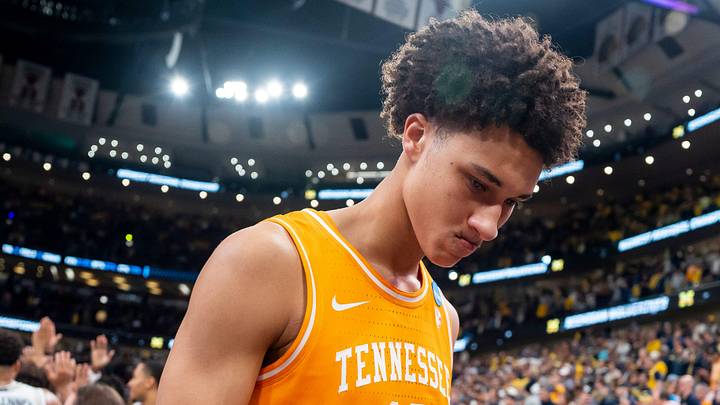
Nate Ament has seemingly gained momentum as a potential top-10 pick, with the Nets, Mavericks and Bucks all connected. He is FanSided's No. 26 prospect and thus feels like the easy answer here. Teams are understandably enamored with the concept of a 6-foot-10 wing that can handle, shoot and defend, but so much of Ament's perceived upside is purely theoretical at this stage.
Ament converted on 42 percent of his halfcourt rim attempts at Tennessee, which is a horrendous number for a player his size. Yes, he dealt with an ankle injury late in the year, but Ament's rim finishing was just as bad in high school. He has never showed the strength or burst necessary to create clean looks for himself inside the arc, despite a high release on his jump shot. He made 37.3 percent of his mid-range attempts with the Vols.
While Ament is a willing passer, he's not the most advanced decision-maker. He can crumble under pressure due to the lack of a functional handle and he's not going win by virtue of his brain in the NBA, at least not early on.
If Ament can add strength, improve his footwork and really max out as a rangy, hyper-versatile defender, there is obviously upside here. I'm not going to say he can't return top-10 value in this class. But the bust risk here is far too elevated for his projected draft range, in this writer's humble opinion.
More NBA Draft news and analysis:
 Add us as a preferred source on Google