
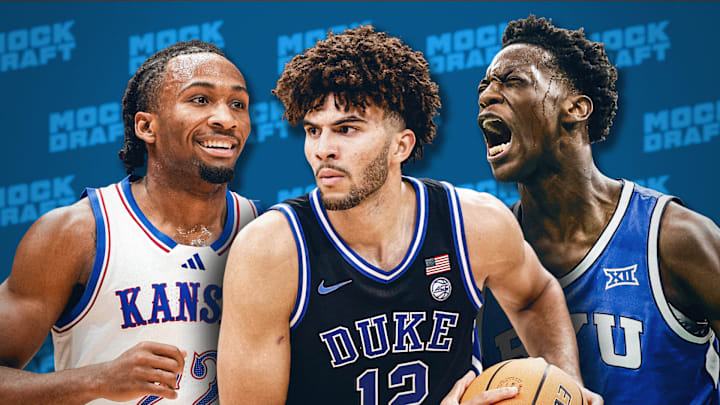
Key Points
Bullet point summary by AI
- The 2026 NBA Mock Draft explores how every team could misstep with its first-round pick, focusing on potential negative outcomes rather than projections.
- Each scenario highlights specific roster mismatches and developmental risks that could derail a team's plans.
- The exercise reveals critical questions about fit, depth, and immediate impact that will shape the draft's legacy for all 30 franchises.
The 2026 NBA Draft is three days away, and the smokescreens are borderline oppressive. There's no way to know exactly what any team plans to do at this stage. New questions have arisen around Washington at No. 1 and Utah at No. 2. The depth of this class means things could break any number of ways.
Let's take a page out of our NFL playbook. For the "botch job," rather than projecting what each team will do, this mock draft will attempt to chart (within reason) how each team could fumble its selection. Not all these picks are bad picks. But we will attempt to imagine how a negative outcome might manifest.
1. Washington Wizards: AJ Dybantsa, F, Brigham Young

It will be hard for Washington to get this pick wrong. But of the two credibly reported options — Dybantsa or Darryn Peterson — the latter would be my choice. Dybantsa is a major talent with an All-NBA ceiling, but there's a world in which the switch never flips on defense, the jumper never fully blossoms and he's too heliocentric a scorer to find the proper harmony with Trae Young and Washington's young core.
Those are fringe concerns, and Dybantsa would be a totally worthy selection in this spot. But realistically, unless Peterson's health is more worrisome than it has been made out to be, Dybantsa has the most downside of the top prospects.
>> Read our AJ Dybantsa scouting report
2. Utah Jazz: Cameron Boozer, F, Duke

There is significant smoke behind the idea that Utah could pass on Peterson, should he be available in this spot, to select Cameron Boozer. That is literally what I would do. Boozer is the No. 1 prospect here at FanSided — a historically productive and impactful 18-year-old with supercomputer processing speed and a pro-ready frame.
That said, the Jazz already have Lauri Markkanen and Jaren Jackson Jr. locked up on massive contracts, with a Walker Kessler extension (hopefully) coming down the pipeline. Too many good players at a position is not a problem, but Peterson is a far cleaner "fit" for this roster as it's currently constructed. Does Boozer get buried on the bench as a rookie, a la Dylan Harper?
>> Read our Cameron Boozer scouting report
3. Memphis Grizzlies: Caleb Wilson, F, North Carolina

This is admittedly a stretch, but there has been enough Caleb Wilson vs. Cameron Boozer discourse to at least consider a similar debate should Peterson fall to No. 3. The Memphis front office heavily values analytics and this past season, stripped of context, Wilson was far and away the more productive, more impactful player.
We know Peterson was not 100 percent. And we know how quickly he could ascend the star ladder. But Memphis could, in theory, lean on Wilson's outlier athleticism and defensive playmaking. He has star traits of his own and is talented enough to at least merit a conversation. Passing on Peterson would quality as a huge gamble, though.
>> Read our Caleb Wilson scouting report
4. Chicago Bulls: Darryn Peterson, G, Kansas

Frankly, Chicago has the easiest job of any team in the draft. Whichever "big four" prospect falls is the correct pick. They can't overthink it. That said, if we want to theorize about the worst-case scenario, what if Peterson can't fully reclaim his high school athleticism? Neither he nor Josh Giddey would generate a ton of rim pressure. The Bulls lack size, rebounding and consistent shot-blocking in the frontcourt. This is a dream outcome, to be blunt, but there is risk associated with Peterson's profile, and the Bulls may benefit more (at least immediately) from help on the interior with either Boozer or Wilson.
>> Read our Darryn Peterson scouting report
5. Los Angeles Clippers (via IND): Brayden Burries, G, Arizona

This is a simple matter of being lower than consensus on Brayden Burries. It's not a bad fit; in fact, it's quite strong. Burries provides the off-ball scoring and hellacious, physical defense necessary to pair successfully with the more slender Darius Garland in the Clippers backcourt. With so much upside on the board, however, it's fair to wonder if Burries has the playmaking chops necessary to return top-five value.
6. Brooklyn Nets: Nate Ament, F, Tennessee

The Nate Ament rumblings around Brooklyn aren't going away, and while this no longer feels like the "expected" pick, it would align with Sean Marks' history of prioritizing pedigree, upside and the unique intersection of positional size and skill.
While those aren't necessarily bad traits to value, in the case of Ament, it's just a massive reach — especially in this class. His inability to generate rim pressure or score effectively inside the arc is alarming on its own. Pair him with Egor Dëmin, another recent lottery pick with a similar deficiency, and it just feels like Brooklyn is stacking cornerstones who compound each other's weaknesses.
7. Sacramento Kings: Darius Acuff Jr., G, Arkansas

This is the Kings' preferred outcome — and probably the most likely outcome, based on the latest reporting. Sacramento's interest in Acuff is totally understandable, for reasons both logical (he's a steady-handed, franchise-caliber point guard) and trivial (Scott Perry coached his dad in college).
It's not a bad pick. But it's fair to wonder if Acuff, the worst defensive prospect in this range by a significant margin, might benefit from a bit more infrastructure around him. None of Sacramento's core pieces really guard; the Kings' roster is in total flux. Acuff can hopefully come in and help to organize things, but there's a potential downside to asking a one-way rookie guard to transform your team.
>> Read our Darius Acuff Jr. scouting report
8. Atlanta Hawks (via NOP): Keaton Wagler, G, Illinois

Wagler is under heavy consideration for the Clippers at No. 5, and while his incredible blend of feel and shot-making carries undeniable appeal, he was a rocky two-point scorer. He continues to add strength to his frame, which is promising, but Wagler is a wiry, not-particularly-explosive combo guard. He struggles to generate clean looks for himself inside the arc. He's especially inefficient (34.8 percent) on mid-range attempts.
The Hawks can surround him with defensive bullies and even an excellent mentor if CJ McCollum re-signs, but for a team in need of more half-court shot creation, it's fair to wonder if Wagler is really the best outcome in this range.
>> Read our Keaton Wagler scouting report
9. Dallas Mavericks: Kingston Flemings, G, Houston

None of these picks (except for Burries and Ament) feel especially disastrous to me. The depth of this class makes an exercise of this nature challenging.
That said, if we want to imagine how things could go wrong, Flemings measured 6-foot-2.5 barefoot at the Combine with a negligible plus-one wingspan. Kyrie Irving shouldn't determine the Mavs' draft strategy, but Dallas would be pretty small in the backcourt out of the gate. Flemings also has lingering questions as a shooter due to his unconventional mechanics, and he wasn't a great rim finisher at Houston despite a killer first step. With Flagg and Irving still due to handle a significant portion of the offensive burden, maybe Flemings turns out to be an awkward fit.
>> Read our Kingston Flemings scouting report
10. Milwaukee Bucks: Mikel Brown Jr., G, Louisville

The Bucks probably somersault to the podium if Mikel Brown Jr. falls to No. 10. The dynamic here is obviously dependent on whether or not Milwaukee actually pulls the trigger on a Giannis trade, either now or in the future.
If Antetokounmpo does finally end up elsewhere, this essentially becomes Brown's basketball team. And while he has the vision, pull-up shooting and ball-handling twitch to operate as a primary engine, Brown's single season at Louisville was defined by inconsistency. He can force the issue in unproductive ways and fall into shooting slumps. Is he really ready to carry the load entirely for a team?
>> Read our Mikel Brown Jr. scouting report
11. Golden State Warriors: Karim López, F, Mexico

Karim López has built up considerable buzz as a potential lottery pick. And while there are positive indicators — chiefly his impressive production in an ultra-physical Australian league — this would feel like a reach, especially for a team (and a coach) that needs to strike the balance between upside and immediate contributions.
López is still hit-or-miss on defense and he's not a great athlete, despite his exceptional strength and tempo on slashes to the rim. He's a good not great shooter. There aren't a ton of standout traits here, period. The Warriors offense typically demands a certain skill and processing threshold, which López may struggle to meet.
12. Oklahoma City Thunder (via LAC): Labaron Philon Jr., G, Alabama

Labaron Philon Jr. would certainly align with OKC's general philosophy of prioritizing schematic fit and talent over positional need. Despite his rail-thin frame, Philon is a productive driver, converting at an extremely high level at the rim thanks to his improved lower body strength and an unmatched blend of creativity and feather-soft touch. He ramped up his 3-point volume as a sophomore and introduced a dependable pull-up in the mid-range. As a freshman, with a lower offensive role, he was quite the energizer bunny on defense.
Philon would be right at home in OKC's slash-and-pass offense, but it's fair to wonder when enough is enough in terms of guard depth. He'd start his career behind Shai Gilgeous-Alexander, Ajay Mitchell, Jared McCain, Alex Caruso and Cason Wallace in the pecking order.
13. Miami Heat: Yaxel Lendeborg, F, Michigan

Teams are mixed on Yaxel Lendeborg's workouts and personality, per The Athletic's Sam Vecenie, which could lead him to slide down the board as a 24-year-old rookie. How anyone could watch Lendeborg at Michigan this past season and really come away concerned with work ethic (which he admitted to addressing and improving during the year) or personality (the dude is a dawg) confounds me.
All that said, he is older than your average lottery pick. Miami has a (recent) history of drafting more established college stars and getting a lot out of them early on. But for a team stuck between timelines, especially if a Giannis trade falls through, it's fair to wonder if Lendeborg is the best use of resources.
>> Read our Yaxel Lendeborg scouting report
14. Charlotte Hornets: Cameron Carr, G, Baylor

Cameron Carr is extremely fun, and he'd be right at home in Charlotte's up-tempo, high-octane system. Does he really address the Hornets' foundational issues, though? This team isn't light on knockdown shooters or talented off-ball scorers. Carr's help-side rim protection is a boon, and he can help on the defensive glass. But he's also rail-thin with a high center of gravity, which makes him a defensive liability in certain matchups.
At the end of the day, Carr is an exciting player who can carve out a productive role right away. But on a team with Kon Knueppel, Brandon Miller and Miles Bridges already in-house, and with a profound need to find that extra gear — on either end of the floor — Carr might not be the most transformative player available in this range.
15. Chicago Bulls (via POR): Christian Anderson Jr., G, Texas Tech

If Chicago somehow lands Darryn Peterson at No. 4, that shouldn't preclude them from considering guards at No. 15. The combined shot-making prowess of Peterson and Christian Anderson Jr. in the Bulls backcourt is tantalizing on paper. Anderson is also a natural facilitator, which can help ease concerns about Peterson's low assist numbers.
That said, Anderson feels like a non-insignificant gamble in this range due to his lightweight frame. He's an easy target on defense. Neither he nor Peterson really pressured the rim in college either, which could raise problems in conjunction with Chicago's still-glaring lack of size in the frontcourt.
16. Memphis Grizzlies (via PHX): Aday Mara, C, Michigan

All signs point to Aday Mara landing higher than this, but someone always falls. And if concerns over Mara's stamina, high foul rate and poor shooting indicators drop him to No. 16, the Grizzlies are the sort of team to bet on an outlier statistical profile. Mara is an awesome shot-blocker and overall rim deterrent, with fun passing flashes on offense. In theory, he can split center minutes with Zach Edey, who can also struggle to stay on the floor 30-plus minutes under rigorous NBA intensity. But there isn't a ton of matchup flexibility between Mara and Edey, so the Grizzlies could be capping Mara's ceiling (at least as a Grizzly) from the onset.
>> Read our Aday Mara scouting report
17. Oklahoma City Thunder (via PHI): Hannes Steinbach, F, Washington

There's much to like about Hannes Steinbach, who measured with true center size at the Combine and who profiles as arguably the best rebounder in this draft. He can help OKC prepare for a future without Isaiah Hartenstein. He can set hard screens, pass on the short roll and one day hopefully even pop out to the 3-point line on a regular basis. But he's also a limited rim protector who does not fully align with OKC's defensive ethos, even if the Thunder's personnel can helpfully mask some of Steinbach's shortcomings as a lateral and vertical mover. Is he really going to help much in a future Spurs series, for example? It's a question the Thunder need to think long and hard about.
18. Charlotte Hornets (via ORL): Ebuka Okorie, G, Stanford

Charlotte passing on frontcourt help twice over feels like a mistake, even with plenty of worthwhile guard talent in this range. Ebuka Okorie put on a show at Stanford, among the most productive point guards — period — in college basketball as a freshman. He's a dynamic downhill attacker with three-level shooting touch. His low assist numbers are mitigated in Charlotte's backcourt next to LaMelo Ball and Brandon Miller, but he'd also be battling Coby White for minutes while not really addressing the fundamental flaws that kept the Hornets out of the postseason.
19. Toronto Raptors: Allen Graves, F, Santa Clara

This is a totally reasonable pick for Toronto, but again, we are looking for Ways It Could Go Wrong. And with Allen Graves, the Raptors add another power forward type behind Scottie Barnes, Collin Murray-Boyles, RJ Barrett and Brandon Ingram in the pecking order. Graves is an awesome defensive playmaker, but his offensive evolution is more theoretical at this stage, as he played a streamlined role against subpar competition at Santa Clara. He's going to hit 3s, make sharp decisions and defend with a frenzied intensity, but if Graves is more of an off-ball defensive disruptor than a versatile, on-ball stopper, it's fair to wonder if he addresses the core needs of this Toronto team. CMB and Barnes fill a lot of the same holes on defense.
20. San Antonio Spurs (via ATL): Chris Cenac Jr., C, Houston

Chris Cenac Jr. has understandably garnered buzz with his massive frame and compelling mix of athleticism, tenacity and shooting touch. He can defend out in space and hammer the glass. There is potential for some very tall, very skilled lineup combos next to Victor Wembanyama. But Cenac is a timid interior scorer who typically prefers a more challenging mid-range diet, and he's still in the early stages of develop as a decision-maker on both ends. San Antonio has the capacity for patience, but Cenac won't satisfy a fan base still mourning a Finals loss (and eager to get back).
21. Detroit Pistons (via MIN): Dailyn Swain, F, Texas

This is awesome from a value perspective. Dailyn Swain is the No. 8 prospect on FanSided's board — a big wing handle who's equally bendy and explosive, with prolific rim finishing and budding upside as a drive-and-kick facilitator. That said, he fits into a similar non-shooting wing category as Ron Holland, and the Pistons desperately need spacing in addition to more shot creation. Swain could bump up against the same limitations that held Detroit back in the playoffs.
22. Philadelphia 76ers (via HOU): Koa Peat, F, Arizona

Koa Peat addresses a clear need for Philadelphia as an extremely physical forward who's willing to engage in dirty work as a screener, rebounder and blunt-force defender. This probably is not the total disaster that some Sixers fans fear. That said, Peat is a complete non-shooter at this stage and he's a complicated defensive projection, without elite foot speed or verticality as a shot-blocker. He does not project very favorably toward playoff minutes at this stage and will need an extremely favorable development arc as a shooter if he's going to pan out.
23. Atlanta Hawks (via CLE): Zuby Ejiofor, C, St. John's

This is — again — not a bad pick. The Hawks need another center who can protect the rim. Ejiofor is undersized, but he's built like a Mack truck, with a 7-foot-2 wingspan and a nonstop motor. He will rebound, block shots, switch one-through-five and provide a real edge with the second unit. He's a fun passer and mismatch hunter on the other end. But for a Hawks team that could use real size behind Onyeka Okongwu, and perhaps a proper floor-spacer next to Jalen Johnson in certain situations, Ejiofor could prove too similar to the Hawks' current frontcourt options.
24. New York Knicks: Bennett Stirtz, G, Iowa

By nature, this exercise forces certain players to drop further than expected. Bennett Stirtz, FanSided's No. 12 prospect, is talented enough to justify this pick. And the Knicks targeting another super-skilled scorer and facilitator to carry the second unit in non-Jalen Brunson minutes sounds good enough on paper. Worst-case scenario, however, Stirtz struggles to live up to the physicality mandate of this Knicks team and gets lost in the shuffle on a roster that already has Deuce McBride, José Alvarado and Tyler Kolek.
25. Los Angeles Lakers: Jayden Quaintance, C, Kentucky

Another great value add with the potential for significant complications. Jayden Quaintance is the exact sort of bouncy, rim-running center the Lakers want next to Luka Dončić — in theory. He's also an awesome shot-blocker and a potential solution to what ails the starting lineup with Deandre Ayton. But Quaintance is 18 years old, with limited ball skills and laggy decision-making on offense. The medical red flags are well-documented, so he's not exactly an immediate solution nor the most dependable option. The Lakers are light on playable depth right now, and there's a nonzero chance Quaintance never quite gets where he needs to.
26. Denver Nuggets: Ryan Conwell, G, Louisville

Ryan Conwell was a throwaway mention in Sam Vecenie's mock draft as a name connected to Denver at No. 26. That just screams reach, but it's not out of line with Denver's track record. The Nuggets tend to value experience and have an understandable desire to pair shooters with gravity next to Nikola Jokić. Conwell can shoot the cover off the ball and defend his position, but he's undersized without creation skills and he doesn't really address any of Denver's endemic problems.
27. Boston Celtics: Isaiah Evans, F, Duke

Isaiah Evans is one of the best off-ball weapons in the draft — a 6-foot-6 wing who will gun it around screens and fire movement 3s with confidence. He also substantially improved his ability to attack closeouts and score at the rim as a sophomore. Alternatively, Evans struggles to render advanded decisions with the ball and he's limited on defense. Boston has its share of 3-point specialists. Evans might end up as a lesser variant of Sam Hauser or Baylor Scheierman.
28. Minnesota Timberwolves (via DET): Tarris Reed Jr., C, Connecticut

The Wolves appear willing to shake up their core this offseason, which puts Rudy Gobert and Naz Reid's futures in limbo. If Tim Connelly views Tarris Reed as the best player available, he will probably pull the trigger. Big, physical rim protectors who can vacuum up rebounds and dexterously score or pass on the short roll don't grow on trees. That said, the Wolves clearly need more help on the perimeter. If the Wolves like Joan Beringer — and they should — Reed becomes a potential misallocation of resources.
29. Cleveland Cavaliers (via SAS): Sergio de Larrea, G, Spain

Sergio de Larrea was a legitimate contributor for one of the best teams in Europe as a 20-year-old. He also measured extremely well at the Combine: 6-foot-6 barefoot and 204 pounds. He's a knockdown shooter and a high-feel connector. The Cavs are looking for ways to reshuffle the backcourt behind Donovan Mitchell and James Harden. That said, Cleveland could really use another high-leverage defender on the wing or in the frontcourt. There's potential overlap with de Larrea and Jaylon Tyson. How exactly de Larrea handles the physicality of the NBA remains to be seen, too. Can he help Cleveland get over the hump? Probably not, at least in the next few years.
30. Dallas Mavericks (via OKC): Meleek Thomas, G, Arkansas

Dallas needs backcourt help and Meleek Thomas isn't a bad swing to end the first round, but doubling down on guards — especially with Kyrie Irving still in the Mavs' plans, for now at least — feels like overkill. Thomas does not have the defensive equity or proven live-dribble decision-making chops to help the Mavs immediately. The Mavs might be better off targeting a bigger wing who can complement Irving and Kingston Flemings more immediately.
More NBA Draft news and analysis:
 Add us as a preferred source on Google