
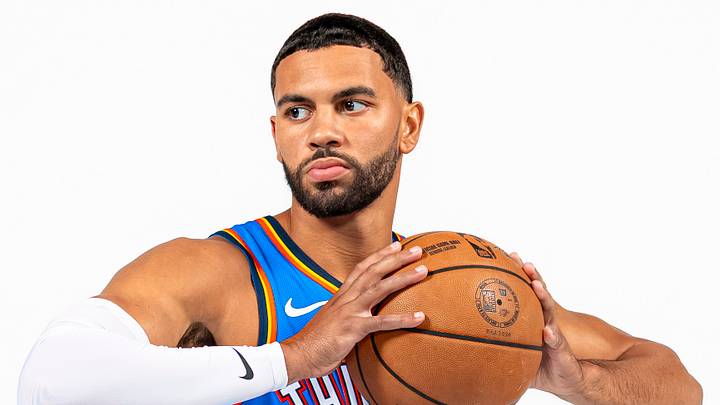
Ajay Mitchell landed at No. 13 on FanSided's 25-under-25 NBA Player Rankings this season, ranking the best young players in the NBA. Check out the rest of the list here.
The Oklahoma City Thunder dynasty hit a speed bump last season with their Western Conference Finals loss to San Antonio. Are the Thunder actually a dynasty, we are left to wonder? Or has the increasingly talented and ever-evolving NBA passed them by? While OKC is no longer head and shoulders above the competition, it's worth reiterating just how special this Thunder team is — even as they've been decimated by injuries to start the season.
Most of the praise starts with Shai Gilgeous-Alexander, Jalen Williams and Chet Holmgren, their trio of max paid All-Stars. As it should. What separates OKC from the rest, however, is depth. The reason the Thunder are still very much in the championship conversation is because Sam Presti is the best GM in basketball when it comes to locating cheap talent on the margins. Nobody exemplifies that skill more than sixth man Ajay Mitchell.
For more player rankings and deep analysis for every NBA team, subscribe to The Whiteboard — FanSided's NBA email newsletter.
Ajay Mitchell is the NBA's best value contract

Ajay Mitchell is not the first obvious star (or at least high-level starter) to be stuck in a bench role on a deep roster. Still, it's not exactly common for such a talented player to make less than $3 million annually with so little room to elevate his stature on the org chart. There's a strong case to be made that Mitchell is the best value contract in the NBA, even when LeBron James is playing for the vet minimum (which, it's worth noting, is still $1 million more than OKC will pay Mitchell this season).
Sam Presti was way ahead of the curve when it came to recognizing Mitchell's value. He spent half his rookie season on a two-way contract before than was quickly replaced with a two-year, $6 million extension. That was then replaced a year later with a three-year, $8.7 million contract, which includes a team option. So OKC has Mitchell locked up on a dirt cheap contract through 2027-28; it's much easier to sustain three weighty max contracts in the modern salary cap landscape when your bench is loaded with young, productive players making a fraction of their open-market value.
Now 24 years old and coming into his third NBA season, Mitchell is ready to take a step forward. He put up 13.6 points and 3.6 assists in 25.8 minutes last season and finished fifth in 6MOY voting; he probably would have won the award already, if not for injuries, which limited him to 57 games. Before a calf injury in the second round, Mitchell was enjoying a proper breakout in the playoffs.
With all of the injuries hitting the Thunder, he's started 10 of 13 games and will probably take himself out of contention for the 6MOY voting and put him in the Most Improved Player conversation. So far, he's averaging 17.7 points, 3.8 rebounds and 3.6 assists per game.
Ajay Mitchell fits hand-in-glove with OKC

Mitchell arrived in OKC as the 38th overall pick in 2024. He was clearly undervalued as a prospect, but he also lucked out with his destination. Not only is the Thunder's track record of player development sterling, but Mitchell's skill set and OKC's offensive setup are a perfect marriage.
The Thunder's whole deal is being able to bombard opponents with multiple ball-handlers who put pressure on the rim and keep the proverbial wheels spinning. Just about every non-center who plays meaningful minutes for OKC can create or sustain advantages in one way or another. Shai Gilgeous-Alexander is the guiding light — the most dynamic live-dribble creator in the NBA, able to shift gears and create driving angles out of nowhere.
Mitchell is a perfect facsimile off the bench. While he's not as lanky and shifty as SGA, the end results are startilingly similar. Mitchell attacks the lane a bullish ferocity, weaponizing an elite first step and underrated functional strength to get downhill and apply pressure. He's an elite rim finisher (72 percent) and short mid-range scorer (50 percent), able to counter rim protection with his floater or power-drive to the rim, where he can hang midair and creatively evade contests.
He's still improving as a shooter, but Mitchell has become far more comfortable off the catch — and especially in the corners, where he converted on 42 percent of his 3-point attempts last season. That is what allows him to coexist in lineups with SGA and OKC's other guards. Mitchell's superpower is his slashing, but he's a malleable presence, able to scale down as necessary (and it's more necessary in OKC than it would be just about anywhere else).
OKC's defensive indentity does not betray Mitchell either. While he's not blessed with elite measurables, Mitchell has the core strength and quickness to bottle up opponents at the point of attack. He can lock up lead ball-handlers and, on occasion, muscle up a bigger guard or wing. That's especially important for the Thunder, who are so dependent on multi-guard lineups. OKC needs to find time for SGA, Cason Wallace, Jared McCain and Alex Caruso, too. All of them are equipped with better-than-average positional strength, which is not a coincidence.
Mitchell landed in the perfect schematic home, which just so happened to be on the league's most competitive team. It's unclear if OKC will have the money to keep him around long term, but Mitchell is on a star ascent. Whether it's with the Thunder or another team, it will not be the least bit shocking if he's one day on an All-Star team and regarded as one of the best young guards in the NBA.
 Add us as a preferred source on Google